
If you are running a crypto project, there is one truth you cannot escape: you do not grow by being right — you grow by being seen.
On X (Twitter), attention moves markets. Narratives create liquidity. And the people who control attention are not companies, ad platforms, or media outlets — they are crypto influencers.
But most projects approach influencer marketing in the worst possible way. They buy tweets. They run promotions. They get a few spikes of traffic. Then everything dies.
Real crypto influencer collaboration does not look like advertising. It looks like distributed belief. This guide shows you how to do it the right way.
Why Crypto Influencers Matter More Than Ads?
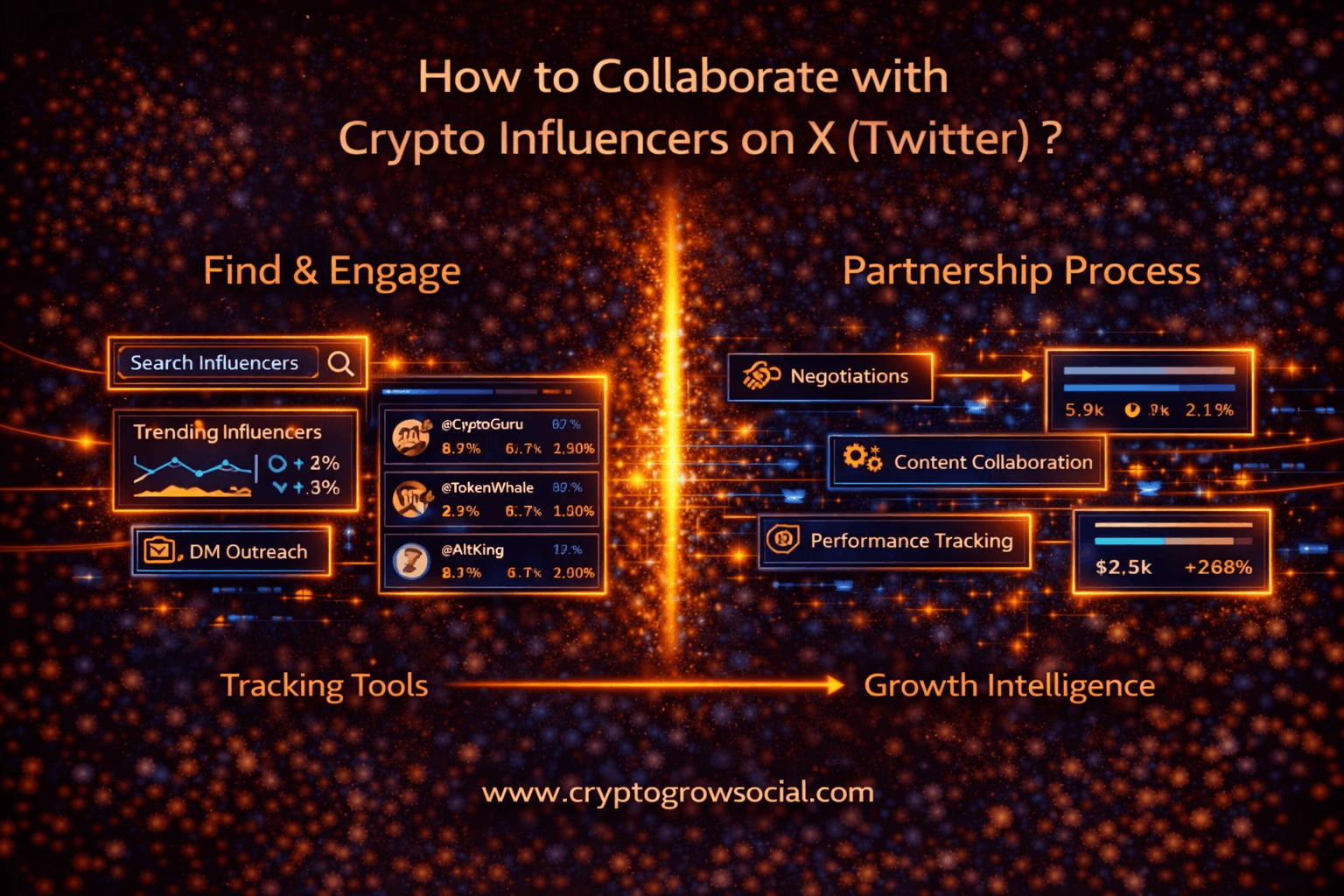
Crypto is not a product market. It is a belief market.
People do not buy tokens because they saw a banner ad.
They buy because someone they trust talked about it, debated it, or framed it as part of a larger narrative.
Twitter is where that belief forms.
Influencers are not just people with followers. They are narrative hubs. When they speak, their audience listens, reacts, argues, and repeats. That repetition is what the algorithm rewards — and that is how a project spreads.
A single influencer mentioning you in the right context can be more powerful than a million-dollar ad campaign, because it creates social proof and conversational momentum at the same time.
The Three Types of Crypto Influencers
Not all crypto influencers do the same job. Treating them as interchangeable is one of the fastest ways to waste money and attention.
Crypto Twitter works like a layered attention system. Different types of accounts control different parts of the market, and each plays a distinct role in how narratives form, spread, and turn into liquidity.
1. Macro & Market Shapers
These are the voices that decide what the market is paying attention to.
Macro influencers are the ones who frame entire sectors. When they start talking about Layer 2s, AI tokens, or real-world assets, those narratives quickly become part of how investors think about the market. Funds, builders, and traders all watch them because they provide context and direction.
Their power is not in telling people what to buy — it is in telling people what matters.
If a macro voice starts including your category or your protocol in their analysis, your project suddenly feels legitimate. You are no longer “a random token”; you are part of a larger market story. That alone can move valuation and investor interest before any trading even happens.
2. Traders & Alpha Accounts
These accounts control liquidity flow.
Traders, on-chain analysts, and so-called “alpha” accounts are followed by people who are actively looking for opportunities. Their audience is not there for philosophy — they are there for signals. When these accounts start mentioning a project, even casually, it creates immediate curiosity, speculation, and often volume.
This is where momentum is born.
Traders do not need to be convinced that your technology is perfect. They need to believe that other people are about to pay attention. When they see multiple trader accounts talking about the same project, it triggers FOMO, and FOMO moves markets.
These accounts turn narrative into price action.
3. Community & Niche Voices
This is where belief becomes loyalty.
NFT collectors, gaming communities, meme traders, and sub-cultures inside crypto may not control massive capital, but they control energy. They create memes, repeat slogans, defend projects, and keep conversations alive long after the first hype wave fades.
These voices are what turn a project from “something people traded” into “something people belong to.”
A strong community layer reduces dumping, increases long-term holding, and gives your project a social identity that outlives short-term market cycles.
Why You Need All Three ?
- A project that only has macro voices gets talked about but not traded.
- A project that only has traders gets pumped but not held.
- A project that only has communities gets loved but not valued.
Real crypto growth happens when all three layers reinforce each other.
Macro voices make you matter. Traders create momentum. Communities turn that momentum into staying power.
A real influencer campaign touches all three — not by chance, but by design.
What Most Projects Get Wrong?
Most crypto teams approach influencer marketing the same way they would buy advertising.
- They look for large follower counts.
- They negotiate a price.
- They purchase a tweet.
- Then they wait.
When nothing meaningful happens, they assume influencer marketing “doesn’t work.”
What actually failed was the strategy.
Influence on Crypto Twitter is not about broadcasting a message to a big audience. It is about placing your narrative inside conversations that already have attention. A single sponsored tweet looks like marketing, so people scroll past it. The algorithm sees low engagement and stops pushing it. The story dies.
But when your project is mentioned across multiple timelines — in replies, debates, quote tweets, and threads — it feels organic. People start asking questions. Traders start watching. The algorithm detects activity and amplifies it.
That is when momentum begins.
Projects fail because they buy isolated exposure instead of building distributed presence. And in an attention-driven market, presence is what turns curiosity into capital.
How Crypto Influencer Collaboration Really Works?
Real collaboration does not start with influencers. It starts with narrative.
Before anyone tweets about your project, you need a clear story that explains three things in simple, repeatable terms:
what is broken in the market, why your project is the solution, and why that solution matters right now.
Without that, even the best influencers have nothing meaningful to amplify.
Once the narrative exists, it is seeded across multiple voices — not as a single coordinated blast, but as a series of natural-looking touchpoints. One influencer might write a thread explaining the problem your project solves. Another might reference it while replying to a trending debate. A third might mention your name while discussing where the market is heading.
None of these posts look like ads on their own. Together, they create a pattern.
To the audience, it feels like your project keeps showing up wherever important conversations are happening.
To the algorithm, it looks like a topic that is generating engagement across different parts of the network.
That combination — repetition across timelines and interaction inside active threads — is what turns a project from “something someone tweeted” into something the market is talking about.
And that is how attention starts to compound.
How to Approach Crypto Influencers?
Most founders think influencer outreach is about sending messages.
In reality, it is about entering someone’s narrative space.
Crypto influencers are not paid promoters. They are curators of ideas. Their audience follows them because they have a point of view about the market — what matters, what is overhyped, what is undervalued, what is dangerous.
When you DM someone asking them to “promote your project,” you are asking them to break that trust. That is why those messages get ignored.
The only way to get a crypto influencer to talk about you is to make your project fit inside what they already believe.
That starts before any DM is sent.
You study what they tweet about:
- Are they obsessed with L2 scaling?
- Do they focus on on-chain data?
- Are they traders, builders, or cultural voices?
Then you engage publicly, not privately. You reply to their posts with insights. You reference their ideas when you talk about your own project. You let them see your name in contexts that make sense to them.
By the time you ever reach out directly, you are not a stranger. You are “that founder who keeps showing up in relevant conversations.”
At that point, the pitch changes.
You are no longer asking for a tweet. You are offering them a story that fits what they already talk about.
And that is the only pitch that works on Crypto Twitter.
How to Structure a Crypto Influencer Campaign?
The biggest mistake projects make is thinking in moments instead of movements.
They imagine one influencer posting once and everything changing. That is not how Crypto Twitter works.
Crypto Twitter runs on pattern recognition.
People only start paying attention when they see the same thing appear in multiple places.
A real campaign unfolds in waves.
First, your narrative appears in a macro context. A big account talks about a sector — AI tokens, L2s, RWA, whatever — and your project is mentioned as part of that trend. Now you exist in the market’s mental map.
Then traders start referencing you. They might not even shill you directly — they might just mention your token in a thread about what they are watching. That signals that something is happening.
Then community voices start picking it up. People make comments, memes, or ask questions. Now it is no longer just influencers talking — it is users.
Then your founder posts again, and suddenly the replies are full of people who already know who you are.
That is not coincidence. That is stacked exposure.
Each wave makes the next one stronger. Each mention makes the next one more believable. And eventually, people feel like your project is “everywhere” — even though it was carefully orchestrated.
That is where conversion happens.
Not when someone sees you once. But when they see you everywhere.
How to Know If It’s Working ?
Most teams measure influencer campaigns the wrong way.
They look at likes, impressions, and follower spikes. Those numbers feel good, but they tell you almost nothing about whether you are actually winning attention.
On Crypto Twitter, what matters is not how many people saw a post — it is how many people started talking.
Real influence shows up when:
Your project gets mentioned by accounts you did not pay.
People start repeating your language and framing.
New users ask questions about you in unrelated threads.
Traders include your token in their watchlists or market takes.
That is how you know a narrative is spreading.
When people argue about you, reference you, or build on what you said, your project has entered the market’s mental space. That is far more valuable than any number of likes.
DIY vs Using a Network
DIY vs Using a Network
You can absolutely reach out to influencers one by one. Some founders do it successfully — for a while.
But that approach has a ceiling.
Every conversation is isolated. Every mention stands alone. There is no reinforcement, no pattern, no feeling that “something is happening.”
The projects that dominate Crypto Twitter do not depend on individual outreach. They operate inside networks — coordinated clusters of traders, builders, and community accounts that repeatedly seed and amplify the same narrative across different parts of the platform. This is where structured crypto Twitter services create an advantage by turning isolated interactions into a consistent distribution system.
When your story appears in multiple timelines, multiple threads, and multiple voices, it stops feeling like promotion and starts feeling like reality.
That is the difference between being a single account talking about itself… and being a market narrative.
How CryptoGrowSocial Does It?
At CryptoGrowSocial, we do not buy influencer posts. We build distribution infrastructure.
Most projects try to grow by convincing one big account to tweet about them. That creates a spike. Then it disappears.
We take the opposite approach.
Through XLaunchPad and XLaunchPad Pro, we give projects access to coordinated networks of aged, crypto-native X accounts that behave like real users — traders, builders, and community voices — not promotional bots.
These accounts do three things in sync:
They enter high-traffic crypto threads and insert your narrative where attention already exists.
They reply under macro accounts, trader posts, and trending debates so your project is seen by thousands of people who were never following you.
They engage with your founder’s content so your profile and pinned post are constantly pushed into new timelines.
To the algorithm, this looks like organic discussion. To the market, it looks like momentum.
Instead of one influencer shouting your name once, your project starts appearing everywhere people already look for alpha — in replies, in debates, in threads, and in community conversations.
That is how belief forms. That is how traders start watching. And that is how liquidity arrives.
Final Thoughts
Crypto influencers are not megaphones. They are nodes inside the attention network that decides what the market sees, discusses, and ultimately values.
If your project can place its narrative inside that network, you no longer need to chase attention. Conversations begin to form around you. Traders start watching. Communities start repeating your story. That is how awareness turns into belief — and belief turns into liquidity.
Most projects fail because they try to speak louder. The ones that win learn how to be heard everywhere.
In crypto, when the market starts talking about you, value follows.