
Crypto markets are not driven purely by fundamentals, technology, or valuation models. They are driven by emotion, attention, and narrative and nowhere is this more visible than on Twitter.
Before price moves on the chart, it often moves in language first. Tweets shift tone. Replies change mood. Engagement accelerates or collapses. Long before indicators react, market sentiment has already formed.
This is where sentiment analysis becomes one of the most powerful yet misunderstood tools in crypto.
What Is Sentiment Analysis in Crypto Markets?
Sentiment analysis, in the crypto context, is the process of identifying and interpreting market emotions based on public communication especially on social platforms like Twitter.
Unlike traditional markets, crypto is:
- Retail-heavy
- Narrative-driven
- Highly reflexive
That means perception frequently precedes reality. Price does not simply reflect value; it reflects belief, expectation, and collective emotion.
Sentiment analysis does not replace technical analysis or on-chain data. It complements them by answering a different question:
How does the market feel right now and how is that feeling changing?
In crypto, emotions are data.
Why Twitter Is the Primary Source of Crypto Market Sentiment ?
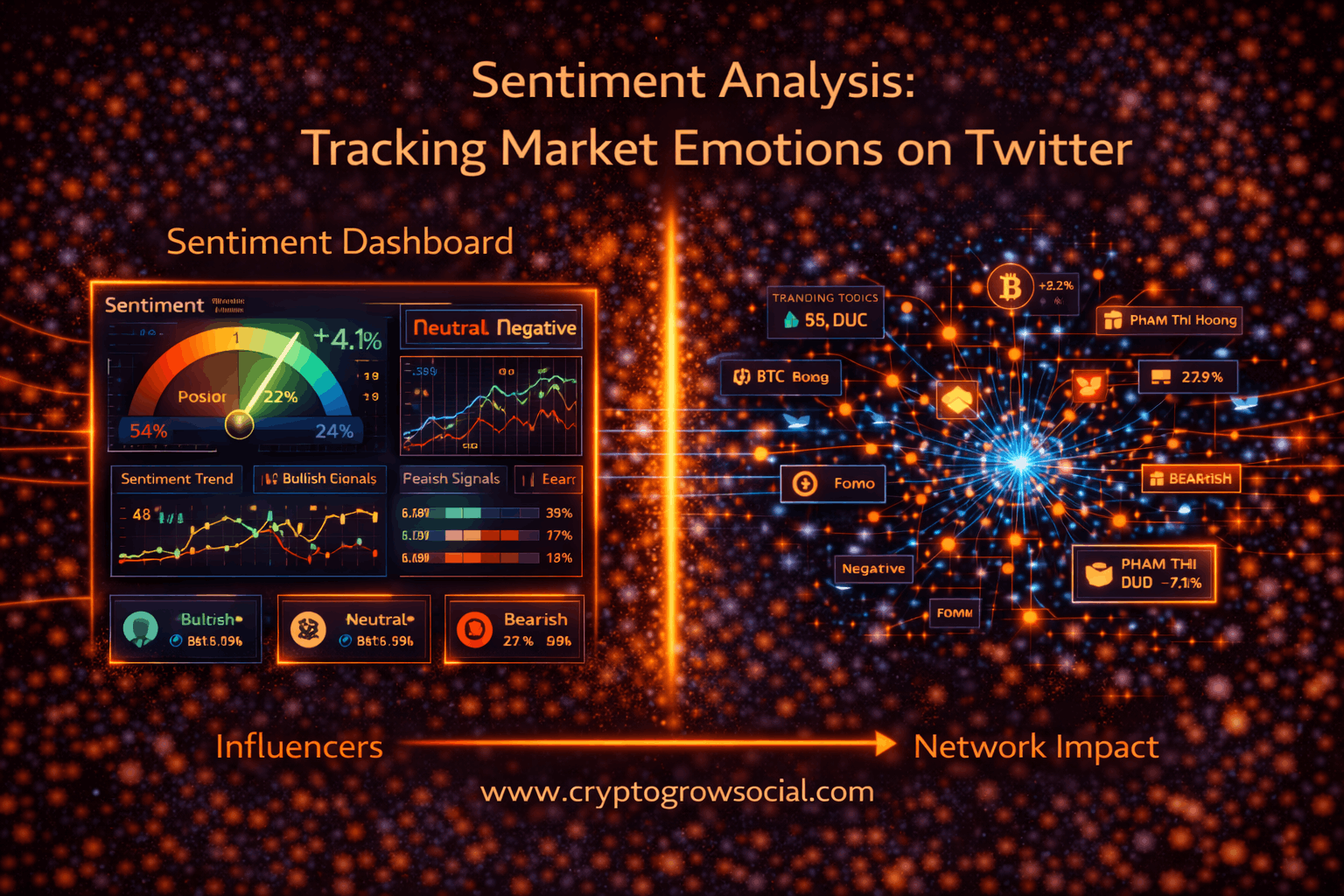
Crypto Twitter as a Real-Time Narrative Engine
Crypto Twitter (CT) is not just a place where information is shared it is where meaning is assigned to information.
When an announcement is released, the market does not immediately react to the facts themselves. It reacts to how those facts are interpreted, framed, and debated in public. Twitter is where this interpretation happens first. Narratives are proposed in tweets, challenged in replies, refined in threads, and ultimately accepted or rejected through engagement.
Rumors often surface on Twitter before they are confirmed anywhere else. Leaks, speculation, and early observations spread rapidly because the platform rewards speed over certainty. By the time official confirmations appear in blog posts or dashboards, Crypto Twitter has often already decided how that information “should” be perceived.
This is why Twitter functions as a real-time narrative engine rather than a simple news feed. It does not just distribute information—it actively shapes consensus. Engagement acts as a filter: narratives that resonate gain visibility, while others quietly disappear. Sentiment, therefore, is not merely expressed on Twitter; it is selected and amplified through algorithmic and social feedback loops.
Unlike private platforms such as Discord or Telegram, Twitter is fully public. Every reaction is visible, comparable, and contextualized. This creates competitive signaling. Projects, founders, and influencers are constantly benchmarking sentiment against one another, accelerating narrative convergence across the market.
Why Market Emotions Move Faster Than Fundamentals
In crypto markets, sentiment almost always moves ahead of fundamentals—not because fundamentals are irrelevant, but because emotions process information faster than analysis.
Information asymmetry in crypto is extreme. Not everyone receives the same data at the same time, and not everyone understands it equally. Twitter acts as a compression layer, where complex ideas are reduced into simplified interpretations, slogans, or emotionally charged takes that spread quickly.
Retail participation amplifies this effect. Retail traders often react collectively and emotionally, especially in response to perceived opportunity or risk. Fear and excitement propagate faster than careful evaluation, creating rapid shifts in sentiment that can precede any measurable fundamental change.
Influencers further accelerate this process. A single reaction from a respected or widely followed account can reframe an entire narrative within minutes. These reactions do not just reflect sentiment—they actively create it by guiding how others interpret events.
This dynamic aligns closely with George Soros’ concept of reflexivity, where beliefs influence market behavior, and market behavior reinforces those beliefs. On Twitter, reflexivity operates at high speed. A bullish interpretation drives engagement, engagement drives visibility, visibility drives price interest, and price movement then validates the original sentiment.
By the time fundamentals catch up—through data, reports, or on-chain confirmation—sentiment has often already peaked, shifted, or begun reversing. Twitter accelerates this cycle, making emotion not a secondary effect, but a leading indicator.
How Sentiment Forms and Spreads on Crypto Twitter?
Early Signals: Engagement Velocity and Language Tone
Sentiment rarely shifts instantly. It leaks.
Early indicators include:
- Faster-than-normal engagement velocity
- A shift in language tone (certainty → doubt, excitement → defensiveness)
- Changes in reply quality, not just quantity
A bullish sentiment often starts as confidence and curiosity. A bearish one begins as sarcasm, skepticism, or subtle dismissal—long before outright FUD appears.
Amplification: Influencers, KOLs, and Echo Chambers
Not all tweets carry equal weight.
Sentiment becomes market-moving when:
- Influencers react
- Multiple large accounts echo similar interpretations
- Engagement clusters form around a shared narrative
This is how echo chambers form. A single opinion, once amplified, begins to feel like consensus—even when underlying data has not changed.
Understanding who is amplifying sentiment is often more important than what is being said.
From Tweets to Price Action
Not all sentiment moves price—but most price moves are preceded by sentiment.
Sentiment tends to lead price when:
- Liquidity is thin
- The narrative is new or ambiguous
- Retail participation is high
It becomes noise when:
- The market is already over-positioned
- Sentiment is repetitive rather than novel
- Price action contradicts emotional signals
The skill is not detecting sentiment—it is contextualizing it.
Bullish vs Bearish Sentiment: Reading Between the Lines
Bullish sentiment is not just optimism. It is conviction without defensiveness.
Healthy bullish sentiment looks like:
- Calm confidence
- Open discussion
- Forward-looking narratives
Unhealthy bullish sentiment looks like:
- Aggressive dismissal of criticism
- Overuse of slogans
- Excessive shilling without substance
Bearish sentiment, similarly, is not always negative.
Constructive bearish sentiment includes:
- Thoughtful skepticism
- Risk discussion
- Re-evaluation of assumptions
Destructive bearish sentiment shows up as:
- Mockery
- Emotional attacks
- Narrative collapse
The strongest signals often appear right before sentiment flips, not at its peak.
Tools and Methods for Twitter Sentiment Analysis in Crypto
Manual Sentiment Reading: Human Context Still Wins
Despite advances in AI, human interpretation remains critical.
Crypto Twitter has culture, irony, sarcasm, and coded language. Automated tools struggle to detect:
- Meme-based sentiment
- Cultural references
- Contextual sarcasm
Founders, marketers, and traders who actively observe CT often outperform purely data-driven approaches because they understand nuance.
Automated Tools and AI-Based Sentiment Trackers
Automated sentiment tools are useful for:
- Tracking volume changes
- Detecting spikes
- Comparing relative sentiment over time
However, they should be treated as directional indicators, not decision-makers. Tools measure what is being said, not why it matters.
Combining Sentiment With Other Signals
Sentiment is strongest when combined with:
- On-chain activity
- Volume and liquidity data
- Narrative timing
For example, bullish sentiment during declining on-chain activity is weaker than bullish sentiment accompanied by new wallet participation.
Context turns sentiment into insight.
How Crypto Projects Use Twitter Sentiment Strategically ?
Sentiment Before Token Launches and Airdrops
Launching into negative or distracted sentiment is one of the most common mistakes crypto projects make.
Before any launch, teams should ask:
- Is the market receptive right now?
- Are similar narratives performing well?
- Is attention available or fragmented?
Successful launches align timing with positive or neutral sentiment, then amplify early traction to shape perception.
This is where crypto Twitter marketing and sentiment analysis intersect—understanding emotion allows teams to engineer momentum rather than fight resistance.
Managing Negative Sentiment and FUD
Not all negative sentiment requires response.
Effective teams know when to:
- Clarify calmly
- Let sentiment burn out
- Redirect attention through updates
Overreacting often amplifies negativity. Silence, when paired with continued execution and visibility, can be more powerful than defensive replies.
Aligning Marketing With Market Emotion
Marketing that ignores sentiment feels tone-deaf.
Strong teams adjust:
- Messaging tone
- Content frequency
- Announcement timing
Based on how the market feels—not just internal timelines. Twitter rewards alignment with emotion, not rigid schedules.
Common Mistakes When Interpreting Crypto Twitter Sentiment ?
Many crypto projects attempt to read Twitter sentiment, but misinterpret what they see. The problem is rarely a lack of data. It is a misunderstanding of what actually matters.
Treating tweet volume as sentiment strength
High tweet volume does not automatically mean strong sentiment. A spike in mentions can be driven by confusion, controversy, or automated amplification. Without examining tone, engagement quality, and who is participating, volume alone is a weak signal. Real sentiment shows up in consistency and follow-through, not just noise.
Overweighting loud minority opinions
Crypto Twitter amplifies extremes. A small group of vocal accounts can dominate timelines and replies, creating the illusion of consensus. Many projects mistake this visibility for market-wide sentiment. In reality, influential or credible accounts matter far more than sheer loudness. Influence is unevenly distributed.
Reacting emotionally instead of strategically
Founders often read sentiment too personally. Negative replies trigger defensive responses. Positive hype creates overconfidence. Both lead to poor decisions. Effective sentiment analysis requires emotional distance. The goal is to observe behavior patterns, not to respond to every reaction in real time.
Ignoring who is speaking
Not all engagement carries the same weight. Replies from inactive accounts, anonymous profiles, or obvious shill accounts contribute little insight. Sentiment becomes meaningful when it is expressed by credible, active, and respected participants. Understanding who is speaking is often more important than what is being said.
Sentiment analysis is not about counting tweets or likes. It is about evaluating signal quality, context, and influence over time. Projects that focus on these factors avoid overreaction and make better strategic decisions.
Why Sentiment Analysis Matters More Than Ever in Crypto ?
Crypto has evolved into a pure attention economy.
Capital does not move only toward the best technology or the strongest fundamentals. It moves toward what is seen, discussed, and believed. Narratives shape perception, perception shapes behavior, and behavior shapes price. At the center of this cycle is emotion.
Emotion spreads fastest on Twitter because Twitter compresses information, opinion, and reaction into a single public stream. A single interpretation can reach thousands within minutes. When repeated and reinforced, it becomes market belief.
As crypto markets mature, this dynamic becomes more pronounced rather than less. Increased participation does not eliminate emotional behavior. It amplifies it. More voices, more narratives, and more competition for attention make sentiment harder to read, but more valuable to understand.
This is why sentiment analysis is no longer just a trading tool. It is a strategic advantage for founders, marketers, and investors. Founders use sentiment to time launches and messaging. Marketers use it to align narratives with market mood. Investors use it to anticipate shifts before they appear in data.
Twitter is no longer just a communication platform. It functions as a price discovery layer where expectations are formed. It acts as a reputation engine where credibility is continuously evaluated. It serves as a coordination mechanism where groups move together based on shared emotion.
Ignoring sentiment is no longer neutral. It creates blind spots. Projects that fail to read market emotion react late, communicate poorly, and miss critical windows of opportunity. In an environment driven by attention and narrative, understanding sentiment is not optional. It is a requirement.
Final Thoughts
In crypto, market emotions are not noise. They are signals imperfect, biased, and powerful.
Twitter is where those emotions surface first. Projects that learn to read sentiment gain clarity. Projects that learn to shape it gain leverage.
Understanding sentiment allows teams to:
Choose better timing
Communicate more effectively
Build narratives that resonate
This is also why many teams integrate sentiment tracking into broader crypto Twitter services that connect analytics, content, and distribution into a unified growth system.
If Twitter is where market emotions form, then mastering sentiment is not optional. It is part of surviving and winning in crypto.