
Crypto Twitter is one of the hardest environments to advertise in. Not because of a lack of attention, but because the audience is highly trained to ignore anything that feels forced, promotional, or out of place. A sponsored tweet that does not immediately signal relevance or credibility is skipped in seconds, regardless of how much budget is behind it.
Many crypto projects try Twitter Ads, see weak results, and conclude that ads “do not work” in crypto. In reality, the problem is rarely the ad platform itself. It is how campaigns are positioned, what they amplify, and whether ads are being used as a growth shortcut instead of a distribution tool. In this article, we break down how Twitter Ads actually work on Crypto Twitter, why most campaigns fail, and how to run ads on X in a way that supports long term growth instead of burning budget.
Why Crypto Twitter Ads Often Underperform ?
The most common mistake crypto teams make is treating Twitter Ads as a standalone growth solution rather than a distribution layer. Ads are expected to create followers, engagement, and credibility from zero, even when the account itself has not earned any trust yet.
Twitter Ads are not designed to build legitimacy. They are designed to increase visibility. When visibility is applied to weak content or to an account with no social proof, the result is not growth but faster rejection. More people see the tweet, decide it is not worth engaging with, and move on. The ad succeeds mechanically but fails strategically.
On Crypto Twitter, users do not consume tweets in isolation. They investigate context. They click profiles, scan recent activity, and look for signs that an account is already part of the ecosystem. Follower count, reply quality, and ongoing conversations all influence whether a promoted tweet feels relevant or intrusive.
Ads can bring attention, but they cannot manufacture legitimacy. Without an active timeline and visible engagement, ads only expose the absence of momentum. This is why many campaigns feel expensive without producing lasting results: they amplify a structural weakness instead of correcting it.
What Twitter Ads Actually Do Well ?
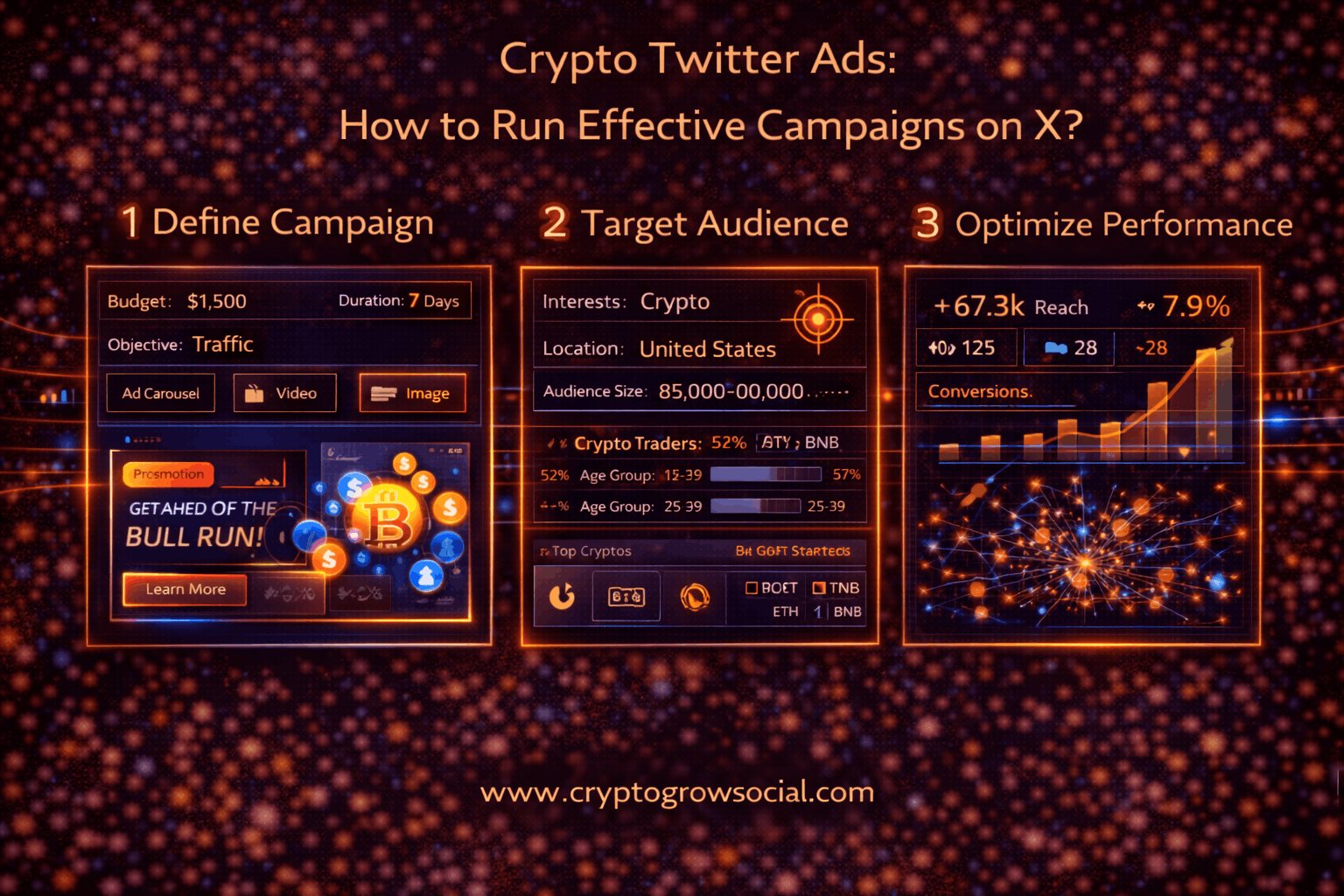
When used correctly, Twitter Ads excel at one specific function: controlled distribution.
They give you the ability to place a message in front of a defined audience, within a defined time window, at a predictable scale. That makes them useful for moments where timing matters more than experimentation—product updates, announcements, launches, partnerships, or narrative reinforcement.
The critical point is that ads do not create momentum. They extend it.
Twitter’s ad system does not override how users behave. If a promoted tweet already shows signs of life—likes, replies, retweets—the ad amplifies something the market has already validated. Engagement increases faster, reach expands beyond the immediate follower base, and the tweet feels “everywhere” instead of forced.
This is where ads quietly perform their best work. They help winning messages travel further, not struggling ones survive.
In contrast, promoting a tweet with weak engagement rarely fixes the problem. The ad delivers impressions, but users still decide whether to interact. When they do not, Twitter learns that the content fails to convert attention into action. The result is wasted spend and no residual lift once the campaign ends.
Effective Twitter Ads function like a volume knob, not a restart button. They make strong signals louder. They do not turn noise into signal.
This is why the highest-performing crypto ad campaigns are built on top of organic traction, social proof, and visible engagement—ads simply accelerate what is already working.
The Role of Social Proof in Ad Performance
On Crypto Twitter, social proof matters more than ad creative.
A promoted tweet coming from an account with low follower count, minimal interaction, or an inactive timeline immediately creates friction. Even if the message is reasonable, users hesitate. They click the profile, see little activity, and subconsciously conclude that the account does not yet belong in the conversation.
This is why many ad campaigns fail after the impression or the click. The ad successfully delivers visibility, but the profile fails to convert attention into interest. Without visible engagement, replies, or ongoing conversation, there is nothing for users to anchor their trust to.
Ads do not exist in isolation. Every promoted tweet leads users to a profile, and the profile either confirms relevance or breaks it. When social proof is weak, ads amplify skepticism rather than curiosity. When social proof is strong, ads accelerate engagement because users feel safer interacting publicly.
In crypto, where credibility is constantly evaluated in public, social proof is not optional infrastructure. It is the landing page for every ad campaign.
How Effective Crypto Twitter Ad Campaigns Are Structured
High-performing crypto Twitter ad campaigns tend to follow the same structural logic.
First, the account is prepared before any budget is deployed. The profile looks active, recent tweets show real interaction, and the timeline reflects participation in current crypto conversations. This ensures that when users click through, they encounter momentum rather than emptiness.
Second, ads are applied to proven content. Instead of creating standalone ad copy, teams promote tweets that already generated organic replies, likes, or discussion. This aligns paid distribution with content the market has already responded to, reducing friction and increasing engagement efficiency.
Third, timing is synchronized with relevance. Ads perform best when they reinforce moments that already matter: launches, major updates, partnerships, or broader narrative shifts happening on Crypto Twitter. Promoting at the right moment amplifies attention instead of forcing it.
Effective campaigns are not built by pushing harder. They are built by removing resistance, then applying distribution only where momentum already exists.
Ads and Organic Growth Are Complementary
Twitter Ads and organic growth are not opposing strategies. They solve different parts of the same problem.
Organic engagement creates signals. It shows the algorithm and real users that content is worth attention. Ads do not replace this process. They extend it. When used together, ads help organic tweets escape low-visibility zones and reach users who are already primed to engage.
Without organic engagement, ads generate impressions with no follow-through. Users see the tweet, scroll past, and the signal ends there. With organic traction in place, ads amplify momentum, accelerating reach and increasing the chance of secondary actions like replies, profile visits, and follows.
This is why effective growth does not rely on ads alone. It uses ads as a multiplier, not a foundation. Organic signals establish relevance. Ads give those signals room to travel.
Where Most Crypto Projects Waste Ad Budget ?
Most wasted ad spend on Crypto Twitter comes from a few recurring structural mistakes.
The first is promoting content before the account is ready. Ads drive users to a profile, not just a tweet. When the timeline shows little activity, no interaction, or no clear narrative, attention collapses on contact. The ad delivers views, but nothing converts because the account has not earned baseline credibility.
The second mistake is running ads on tweets with no discussion value. Informational or promotional posts that do not invite reaction rarely perform well under paid distribution. Ads magnify reach, but they cannot manufacture curiosity or conversation. When a tweet gives users nothing to respond to, impressions turn into silent scrolls.
The third pattern is stopping all activity once the ad campaign ends. Many projects treat ads as a temporary push rather than part of a system. When paid distribution stops and organic engagement is not sustained, momentum disappears immediately. No compounding effect is created, and the account returns to the same low-visibility state as before.
In all three cases, the problem is not the ad platform. It is the absence of continuity. Ads work best when they sit inside an ongoing growth loop, not when they are used as a one-time spike.
Using Twitter Ads Inside a Growth System
Twitter Ads perform best when they are part of a broader growth system, not a standalone tactic.
In an effective system, early engagement already exists. The account has relevant followers, visible interaction, and participation from crypto-native accounts. These elements create baseline trust. Ads are then layered on top to extend reach, not to compensate for its absence.
This is where most ad strategies break down. Teams try to use paid distribution to solve structural problems that ads are not designed to fix. Without engagement, without conversation, and without social proof, ads simply expose friction faster.
Growth systems like XLaunchPad are built around the opposite logic. Visibility is engineered before ads are introduced. Early engagement and gradual follower growth create the signals Twitter’s algorithm responds to. When promoted distribution is added, it reinforces existing momentum instead of fighting algorithmic resistance.
In this setup, ads stop being a gamble. They become a controlled amplifier inside a system that is already working.
What to Do Next ?
If Twitter Ads feel ineffective, the issue is rarely the platform. It is the absence of infrastructure.
Before increasing ad spend, focus on building visibility, engagement, and social proof that ads can actually amplify. When those pieces are in place, ads stop feeling expensive and start behaving like leverage. Used correctly, Twitter Ads do not create growth. They reveal it.
How to Run Crypto Twitter Ads Campaigns Step by Step?
Understanding how Twitter Ads work conceptually is not enough. Most failures happen at the execution layer, where content, timing, and targeting are misaligned.
The first step is selecting the right tweet.
Ads should not be used on untested content. The most effective campaigns promote tweets that already show early engagement signals. Even a small number of replies or quote tweets is enough to indicate that the content resonates. Promoting these tweets increases the probability that paid distribution will amplify something real instead of forcing attention onto weak content.
The second step is audience targeting.
Crypto Twitter is not a single audience. It is a collection of fragmented communities such as traders, DeFi users, NFT collectors, and specific chain ecosystems. Broad targeting reduces relevance. Narrow, narrative-aligned targeting increases engagement quality.
Follower-based targeting tends to perform better than generic interest targeting. Reaching users who already follow similar accounts creates contextual alignment, which reduces friction when the ad appears in their feed.
The third step is timing.
Ads perform best when they are synchronized with existing attention. This includes launches, announcements, or active conversations already happening on Crypto Twitter. Running ads during low-activity periods reduces interaction and wastes budget.
The fourth step is performance control.
Promoted tweets should be monitored early. If engagement remains weak after initial distribution, increasing budget rarely improves results. Adjusting targeting or switching to a different tweet is more effective than scaling a poor performer.
Execution is not about complexity. It is about alignment between content, audience, and timing.
Targeting and Budget Strategy for Crypto Ads
Targeting determines relevance. Budget determines amplification.
The mistake most teams make is trying to solve targeting problems with budget.
A more effective approach is to start with small budgets and test multiple tweets. When a tweet shows strong engagement signals—replies, profile clicks, or follows—it becomes a candidate for scaling. Budget should follow performance, not precede it.
Campaigns should also be distributed across multiple pieces of content rather than concentrated on a single tweet. This reduces risk and provides data on what type of messaging actually converts attention into interaction.
Scaling only works when there is something worth scaling.
Common Execution Mistakes That Kill Ad Performance
Even when strategy is correct, execution errors can destroy results.
One common issue is promoting content from an unprepared account. Ads drive traffic to your profile, not just your tweet. If the timeline shows no activity or engagement, users disengage immediately.
Another mistake is using ads on purely promotional content. Tweets that do not invite replies or discussion rarely perform well under paid distribution. Ads increase visibility, but they do not create curiosity.
Stopping all activity after the campaign ends is another failure point. When ads stop and organic engagement is not maintained, momentum disappears instantly. No compounding effect is created.
Most ad failures are not caused by the platform. They are caused by weak structure around it.
Using Twitter Ads Inside a Growth System
Twitter Ads work best when they are part of a system, not a standalone tactic.
Organic engagement creates the signals that the algorithm responds to. Ads extend those signals into wider distribution. When used together, they create a feedback loop where visibility generates interaction, and interaction increases visibility.
Without organic signals, ads generate impressions without engagement. With strong signals, ads accelerate growth.
This is the difference between ads as a cost and ads as leverage.
XLaunchPad — Building the Signals Ads Cannot Create
Twitter Ads depend on signal quality. They do not create it.
This is where most crypto campaigns fail. Teams use ads to generate engagement before the account has established any baseline activity. The result is predictable: more exposure, but no interaction.
XLaunchPad is designed to solve this before ads are introduced.
Instead of focusing on reach, it focuses on the initial conditions required for reach to work. Tweets are not published into empty timelines. They enter the ecosystem with early engagement, contextual interaction, and participation from crypto-relevant accounts.
This changes how the algorithm evaluates content.
Early activity reflects patterns the system already trusts. Replies are relevant. Interactions come from accounts within the crypto ecosystem. Engagement appears gradual, not forced.
The system focuses on:
- Early engagement from crypto-native accounts
- Interaction patterns aligned with real conversation behavior
- Gradual follower growth that matches engagement ratios
- Contextual replies that support the tweet narrative
The objective is not to inflate metrics, but to generate the minimum viable signal required for the algorithm to take the content seriously.
Once that signal exists, distribution changes. Tweets move beyond the initial testing phase and begin entering wider visibility cycles.
At that point, ads become effective.
Instead of forcing attention, they amplify momentum that already exists. The same budget produces stronger engagement because it is applied to content that has already passed algorithmic filtering.
XLaunchPad is not an alternative to ads. It is the layer that makes ads work.
XLaunchPad Pro — Operating Growth as a System
Some teams do not want a managed solution. They want control over execution.
XLaunchPad Pro provides the structure to run growth internally.
Instead of outsourcing engagement, teams gain frameworks for how to manage visibility themselves. This includes timing, interaction patterns, and scaling methods that align with how Crypto Twitter actually operates.
The focus is coordination, not automation.
Teams learn how to:
- Control engagement timing during critical visibility windows
- Maintain consistent interaction patterns across content
- Distribute activity across multiple accounts without repetition
- Scale campaigns without triggering instability
This allows growth to function as a system rather than a series of isolated actions.
In the context of ads, this is critical.
When internal activity already generates strong signals, ads become an extension of that system. They amplify patterns that are already working instead of compensating for weak structure.
The result is stable, repeatable growth.
Organic engagement remains the foundation. XLaunchPad Pro ensures that foundation is supported by a system that can scale.
Conclusion
Twitter Ads do not fail because the platform is ineffective. They fail when they are used without structure.
Ads are a distribution tool. They amplify signals. If those signals do not exist, no amount of budget will create them.
Effective crypto growth combines three layers: organic engagement, structured visibility, and paid distribution. When these layers work together, visibility compounds. When they are separated, performance collapses. This is why many teams adopt integrated crypto Twitter services that align these layers into a single, coordinated system.
On Crypto Twitter, growth is not random. It is engineered.