
Launching a crypto token is no longer about shipping first. It is about being seen first.
Every week, technically solid projects launch with no traction, while weaker ideas capture attention, liquidity, and narrative momentum. The difference is rarely the product. It is distribution.
Crypto seeding and hype campaigns exist because organic discovery does not work at launch scale. Attention does not spread evenly, and Twitter does not reward silence. If a launch does not generate visible activity early, it effectively does not exist.
This article explains what crypto seeding really is, how it works behind the scenes, why it is different from shilling, and how serious projects use it to control perception during critical launch windows.
What Is Crypto Seeding ?
Crypto seeding is the deliberate distribution of early attention.
It is the process of placing a project inside existing conversations, timelines, and narratives before the wider market notices it. The goal is not to convince everyone. The goal is to make the project visible enough that organic interest can begin.
Most people misunderstand seeding because they confuse it with paid shilling. Shilling pushes messages outward without context. Seeding places a project inside context.
Proper seeding focuses on replies, quote tweets, and discussion, not just mentions. It introduces the project where attention already exists instead of shouting into empty timelines.
In practice, seeding answers one core question: When someone first sees this project on Crypto Twitter, does it look like it already belongs there?
Why Token Launches Need Seeding, Not “Organic Hope”?
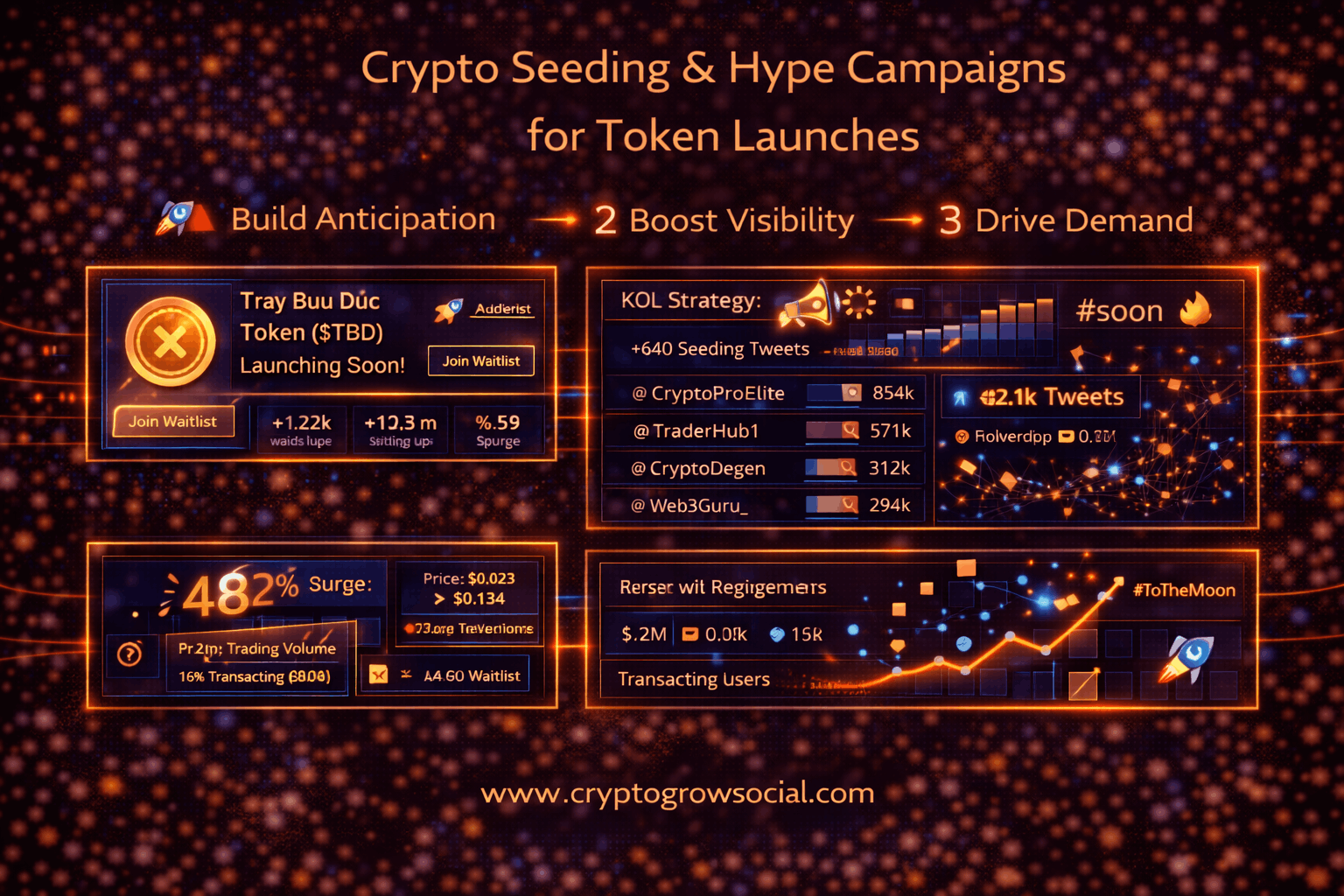
Token launches operate inside extremely compressed attention windows.
You do not have weeks to educate the market or slowly build familiarity. In most cases, you have hours. Sometimes only minutes. Organic growth relies on repetition, feedback loops, and gradual algorithmic trust. Launch environments offer none of those conditions.
This creates the core structural problem: the visibility gap.
New projects start with zero algorithmic trust and no established distribution. Twitter does not evaluate announcements on quality alone. It evaluates whether an account has earned the right to be shown. As a result, even well-crafted launch tweets begin in the dead zone, visible to almost no one.
Seeding exists to bridge this gap.
By injecting early engagement and contextual activity, seeding gives launch messages an initial surface area. Tweets get seen, discussed, and interpreted by real users instead of disappearing quietly into inactive timelines. This early visibility allows both the algorithm and the market to register that something is happening.
Without seeding, most launches fail invisibly. Not because the product is weak, but because the market never gets a chance to react.
How Crypto Seeding Actually Works Behind the Scenes?
Effective crypto seeding is not random. It is engineered.
The first layer is early visibility. Tweets receive engagement quickly after posting, signaling relevance to the algorithm. This allows Twitter to test the content beyond the immediate follower base.
The second layer is narrative alignment. Engagement is contextual. Replies reference the idea, the problem, or the broader market narrative. This makes interaction feel natural rather than manufactured.
The third layer is social proof. When users discover the tweet, they see discussion already happening. That reduces hesitation and increases the likelihood of organic replies, quotes, and follows.
This combination turns early engagement into a feedback loop. The algorithm distributes more. Real users engage. Momentum builds.
Seeding does not replace organic growth. It creates the conditions for it to happen.
Crypto Twitter Seeding vs Influencer Shilling?
Crypto Twitter is highly sensitive to intent.
Shilling is easy to recognize. It relies on forced mentions, repetitive talking points, and accounts with no real connection to the project or its narrative. The result is visibility without credibility. People notice the message, but they do not trust it.
Seeding operates on a different logic. It prioritizes presence over persuasion. Instead of telling users what to think, it places the project inside conversations that are already happening. The goal is not to convince immediately, but to make the project visible where attention already exists.
When done well, seeding barely looks promotional. It shows up as curiosity, commentary, or early discussion. That subtlety is exactly why it works. It aligns with Crypto Twitter culture instead of triggering its defenses.
The difference between seeding and shilling is not budget or reach. It is understanding how attention, trust, and narrative formation actually work on Crypto Twitter.
Types of Crypto Seeding & Hype Campaigns
Seeding strategies are not universal. They change depending on where a project is in its launch lifecycle.
Each phase has a different objective, a different attention profile, and a different risk if executed poorly. Treating all seeding the same is one of the fastest ways to waste budget and damage credibility.
Pre-Launch Seeding: Narrative Introduction
Pre-launch seeding happens before the token or product is publicly available.
The objective is not conversion. It is recognition.
At this stage, the market does not need links or calls to action. It needs context. Pre-launch seeding introduces the problem space, hints at the solution, and positions the project inside an existing narrative so that it does not feel foreign when it officially appears.
Noted objectives:
- Surface the core problem the project addresses
- Establish familiarity before any announcement
- Create early recognition among crypto-native users
When done correctly, pre-launch seeding ensures that the launch does not feel like a cold start.
Launch-Day Seeding: Attention Compression
Launch day is about speed.
Crypto Twitter is crowded, and multiple announcements compete at the same time. Without coordinated engagement, even important updates can disappear within minutes.
Launch-day seeding compresses attention into a short window so that key tweets gain immediate traction and break out of the dead zone. This allows the algorithm to test distribution beyond the existing audience while human users notice that “something is happening.”
Noted objectives:
- Trigger early engagement velocity
- Prevent launch tweets from being buried
- Create visible discussion around the announcement
This phase is not about sustained growth. It is about surviving the most competitive moment.
Airdrop & Whitelist Seeding: Legitimacy Signaling
Airdrops and whitelists rely heavily on social proof.
Users rarely join because of information alone. They join because they see others participating. Seeding at this stage focuses on making participation visible, normal, and validated.
When people see replies, quotes, and discussions about eligibility, requirements, or strategies, hesitation drops. Participation feels safer.
Noted objectives:
- Signal that real users are engaging
- Reduce friction around participation
- Increase perceived legitimacy
This type of seeding works because it mirrors natural herd behavior rather than forcing hype.
Post-Launch Seeding: Momentum Preservation
Most projects stop seeding too early.
After the initial spike, attention collapses quickly if nothing reinforces it. Post-launch seeding exists to stabilize visibility and prevent the project from fading immediately after launch.
This phase shifts from announcement-driven engagement to conversation-driven engagement. It keeps the project present in timelines while organic interest either matures or declines naturally.
Noted objectives:
- Prevent momentum collapse
- Reinforce memory and recognition
- Transition from hype to sustained visibility
Post-launch seeding is often the difference between a launch that spikes and disappears and one that compounds into long-term awareness.
Each seeding phase serves a different function. Each requires different pacing, messaging, and engagement behavior.
Treating them as one generic “hype campaign” ignores how attention actually moves on Crypto Twitter—and usually results in short-lived noise instead of lasting momentum.
What Makes a Seeding Campaign Work (And What Breaks It)?
Successful seeding depends on four factors.
Timing matters first. Engagement must arrive early enough to influence distribution, not hours later when the tweet is already buried.
Relevance comes next. Accounts involved in seeding must belong to the crypto ecosystem. Engagement from unrelated or inactive accounts weakens signals instead of strengthening them.
Diversity prevents detection. Replies, likes, and quotes should vary in timing and behavior. Uniform patterns are filtered quickly.
Continuity sustains momentum. Seeding works best when followed by ongoing participation. One spike without follow-up quickly fades.
Most failed campaigns break at least one of these rules.
Common Mistakes Projects Make With Seeding
One of the most common mistakes is overpaying influencers too early. Large accounts without narrative context rarely convert attention into real discussion. They generate short-lived exposure, but the conversation does not continue once the post disappears from timelines.
Another frequent error is prioritizing volume over depth. A high number of shallow interactions may look impressive on the surface, but it does not create meaningful signals. Fewer, contextual replies that reference the idea, the problem, or the launch itself are far more effective at triggering organic engagement.
Many projects also treat seeding as a one-day tactic rather than a system. Activity peaks on launch day and then stops. Without follow-up engagement, momentum collapses and visibility resets, wasting the initial effort. This is why structured crypto Twitter services focus on maintaining continuity rather than creating isolated bursts of activity.
Finally, teams often ignore how the profile appears during seeding. Every interaction invites users to click through. If they encounter an inactive timeline or a lack of ongoing participation, trust erodes instantly. In seeding, the profile is part of the campaign, not an afterthought.
When Crypto Seeding Campaigns Make Sense?
Crypto seeding is most effective in moments where timing matters more than patience.
Token launches, airdrops, fundraising announcements, major updates, and broader narrative shifts all operate inside narrow attention windows. In these moments, visibility determines outcomes. Projects that are seen early shape perception, while those that arrive late struggle to be noticed at all.
Seeding is especially valuable for projects that are early, unknown, or trapped in low visibility. When organic reach is limited, seeding changes the starting position. It influences how the market encounters the project for the first time and whether that encounter feels relevant or dismissible.
Used correctly, seeding does not force interest. It ensures that when interest could exist, the project is actually visible.
Final Thoughts
Crypto seeding is not about being loud. It is about being present at the right time, in the right conversations, with the right signals.
Markets do not discover projects fairly. They notice what already looks noticed.
If your launch matters, visibility cannot be left to chance. Structured seeding exists to remove that uncertainty and give real projects a chance to be evaluated on their merits.
That is exactly what systems like XLaunchPad are designed to support: early visibility, credible engagement, and momentum that compounds instead of disappearing.