
Buying crypto Twitter likes vs retweets has become a recurring question for crypto founders, marketers, and growth teams who are under constant pressure to increase visibility on X.com. In an environment where attention moves faster than product development and narratives can shift overnight, engagement metrics often become shorthand for legitimacy. Projects with higher visible engagement are perceived as more relevant, more active, and more trustworthy, even before users examine the substance of their content. This dynamic has pushed many teams to explore paid Twitter engagement as a way to accelerate exposure.
However, not all engagement signals are evaluated equally by Twitter’s algorithm, nor do they create the same downstream effects for crypto projects. Likes and retweets play very different roles in how content is validated, distributed, and ranked. Treating them as interchangeable metrics often leads to poor outcomes, including engagement decay, reduced reach per follower, and long term trust score erosion. Understanding the difference between buying crypto Twitter likes and buying crypto Twitter retweets is not a tactical detail. It is a structural decision that directly affects how a crypto account performs over time.
This guide examines the real impact of buying Twitter likes vs retweets for crypto projects. It explains how each engagement type influences algorithmic visibility, audience perception, and engagement quality. More importantly, it clarifies when paid engagement can support growth and when it quietly undermines it. By the end of this article, crypto teams should be able to evaluate engagement strategies with clarity rather than relying on assumptions or surface metrics.
Why Crypto Projects Buy Twitter Engagement in the First Place?
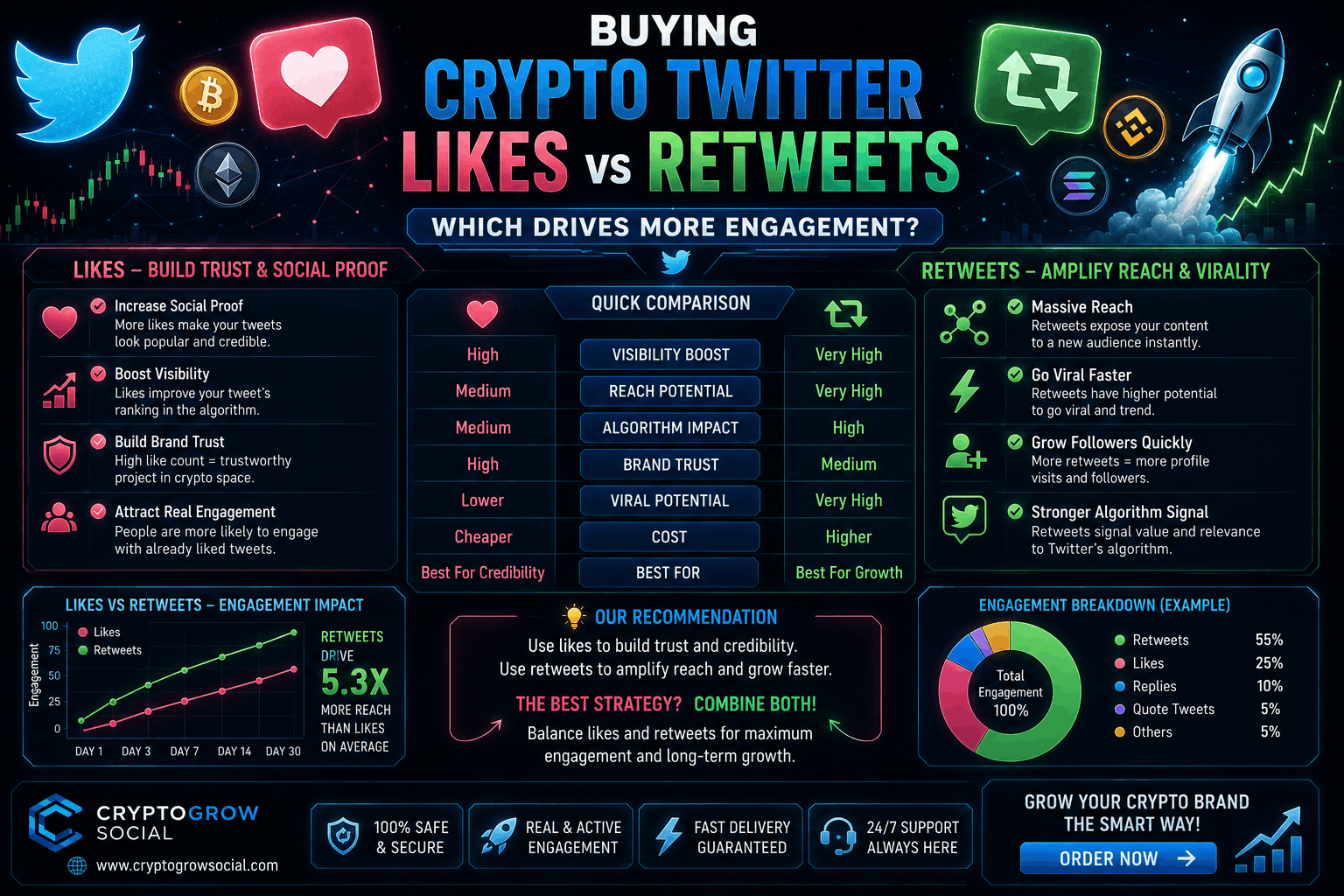
Crypto projects operate in one of the most competitive attention markets on social media. Thousands of tokens, protocols, NFT collections, AI tools, and meme projects compete for visibility on the same timelines. Organic discovery alone is often insufficient, especially for new accounts that lack historical engagement data. This reality explains why buying crypto Twitter engagement has become normalized across the industry, even among teams that understand the risks.
The first driver behind paid engagement is perception. A tweet with visible likes or retweets signals activity and relevance. For first time visitors, engagement acts as social proof. It reduces friction and increases the likelihood that a user will take the project seriously. In early stages, when an account has limited followers, this perception gap can be damaging. Paid engagement appears to offer a shortcut to legitimacy.
The second driver is algorithmic visibility. Many teams believe that higher engagement automatically translates to higher reach. While this belief is incomplete, it is not entirely wrong. Twitter does evaluate engagement signals when deciding how widely a tweet should be distributed. The problem is that different types of engagement carry different weights and contexts. Buying engagement without understanding these distinctions often leads to misaligned signals.
The third driver is competitive pressure. When competing projects appear to receive strong engagement, teams feel compelled to match those numbers. This creates a feedback loop where engagement metrics become weapons rather than indicators. In this environment, buying likes or retweets feels less like manipulation and more like self defense.
Despite these motivations, most crypto projects approach paid engagement incorrectly. They focus on volume instead of signal coherence. They prioritize speed over pacing. They evaluate success based on visible numbers rather than reach stability or audience relevance. This is where the distinction between likes and retweets becomes critical.
How Twitter Interprets Engagement Signals Internally?
To understand whether buying crypto Twitter likes or retweets drives more engagement, it is necessary to understand how Twitter interprets these signals internally. Twitter does not treat all engagement equally. Each interaction type serves a different purpose within the ranking and distribution system.
Likes function primarily as validation signals. They indicate that a piece of content resonated with viewers. Likes help Twitter assess whether a tweet should continue to be shown to users who have already seen it or to similar audiences. However, likes do not inherently expand distribution. A tweet with many likes but few retweets may be perceived as agreeable but not necessarily shareworthy.
Retweets, on the other hand, function as distribution signals. A retweet places the content into a new network. It exposes the tweet to followers of the retweeting account. This expansion effect is why retweets are often associated with higher impressions. However, this also makes retweets more sensitive to network quality. Retweets from irrelevant or low trust accounts can harm signal coherence.
Twitter’s algorithm evaluates engagement in context. It looks at who is engaging, how they engage, and whether the engagement aligns with the content’s topic and audience. A crypto tweet receiving retweets from accounts with no crypto relevance sends conflicting signals. Similarly, a tweet receiving a high volume of likes without proportional replies or retweets may appear artificially supported.
Another critical factor is engagement velocity. Sudden spikes in likes or retweets without corresponding organic activity can trigger suppression. Twitter’s systems are designed to identify unnatural patterns, especially when engagement does not match the account’s historical baselines.
Understanding these internal interpretations reveals why buying likes and retweets blindly often fails. Engagement must align with audience relevance, pacing, and content intent. Without this alignment, paid engagement becomes noise rather than signal.
What Buying Twitter Likes Actually Does for Crypto Accounts?
Buying crypto Twitter likes primarily affects perception and validation rather than distribution. Likes are visible, low friction interactions. They signal that people approve of the content, even if they do not engage deeply. For crypto projects, this can be useful in specific contexts, particularly when establishing baseline credibility.
One of the main benefits of buying likes is psychological. Users scanning a timeline are more likely to pause on a tweet that already has visible engagement. Likes create a sense of safety. They suggest that the content has been vetted by others. This is especially important for new accounts or announcements that might otherwise be ignored.
From an algorithmic perspective, likes can help stabilize engagement ratios. If an account has a moderate follower count but receives almost no engagement, Twitter may reduce distribution. Strategic likes can reduce this gap and help tweets perform closer to expected baselines. However, this benefit only exists when likes are introduced gradually and align with organic behavior.
The limitations of buying likes are significant. Likes do not expand reach on their own. A tweet with many likes but no retweets or replies may stagnate. Over time, this can lead to engagement decay, where tweets receive consistent likes but declining impressions. This pattern signals low distribution value.
There is also a risk of overuse. Excessive likes without depth can make engagement feel hollow. Crypto audiences are highly sensitive to artificial patterns. When likes appear generic or disconnected from content relevance, trust erodes.
Buying Twitter likes makes sense as a supporting signal, not a primary growth driver. Likes should reinforce organic engagement, not attempt to replace it. Used incorrectly, they become cosmetic rather than functional.
What Buying Twitter Retweets Actually Does for Crypto Accounts?
Buying crypto Twitter retweets directly affects distribution. Each retweet introduces the content to a new audience. This makes retweets powerful but also dangerous when misused. Retweets amplify both good and bad signals.
When retweets come from relevant, aged, crypto native accounts, they can significantly increase impressions. They help narratives travel across sub networks within Crypto Twitter. This is why retweets are often associated with virality. However, virality without coherence can be destructive.
The primary risk of buying retweets lies in network quality. Retweets from accounts with no crypto relevance, low trust scores, or repetitive behavior patterns can trigger suppression. Twitter evaluates the credibility of the retweeting account as part of the signal. Poor quality retweets contaminate distribution.
Another risk is pacing. Sudden bursts of retweets, especially immediately after posting, can appear unnatural. Organic retweets typically follow a curve, starting slowly and accelerating if content resonates. Paid retweets that ignore this pattern stand out.
Despite these risks, retweets are essential for reach expansion. Crypto projects that rely solely on likes often struggle to break out of their existing follower base. Retweets enable narrative distribution beyond immediate audiences.
Buying retweets makes sense when used strategically, with attention to pacing, account quality, and narrative alignment. Without these controls, retweets can do more harm than good.
Likes vs Retweets for Algorithmic Reach on Crypto Twitter
When comparing buying crypto Twitter likes vs retweets for algorithmic reach, the distinction becomes clear. Likes support validation within an existing audience. Retweets drive expansion beyond that audience. The algorithm values both, but in different ways.
Reach per follower is a critical metric. Retweets typically increase reach per follower because they introduce content to new users. Likes tend to stabilize reach within an existing network. An imbalance between these signals can distort performance.
Engagement velocity also differs. Likes often accumulate steadily. Retweets tend to come in bursts. Twitter expects this pattern. Artificial retweet velocity without supporting signals can trigger suppression, while artificial likes often lead to stagnation rather than immediate penalties.
The most damaging scenario is overreliance on one signal. Accounts that buy large volumes of likes without retweets often experience declining impressions over time. Accounts that buy aggressive retweets without validation often experience short spikes followed by collapse.
Algorithmic reach is optimized when likes, retweets, and replies support each other. This coherence signals genuine interest and relevance. Paid engagement that ignores this balance undermines long term performance.
Engagement Quality vs Engagement Quantity in Crypto Niches
Crypto Twitter is not a single audience. DeFi, NFT, AI, and meme communities behave differently. Engagement quality matters more than raw quantity, especially in technical niches.
In DeFi, engagement tends to be slower and more deliberate. Generic likes or retweets often feel out of place. High quality replies and contextual retweets matter more. Buying engagement that ignores this nuance leads to low trust.
NFT communities are more conversational. Likes and retweets are common, but replies drive credibility. Engagement quantity can be higher, but it must feel social rather than automated.
AI crypto audiences value insight. Likes without thoughtful replies often fail to convert into meaningful reach. Retweets from respected accounts matter more than volume.
Meme niches are cyclical. Engagement spikes are normal, but they are followed by drop offs. Paid engagement that does not respect these cycles can flatten reach.
Understanding niche behavior is essential. Engagement quality aligned with niche expectations supports growth. Quantity without relevance accelerates decay.
When Buying Likes Makes Sense for Crypto Projects?
Buying crypto Twitter likes is not inherently wrong. The problem is how and why they are used.
In controlled scenarios, likes can serve a functional purpose. Early stage accounts often suffer from perception gaps. Content may be legitimate, but without visible interaction, users hesitate to engage. In these cases, a limited number of likes can help reduce initial friction.
Likes also play a role in stabilizing engagement ratios. When organic replies already exist, supportive likes help balance visible interaction and prevent posts from appearing underperforming. This can increase confidence among real users and encourage additional participation.
Another valid use case appears during announcements. When a post begins receiving genuine replies, a moderate layer of likes can reinforce perceived momentum. This does not create engagement. It amplifies what already exists.
However, likes should never function as the primary engagement layer.
Likes alone do not create reach. They do not initiate distribution. Without replies or retweets, likes become cosmetic. Excessive reliance creates hollow interaction that algorithms quickly discount.
Likes become harmful when they precede content quality rather than follow it. If likes appear before real users respond, the signal feels artificial. Sustained campaigns that rely mainly on likes gradually weaken trust.
They also fail when engagement comes from mismatched audiences. Likes from non crypto users dilute topical authority and confuse relevance signals.
Used correctly, likes support engagement. Used incorrectly, they replace it. That distinction defines whether growth compounds or collapses.
When Buying Retweets Makes Sense for Crypto Projects?
Retweets serve a fundamentally different function.
While likes influence perception, retweets influence distribution. They determine whether content escapes the immediate follower graph and enters adjacent networks.
Buying crypto Twitter retweets can make sense when the objective is visibility. Product launches, partnerships, listings, and narrative pushes often require reach beyond existing followers. Retweets can introduce content to aligned micro communities.
However, retweets must be contextual.
They should originate from accounts whose audiences overlap with crypto discussions. Retweets from irrelevant profiles distort distribution and reduce downstream engagement quality.
Pacing matters even more here. Retweets that arrive in bursts look unnatural. Gradual distribution mirrors organic sharing and allows the algorithm to test content progressively.
Retweets also require validation.
Without replies or meaningful interaction, retweets often fail to convert reach into engagement. Distribution without context creates impressions but not momentum.
When integrated into a broader engagement mix, retweets can accelerate visibility without damaging trust. When isolated, they produce empty reach that disappears quickly.
The Biggest Risks When Buying Likes or Retweets Blindly
Blind engagement purchases fail because they ignore structure.
Most cheap services prioritize volume and speed. Engagement is delivered instantly. Accounts are reused across clients. Behavioral variation is minimal.
These patterns are easy to detect.
When engagement arrives too quickly, appears repetitive, or originates from polluted networks, algorithms reduce trust immediately. Distribution contracts even if numbers rise.
The result is engagement decay. Posts perform worse over time. Impressions decline. Growth becomes harder despite increased spending.
The true cost is not wasted money. It is lost visibility.
Once distribution is suppressed, recovery can take weeks or months. Some accounts never fully regain reach, especially if suppression compounds across campaigns.
Blind buying trades short term appearance for long term damage.
Infrastructure Based Engagement vs Marketplace Purchases
Infrastructure based engagement treats likes and retweets as functional roles within a system.
Accounts are aged. Behavioral pacing is controlled. Interaction timing varies. Engagement follows content rather than preceding it.
Each action supports a specific objective such as perception stabilization, distribution testing, or momentum reinforcement.
Marketplace purchases treat engagement as a transaction.
There is no evaluation, no pacing, and no relevance control. Accounts are reused. Patterns repeat. Context is ignored.
Infrastructure creates coherence. Engagement aligns with narrative, audience, and timing.
Marketplaces create noise. Signals conflict. Algorithms respond defensively.
This difference determines whether engagement supports growth or quietly destroys it.
How Professional Crypto Teams Balance Likes, Retweets, and Replies?
Professional crypto teams never treat engagement as interchangeable actions.
Each type plays a different psychological and algorithmic role. Likes validate content. They reduce hesitation and signal basic approval. Retweets distribute content beyond the immediate follower graph. Replies provide context and meaning.
The balance between these three determines whether a tweet gains momentum or stalls.
Teams monitor engagement ratios closely. If likes grow but replies remain flat, content appears shallow. If retweets rise without replies, distribution occurs without validation. If replies dominate without likes, perception feels limited.
Pacing matters as much as proportion. Engagement arriving too quickly creates suspicion. Engagement arriving too late fails to support early algorithm testing.
Professional teams continuously adjust based on performance. When a tactic harms impressions or reach per follower, it is reduced or abandoned. No action is defended emotionally.
This discipline is what separates sustainable visibility from vanity metrics that look impressive but weaken accounts long term.
How CryptoGrowSocial Approaches Likes vs Retweets Differently?
CryptoGrowSocial does not sell likes or retweets as standalone products.
Engagement is not treated as inventory. It is treated as infrastructure behavior.
Likes, retweets, and replies are deployed based on narrative requirements rather than fixed quantities. Announcements, educational threads, launches, and storytelling posts all require different engagement compositions.
Accounts used for interaction are aged, isolated, and behaviorally controlled. Engagement pacing mirrors organic activity patterns instead of artificial bursts.
This approach preserves trust while supporting reach. Engagement reinforces content rather than overpowering it.
Instead of chasing visible numbers, CryptoGrowSocial focuses on how engagement affects downstream distribution.
XLaunchPad vs XLaunchPad Pro for Engagement Strategy Control
XLaunchPad is designed for teams that want execution handled end to end.
Engagement strategy, pacing, and adjustment are managed internally. Founders focus on messaging and narrative while infrastructure supports visibility.
XLaunchPad Pro is built for agencies and advanced teams.
It provides strategic control while keeping execution inside protected systems. Teams influence engagement direction without exposing accounts to network risk.
Both models eliminate marketplace behavior. The difference lies in operational involvement, not philosophy.
Choosing the Right Engagement Strategy Before Buying Anything
Most engagement mistakes happen before money is spent.
Teams buy actions without understanding how those actions affect reach per follower, engagement decay, or topical trust.
Before any engagement is added, strategy must be defined. What is the objective? Visibility, validation, or narrative reinforcement? Each requires a different mix.
Speed should never come before structure. Once harmful signals enter an account, reversing them becomes difficult.
Professional teams plan engagement behavior before initiating it.
Preparing for Sustainable Crypto Twitter Engagement Growth
Sustainable growth depends on coherence.
Engagement must support distribution. Distribution must reinforce narrative. Metrics must remain stable across time.
This requires monitoring impressions consistency, engagement timing, and interaction relevance continuously, not occasionally.
When growth aligns with these principles, visibility compounds naturally instead of resetting after every campaign.
This mindset builds long term presence rather than temporary attention.
Direction Toward Professional Crypto Twitter Engagement Services
If engagement appears strong but reach continues declining, the issue is structure.
If impressions spike briefly and collapse, the issue is network quality.
Professional services exist to eliminate these risks by replacing random purchases with managed systems.
CryptoGrowSocial, XLaunchPad, and XLaunchPad Pro are designed to provide that protection through controlled engagement infrastructure rather than disposable tactics.
They convert engagement from a gamble into a strategy.
Conclusion
Buying crypto Twitter likes vs retweets is not a binary choice. Both signals matter, but only when used within a coherent system. Likes validate. Retweets distribute. Replies contextualize.
Projects that chase numbers without structure lose reach. Projects that invest in infrastructure gain compounding visibility.
The safest path forward is not choosing between likes or retweets, but choosing systems that manage both responsibly. CryptoGrowSocial and its engagement frameworks exist to support this approach, enabling crypto projects to grow visibility without sacrificing trust or long term performance.