
Crypto Twitter has become one of the most influential distribution channels in the entire blockchain ecosystem. Token launches, protocol narratives, meme coins, and market sentiment are shaped daily by what appears on the timeline. Yet many crypto projects struggle with one persistent problem: they post consistently, invest time and resources, but still fail to gain reach. Impressions remain low, engagement feels weak, and growth becomes unpredictable. The reason is rarely content quality alone. In most cases, the real barrier is misunderstanding how the crypto Twitter algorithm evaluates behavior, relevance, and trust.
This guide explains how the crypto Twitter algorithm actually works and why it behaves differently for crypto related accounts. This article breaks down the mechanics behind reach, engagement, and visibility, while showing how projects can align their strategy with algorithm logic instead of fighting against it. By understanding these systems, crypto teams can turn Twitter from a frustrating platform into a sustainable growth engine.
Why the Crypto Twitter Algorithm Feels Different From Normal Twitter?
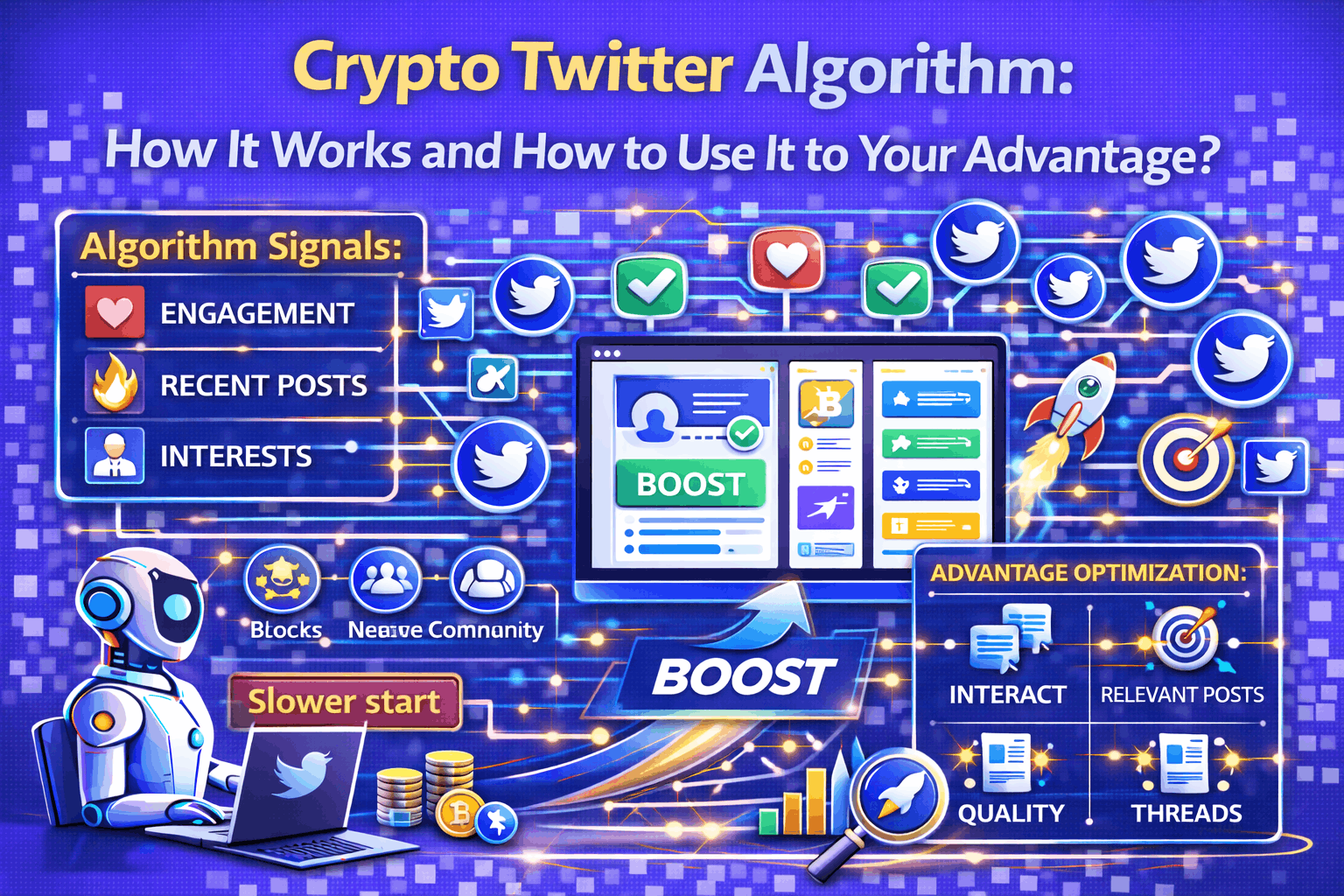
Many founders assume that Twitter operates the same way for every niche. In theory, the algorithm is unified. In practice, crypto accounts are evaluated under far stricter conditions. This is why two accounts posting similar formats can experience completely different reach outcomes.
The first reason lies in platform risk classification. Crypto content sits within a high risk category that includes finance, trading, and investment related discussion. These areas historically attract scams, bots, impersonation, and coordinated manipulation. Because of this, the crypto Twitter algorithm applies stronger behavioral filters before distributing content widely.
This does not mean crypto is suppressed by default. It means crypto activity is monitored more aggressively. Accounts are evaluated not only by what they post, but how they behave over time. Sudden growth spikes, unnatural engagement patterns, or repetitive promotional signals can reduce distribution without any visible penalty notification.
Another major difference comes from audience behavior. Crypto Twitter users interact differently from mainstream audiences. Replies are more frequent. Debates are common. Quote tweets often challenge opinions rather than amplify them. The algorithm learns from this behavior and prioritizes posts that generate conversation rather than passive consumption.
For non crypto niches, likes may be sufficient to push distribution. In crypto, replies and discussion depth matter far more. A post with fewer likes but active replies often outperforms a post with higher surface engagement but no conversation.
There is also narrative saturation. Crypto Twitter is extremely crowded. Hundreds of projects compete for attention using similar vocabulary, visuals, and promises. The algorithm therefore favors originality signals such as opinion, interpretation, and perspective rather than generic announcements.
This explains why many projects feel invisible even while posting frequently. The issue is not volume. It is mismatch between content behavior and algorithm expectations inside the crypto category.
Understanding this distinction is the first step toward gaining consistent crypto Twitter reach.
How the Crypto Twitter Algorithm Evaluates Accounts?
The crypto Twitter algorithm does not evaluate posts in isolation. It evaluates accounts as behavioral systems.
Every account builds an internal trust profile over time. This profile is shaped by consistency, interaction history, audience relevance, and engagement quality. Once established, this profile heavily influences how new posts are distributed.
Account age plays a role, but not as strongly as many assume. Older accounts do not automatically receive higher reach. What matters more is behavioral stability. Accounts that demonstrate predictable posting patterns and natural engagement cycles develop stronger trust signals.
One of the most important factors is interaction symmetry. When an account receives engagement, the algorithm observes whether the account responds. Projects that receive replies but never engage back are often deprioritized over time. Twitter rewards reciprocity because it increases platform retention.
The algorithm also evaluates who interacts with the content. Engagement from crypto native accounts reinforces relevance. Engagement from unrelated niches creates confusion. If a crypto post receives interaction mainly from generic or inactive accounts, future distribution becomes weaker.
Another overlooked factor is historical penalty weight. Accounts that previously engaged in aggressive promotion, spam behavior, or artificial growth may carry reduced distribution capacity even after stopping those actions. This is why some projects struggle to recover reach months later.
Behavioral consistency is critical. Sudden changes in posting style, frequency, or engagement behavior can reset algorithm learning. This often happens after campaigns, airdrops, or paid promotions executed without structure.
The algorithm does not punish ambition. It punishes unpredictability.
Projects that grow steadily, interact naturally, and maintain narrative coherence tend to receive compounding visibility over time. Those that spike, disappear, and restart repeatedly confuse distribution systems.
Understanding account evaluation helps explain why long term crypto Twitter growth is cumulative rather than linear.
Core Signals That Influence Crypto Twitter Reach
While the algorithm is complex, several core signals consistently determine how far crypto content travels.
The first is engagement velocity. This refers to how quickly a post receives interaction after publishing. Early replies signal relevance. Slow engagement reduces testing opportunities. This is why timing and active communities matter.
The second signal is reply depth. Replies carry more weight than likes because they indicate cognitive engagement. A post that sparks disagreement, clarification, or follow up questions performs better than a post that receives passive approval.
Another major factor is conversation continuation. When replies lead to additional replies, the algorithm identifies an ongoing discussion. This increases content lifespan and expands distribution beyond initial followers.
Time spent on content also matters. Threads that encourage reading, scrolling, or reflection generate stronger dwell time signals. This benefits educational and narrative driven crypto content.
Quote tweets play a dual role. Thoughtful quote tweets with commentary increase reach. Empty or repetitive quotes add little value. The algorithm evaluates semantic contribution, not just amplification.
A useful way to think about crypto Twitter reach signals is to group them into functional categories:
- Interaction quality rather than interaction quantity
- Conversation depth rather than surface reactions
- Relevance of engaging accounts
- Speed of early engagement
- Behavioral consistency over time
Not every post needs to maximize every signal. But accounts that repeatedly activate two or three of these signals build stronger distribution profiles.
This is why professional crypto Twitter strategies focus on engagement design, not viral tricks.
Content is not rewarded because it exists. It is rewarded because it activates behavior.
How Engagement Behavior Strengthens Algorithm Trust?
Posting content is only one side of crypto Twitter distribution. What happens immediately after publishing often matters more than the post itself. The algorithm closely observes how interaction unfolds in the first stage of visibility.
Early engagement acts as a validation signal. When replies, likes, and reposts appear naturally within the first minutes, the system begins testing the post with a wider audience. If interaction continues, reach expands further. If activity stalls, distribution stops quietly.
Reply behavior is especially important. When an account responds to comments, it extends the life cycle of the post. Each reply refreshes interaction signals and increases conversation depth. This shows the algorithm that the content is not passive but socially active.
Quote tweets contribute differently. They signal interpretive value. When users add commentary, the algorithm treats the post as discussion worthy rather than informational. This often leads to second layer exposure beyond the original follower base.
Likes alone have limited impact. They confirm approval but do not extend conversation. Heavy like only engagement rarely triggers large distribution unless supported by replies or quotes.
Timing also affects trust. Rapid engagement from a small but relevant audience performs better than delayed interaction from unrelated users. This is why niche relevance matters more than raw numbers.
Consistent engagement patterns build long term algorithm confidence. Accounts that repeatedly generate discussion are treated as conversation hubs. Over time, their posts receive broader initial testing automatically.
The algorithm does not reward virality once. It rewards behavioral reliability.
Why Audience Relevance Shapes Distribution?
Crypto Twitter operates as interconnected topic clusters. The algorithm groups users based on interaction behavior, not profile keywords.
When an account consistently engages with DeFi content, interacts with traders, or discusses infrastructure topics, the system learns where that account belongs. Distribution becomes more precise over time.
Problems arise when engagement comes from unrelated audiences. Generic followers dilute relevance. When replies originate from accounts that do not interact with crypto topics, the algorithm struggles to classify the content.
This confusion reduces reach. The system cannot confidently determine which cluster should receive the post next.
Relevance compounds. When crypto native users engage early, content travels deeper into crypto focused feeds. When non crypto engagement dominates, visibility weakens.
This is why artificial engagement damages performance. It introduces noise into relevance modeling.
Healthy distribution requires consistency of audience behavior. The algorithm rewards clarity. It punishes confusion.
Crypto projects that prioritize niche discussion outperform those chasing global attention.
Posting Frequency and Algorithm Stability
Many teams assume posting more leads to higher reach. In reality, unstable posting often harms distribution.
The algorithm favors predictable behavior. Accounts that maintain steady cadence build behavioral memory. When posting becomes erratic, distribution resets.
Posting too frequently can reduce average engagement per post. When engagement density drops, the system lowers testing range.
Posting too rarely causes decay. Dormant accounts lose distribution momentum and require rebuilding trust when activity resumes.
Optimal frequency depends on capacity. Consistency matters more than volume.
A stable posting rhythm allows the algorithm to anticipate behavior. Predictability strengthens visibility.
Sudden bursts followed by silence create instability. Stability builds algorithm confidence.
Long term growth emerges from rhythm, not intensity.
Common Algorithm Mistakes Crypto Projects Make
Many crypto projects unknowingly sabotage their own distribution.
One common mistake is excessive promotional posting. Repeated announcements without interpretation train the algorithm to expect low interaction. Future posts receive limited testing.
Another error is ignoring replies. When users engage and receive no response, conversation ends prematurely. The algorithm registers low interaction depth.
Random content shifts also cause damage. Switching between memes, announcements, price talk, and unrelated topics confuses classification.
Over amplification through poor quality engagement weakens relevance signals. Growth that appears artificial often results in reach decay.
Inconsistent tone breaks identity. The algorithm tracks behavioral patterns over time. Abrupt personality changes reduce trust.
These mistakes accumulate quietly. Reach does not disappear immediately. It erodes gradually.
Most teams realize the problem only after impressions collapse.
How to Use the Crypto Twitter Algorithm to Your Advantage?
Using the algorithm effectively requires alignment rather than manipulation.
Content should be designed to invite interpretation. Asking thoughtful questions, sharing viewpoints, and explaining reasoning creates engagement naturally.
Early replies should be prioritized. Engaging with the first commenters extends distribution cycles.
Audience relevance must remain consistent. Interaction within crypto native networks strengthens topic authority.
Posting cadence should be stable and realistic. Sustainable activity outperforms aggressive bursts.
Narrative continuity matters. Repeated themes reinforce identity and improve classification.
The algorithm does not reward tricks. It rewards coherence.
When behavior aligns with system expectations, reach compounds automatically.
How Professional Growth Infrastructure Supports Algorithm Performance?
Even strong content struggles without visibility. The algorithm cannot evaluate content that never reaches initial audiences.
Professional growth infrastructure supports discovery without distorting behavior.
Instead of simulating engagement, visibility systems introduce content into relevant evaluation cycles. Real users then determine whether interaction continues.
This protects algorithm trust while expanding reach potential.
Discovery must be paced. Sudden exposure spikes often trigger suppression. Gradual visibility allows natural signal formation.
When combined with quality content, infrastructure accelerates compounding distribution rather than replacing organic interaction.
Visibility enables opportunity. Interaction determines outcome.
How CryptoGrowSocial and XLaunchPad Help Align With Algorithm Behavior?
CryptoGrowSocial is designed around algorithm alignment rather than metric inflation.
Growth focuses on controlled exposure within crypto native networks. Audience relevance is preserved. Pacing matches account maturity.
XLaunchPad supports discovery by introducing posts into active crypto evaluation cycles. This allows content to be judged under real conditions instead of remaining unseen.
For larger campaigns, XLaunchPad Pro provides higher capacity discovery while maintaining behavioral thresholds. Scale increases without breaking distribution patterns.
These systems do not automate conversation. They create the conditions where conversation can occur.
Instead of forcing signals, they support signal generation.
Conclusion
The crypto Twitter algorithm is not random. It responds to behavior, relevance, and consistency.
Projects fail when they attempt to manipulate visibility rather than align with platform logic. They succeed when content, engagement, and growth systems work together.
Understanding how distribution functions allows teams to design smarter strategies instead of guessing.
Visibility creates opportunity. Interaction creates trust. Consistency creates growth.
For projects seeking sustainable exposure, professional infrastructure provides the stability required to work with the algorithm rather than against it.
CryptoGrowSocial and XLaunchPad exist to help crypto teams grow visibility safely, maintain relevance, and turn algorithm mechanics into long term advantage rather than unpredictable risk.