
Paid Twitter growth for crypto projects has existed almost as long as Crypto Twitter itself. From early ICO teams trying to appear legitimate to modern DeFi protocols competing for attention in a crowded timeline, buying visibility has always been tempting. When a project launches with zero followers and no visible engagement, perception becomes the first obstacle. Investors, traders, and community members often judge credibility within seconds. This pressure pushes many teams toward paid followers, paid engagement, and growth services without fully understanding how Twitter evaluates value beneath the surface. As algorithms mature, the cost of misunderstanding these mechanics increases dramatically.
The future of paid Twitter growth for crypto projects is no longer about whether paid growth exists, but how it is executed and integrated. This guide explores how paid Twitter growth is evolving, why old follower buying models are losing effectiveness, and what sustainable strategies look like moving forward. By examining algorithm behavior, engagement signals, and infrastructure based growth systems, this article provides a strategic framework for crypto teams who want visibility without sacrificing long term trust, reach, or account health.
Why Paid Twitter Growth Became Essential for Crypto Projects?
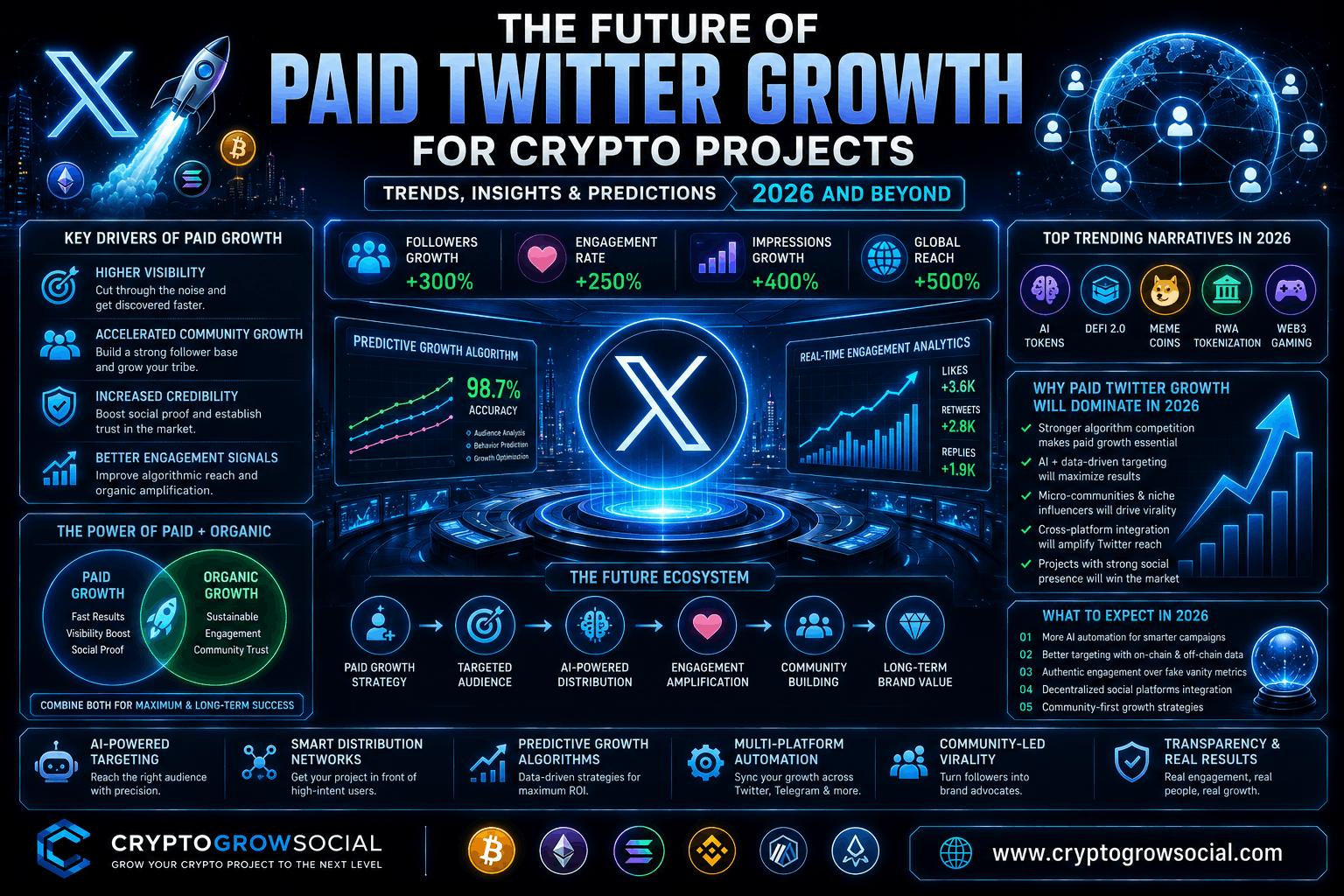
Crypto moves at a speed that traditional marketing cannot easily match. Token launches, liquidity events, protocol updates, and narrative shifts happen within days or even hours. Organic Twitter growth, while valuable, rarely keeps pace with these cycles. A new crypto project starting from zero followers faces an immediate visibility problem. Without social proof, even high quality content struggles to gain traction. This is where paid Twitter growth entered the ecosystem as a shortcut to perceived legitimacy.
Paid followers crypto projects initially viewed follower count as a credibility badge. A higher number suggested adoption, interest, and momentum. This mattered not only to retail traders but also to partners, influencers, and exchanges evaluating whether a project was worth attention. Paid engagement on Crypto Twitter further amplified this effect by creating visible interaction around tweets, making accounts appear active rather than dormant.
However, the essential role of paid Twitter growth was never about vanity metrics alone. At its core, paid growth attempted to solve a distribution problem. Crypto Twitter is noisy, competitive, and algorithmically filtered. Without an initial push, many projects remain invisible regardless of technical quality. Paid growth emerged as a way to enter the conversation rather than dominate it.
How X.com Algorithm Evolution Is Reshaping Paid Growth?
X.com no longer evaluates accounts based on follower count alone. The algorithm increasingly focuses on behavioral signals, engagement quality, and network consistency. Tweets are assessed based on how followers interact, how quickly engagement arrives, and whether those interactions appear natural over time. Sudden spikes, synchronized behavior, or irrelevant engagement patterns raise internal risk signals.
This evolution reshapes paid Twitter growth strategies fundamentally. Buying followers without engagement now often reduces reach instead of increasing it. Engagement rate dilution becomes a real problem when follower growth outpaces interaction. Twitter marketing for crypto projects must now consider how growth affects reach per follower, not just raw numbers.
Another critical change lies in network level analysis. The algorithm evaluates not just individual accounts, but the behavior of connected accounts. Low quality followers interacting across multiple unrelated projects create detectable patterns. This is why simple paid growth packages that rely on the same pools of accounts across clients are increasingly ineffective.
The future belongs to paid growth systems that understand and respect these evaluation mechanisms rather than attempting to bypass them.
The Decline of Simple Follower Buying Models
Simple follower buying models were built on volume and speed. Thousands of followers delivered overnight promised instant credibility. In practice, these models now produce diminishing returns and increasing risk. Follower quality versus quantity has become a defining distinction in crypto social media growth.
When low quality followers are added to an account, engagement ratios decline. Tweets reach fewer real users. The algorithm interprets this as low relevance content, not as a marketing issue. Over time, even organic followers stop seeing posts. The account becomes trapped in a low reach state that is difficult to reverse.
Beyond algorithmic impact, blind follower buying damages brand perception. Experienced crypto users can easily spot accounts with inflated follower counts and minimal real interaction. This erodes trust at exactly the moment projects need credibility most.
The decline of these models does not mean paid growth is obsolete. It means paid growth must evolve from transactions into systems.
Paid Followers vs Paid Engagement in the Future
The future of paid Twitter growth will increasingly differentiate between paid followers and paid engagement. Followers provide social proof but engagement drives visibility. Likes support initial distribution. Replies add context and narrative. Retweets expand reach beyond the immediate audience.
Paid engagement on Crypto Twitter, when executed correctly, can outperform paid followers in terms of algorithmic value. Engagement signals influence whether tweets are shown to non followers, recommended in timelines, or included in topic discussions. However, engagement without proper structure becomes just as risky as follower buying.
The key distinction moving forward is not whether engagement is paid, but how it is delivered. Authentic engagement patterns, pacing, and relevance matter more than the source of the interaction. Paid engagement must behave like organic engagement to remain effective.
Future strategies will often combine modest follower growth with structured engagement rather than pursuing either in isolation.
The Rise of Infrastructure Based Twitter Growth
Infrastructure based Twitter growth represents a shift from purchasing outcomes to building systems. Instead of buying followers or likes directly, projects access managed networks designed to behave naturally within X.com’s evaluation framework.
These systems rely on aged accounts with established crypto histories. Each account operates on isolated IPs and devices. Behavioral profiles define how often and in what manner engagement occurs. Pacing ensures no unnatural spikes. Narrative seeding ensures replies add context rather than noise.
This approach reduces risk by isolating behavior and avoiding detectable patterns. Growth becomes gradual and consistent. Engagement supports distribution rather than distorting it.
Infrastructure based growth aligns with how the algorithm evaluates value. It prioritizes stability, relevance, and behavioral consistency over raw volume. This is why it is increasingly replacing marketplace style growth services.
Future Role of Paid Twitter Growth in Crypto Marketing
Paid Twitter growth will not disappear from crypto marketing. Its role will change. Instead of being the primary driver of visibility, it will support organic content, narratives, and launches.
Future paid growth acts as amplification rather than fabrication. It helps good content travel further instead of propping up weak messaging. It smooths early distribution during launches while organic engagement takes over as credibility builds.
Crypto projects that integrate paid growth into a broader strategy gain compounding benefits. Those who rely on paid growth alone face diminishing returns.
The most effective teams will treat paid growth as infrastructure that enables visibility rather than a shortcut to popularity.
How Crypto Projects Will Use Paid Growth Differently?
Crypto projects are already changing how they approach paid Twitter growth because the old shortcuts no longer scale. Instant spikes, bulk follower injections, and one time engagement blasts increasingly create negative signals instead of visibility. As a result, paid growth is being reframed from a shortcut into a controlled lever within a broader distribution system.
Instead of accelerating growth unnaturally, teams now use paid growth to stabilize momentum. Gradual scaling replaces sudden jumps. Growth is layered on top of existing activity rather than injected in isolation. This allows accounts to maintain consistent behavioral baselines, which is critical for algorithmic trust.
Measurement is also evolving. Teams no longer evaluate paid growth by follower count alone. They monitor reach per follower, engagement decay over time, and how new followers affect content distribution. If paid growth improves these metrics, it is continued. If it distorts them, it is paused or removed.
Another important shift is selectivity. Rather than buying volume, teams filter by relevance. Audience alignment matters more than raw numbers. Paid growth is increasingly targeted toward users who already interact with crypto narratives, ensuring that added exposure reinforces existing signals instead of introducing noise.
Paid growth decisions are no longer static. They are evaluated continuously. Teams test, observe, and adjust. This ongoing calibration reflects a deeper understanding that Twitter visibility is dynamic. What helps today can hurt tomorrow if left unchecked. The projects that adapt are those that treat paid growth as an evolving input rather than a fixed purchase.
This change in behavior separates teams building long term visibility from those chasing surface metrics. Paid growth becomes a support mechanism, not the foundation.
Risks Crypto Teams Must Avoid Moving Forward
Despite this evolution, several structural risks remain and they are becoming more costly over time. The most persistent risk is misunderstanding how Twitter evaluates account value. Many teams still equate visibility with follower count, ignoring how engagement ratios and audience relevance shape distribution.
Over reliance on cheap growth providers remains another major pitfall. Low cost followers and engagement often come from polluted networks that are reused across unrelated projects. These networks introduce inconsistent signals that can quietly suppress reach long after the purchase is complete.
Another growing risk is treating paid growth as a one time action. Growth decisions affect account health cumulatively. A single aggressive purchase may not cause immediate damage, but repeated missteps compound. Over time, reach declines, engagement weakens, and recovery becomes difficult.
Operational inconsistency also creates risk. When teams manually manage growth without systems, human behavior becomes unpredictable. Language repetition, timing compression, and login anomalies all increase detection probability. These errors often occur unintentionally but have lasting consequences.
Avoiding these risks requires discipline. Teams must accept slower progress in exchange for stability. They must monitor performance honestly and be willing to abandon tactics that look good on dashboards but harm distribution. This mindset shift is essential for sustainable growth.
Signs of a Sustainable Paid Twitter Growth Strategy
Sustainable paid Twitter growth produces subtle but consistent indicators. One of the clearest signs is stable reach per follower. As follower count increases, average impressions do not collapse. Instead, reach either holds steady or improves gradually.
Engagement patterns also remain consistent. Likes, replies, and retweets arrive over time rather than all at once. Replies feel contextual. Language varies. Conversations evolve naturally rather than repeating generic phrases.
Audience alignment improves as well. Content begins to surface to users who share similar interests. Secondary interactions increase. Tweets are discovered by new users without aggressive boosting.
Another important signal is the absence of volatility. There are no sudden drops in visibility after growth actions. Performance changes gradually, making it easier to diagnose cause and effect. This stability indicates that paid growth is reinforcing trust signals rather than distorting them.
When these signs are present, paid growth functions as intended. It supports distribution without drawing attention to itself.
Managed Twitter Growth Services as the Next Phase
As complexity increases, managed Twitter growth services are emerging as the natural next phase. These services exist because most crypto teams do not have the time, infrastructure, or expertise to manage growth mechanics safely at scale.
Instead of clients buying followers or engagement directly, managed services centralize execution. Infrastructure, pacing, behavioral consistency, and monitoring are handled by specialists. This reduces human error and removes many of the detectable patterns that plague manual growth efforts.
For crypto teams focused on shipping products, building communities, or managing launches, this model offers clarity. Growth becomes predictable rather than stressful. Decisions are based on performance signals instead of guesswork.
Most importantly, managed growth shifts responsibility from individuals to systems. This aligns with how platforms evaluate behavior. Accounts managed consistently over time are treated differently than those driven by fragmented actions.
As paid growth continues to evolve, the projects that succeed will be those that stop asking how to buy attention and start asking how to sustain it. Managed growth is not about doing more. It is about doing less, but doing it correctly, repeatedly, and safely.
How CryptoGrowSocial Aligns With the Future of Paid Twitter Growth?
The future of paid Twitter growth in crypto is not about buying attention. It is about controlling exposure in ways that align with how platforms evaluate value. CryptoGrowSocial was built specifically around this reality. Instead of treating growth as a transaction, it treats growth as infrastructure.
CryptoGrowSocial does not sell followers or engagement packages because those models assume growth can be injected without consequence. Instead, it operates private networks of aged, crypto native Twitter accounts that already possess posting history, behavioral consistency, and established trust signals. These accounts are not activated on demand. They are maintained continuously.
Every account within the network is vetted across multiple dimensions. Posting history is reviewed for topical relevance. Engagement behavior is analyzed for consistency and authenticity. Trust score stability is monitored over time rather than assumed. This ensures that accounts do not simply exist, but function predictably within Twitter’s evaluation systems.
Infrastructure design is central to this approach. Each account runs on isolated IPs and dedicated device environments. Behavioral profiles are defined and respected. Engagement is paced gradually and distributed across time rather than clustered. Narratives are varied to avoid linguistic repetition and coordinated signaling. These factors prevent network contamination and reduce the probability of detection.
Clients never receive logins and never manage accounts directly. This is not a limitation. It is a safeguard. Most platform risk originates from human inconsistency. By removing manual access, CryptoGrowSocial eliminates login shocks, behavioral drift, and operational mistakes that often undermine paid growth strategies.
Growth under this model is created through controlled distribution rather than artificial injection. Content is surfaced within relevant networks. Conversations form naturally. Visibility expands outward. This mirrors organic discovery while retaining the advantages of scale.
Because this structure aligns with how X.com evaluates accounts, it remains resilient to algorithm updates. Systems that emphasize stability, relevance, and behavioral consistency tend to survive changes better than tactics optimized for short term gains. In this sense, CryptoGrowSocial does not react to the future of paid growth. It is designed for it.
XLaunchPad and XLaunchPad Pro as Future Proof Growth Models
XLaunchPad and XLaunchPad Pro represent two execution layers built on the same underlying infrastructure, each aligned with different operational needs and psychological profiles.
XLaunchPad is designed for founders and project teams who want growth without operational complexity. Campaigns are fully managed. Narrative seeding, engagement pacing, and distribution are handled within established systems. Teams focus on messaging, development, and community direction while infrastructure operates quietly in the background.
This model reduces cognitive load. Decisions about pacing, risk, and execution are removed from day to day consideration. For early stage teams or builders under time pressure, this clarity is often more valuable than granular control.
XLaunchPad Pro is designed for agencies and advanced teams who require strategic autonomy. It provides access to the same protected infrastructure while allowing teams to design and execute campaigns internally. Control increases, but safeguards remain intact. Raw accounts are still not exposed. Behavioral and technical isolation is preserved.
Both models eliminate exposure to fake follower risk by eliminating direct purchases entirely. There is no point where teams are tempted to trade safety for speed. Growth is embedded within systems that prioritize longevity.
In future paid growth environments where enforcement becomes more nuanced and trust signals matter more, these models offer flexibility without fragility. They allow teams to scale while remaining aligned with platform expectations.
Choosing Between Organic Only, Hybrid, and Paid Growth Models
Not all projects require the same growth approach. Understanding the differences between organic only, hybrid, and paid growth models helps teams choose intentionally rather than reactively.
Organic only growth offers maximum safety. It relies entirely on content quality, community participation, and time. For projects with long timelines and strong existing networks, this approach can be effective. However, organic growth is slow and highly sensitive to initial visibility constraints.
Hybrid growth models combine organic content with paid amplification through controlled systems. This approach accelerates discovery while preserving authenticity. When executed correctly, hybrid models smooth early momentum gaps without distorting long term signals. Many early stage and mid stage projects benefit most from this balance.
Paid growth models vary widely in quality. Transactional models that sell followers or engagement directly often introduce more risk than reward. Infrastructure based paid growth focuses on exposure rather than metrics. It supports organic discovery instead of replacing it.
The right choice depends on project stage, launch timelines, and risk tolerance. Early stage projects often need hybrid support to escape low visibility traps. Mature projects prioritize stability and signal preservation. The mistake is not choosing paid growth. The mistake is choosing it without structure.
Preparing Your Crypto Project for the Next Era of Twitter Growth
Preparing for the next era of Twitter growth requires a shift in mindset. Metrics that once dominated dashboards, such as follower count alone, lose importance. Engagement quality, reach stability, and audience relevance become the primary indicators of health.
Teams must stop optimizing for appearance and start optimizing for performance over time. This means accepting slower growth curves in exchange for consistency. It means monitoring how growth actions affect reach per follower and engagement decay rather than celebrating temporary spikes.
Infrastructure becomes a competitive advantage. Projects that invest early in systems rather than shortcuts accumulate compounding benefits. Their accounts age cleanly. Their audiences align naturally. Their content travels further with less effort.
As algorithms mature, they increasingly reward predictability, relevance, and trust. Projects that align with these principles gain resilience. Those that resist continue to fight declining visibility despite rising follower counts.
The future of paid Twitter growth in crypto belongs to teams that understand this transition. Growth is no longer about buying numbers. It is about building conditions where attention emerges sustainably.
Conclusion
The future of paid Twitter growth for crypto projects is not about abandoning paid strategies, but about evolving them. Simple follower buying models are fading. Infrastructure based, managed growth systems are taking their place.
Crypto projects that understand how X.com evaluates behavior will thrive. Those who continue chasing vanity metrics will struggle with declining reach and credibility. Choosing the right growth path today determines whether visibility compounds or collapses tomorrow.