
Twitter automation has become one of the most debated topics in crypto marketing. As competition for attention increases, many projects rely on automation to maintain visibility, manage communication, and operate at the speed required by crypto markets. At the same time, concerns around legality, platform compliance, and ethical responsibility continue to grow. Projects fear account restrictions, reputation damage, and accusations of manipulation. This tension has created confusion where automation is often misunderstood as inherently dangerous or unethical, even when used responsibly. Understanding the legal and ethical boundaries of Twitter automation is now essential for any crypto brand seeking sustainable growth.
This guide explains the legality and ethics of Twitter automation in crypto marketing from a practical and compliance focused perspective. This article breaks down what automation actually means, how platform rules apply to crypto accounts, where ethical boundaries exist, and how professional teams design systems that support visibility without manipulation. By the end, readers will understand how automation can be used safely, responsibly, and effectively without placing long term credibility at risk.
Understanding Twitter Automation in Crypto Marketing
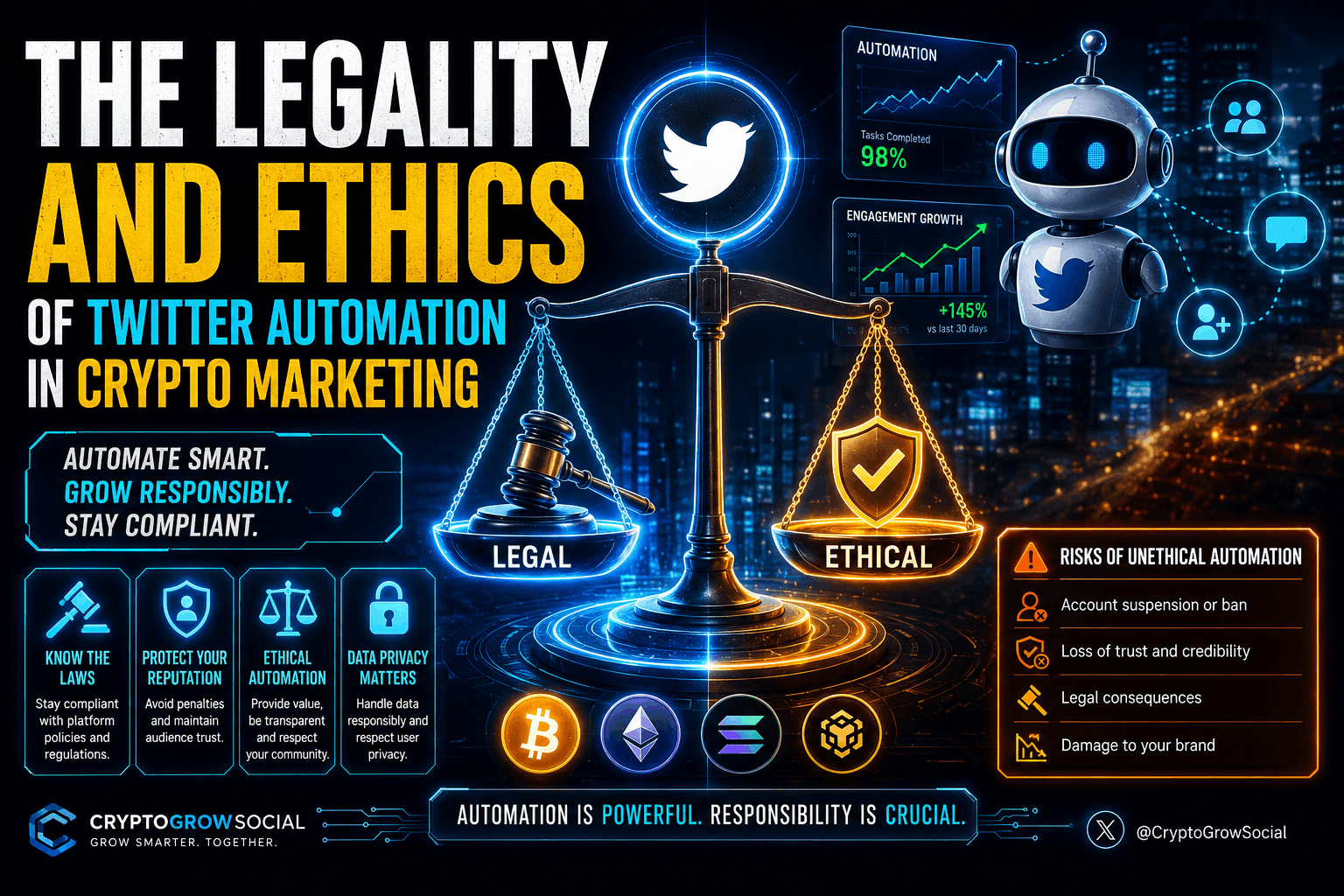
Twitter automation is often described vaguely, which leads to misinformation. Automation does not mean fake followers, artificial replies, or mass bot networks by default. At its core, automation refers to the use of software systems to assist repetitive operational tasks such as scheduling content, managing posting frequency, organizing analytics, and coordinating distribution workflows.
In crypto marketing, automation exists because the environment demands constant presence. Markets move continuously. Conversations do not pause. Communities expect updates even during development cycles. Without automation, most teams cannot maintain consistency without burning internal resources.
Automation becomes problematic only when it attempts to imitate human behavior deceptively. This includes generating fake engagement, simulating conversations, or manipulating visibility signals in ways that mislead users or algorithms.
A responsible definition of crypto Twitter automation includes:
- content scheduling and timing optimization
- analytics tracking and performance monitoring
- structured distribution workflows
- visibility support systems
- operational coordination across accounts
It does not include impersonation, fabricated interaction, or misleading representation of popularity.
Understanding this distinction is critical. Automation itself is neutral. Intent and execution determine whether it becomes compliant infrastructure or harmful manipulation.
Is Twitter Automation Legal Under Platform Rules?
The legality of Twitter automation depends on adherence to X.com platform policies rather than national laws in most cases. Twitter operates under its own Terms of Service, automation rules, and developer policies. Violations result in account restrictions, reach suppression, or permanent bans.
Automation is not prohibited by default. In fact, Twitter officially supports automation through APIs and approved tools. Many mainstream platforms use automation daily without issue.
What matters is behavior.
Twitter policies focus on preventing misleading activity, not preventing automation entirely. The platform evaluates patterns such as engagement velocity, repetition, coordination signals, and authenticity indicators.
Generally allowed automation operates within transparent behavior boundaries. Prohibited automation attempts to artificially influence metrics or deceive users.
This means legality is contextual. The same tool can be legal or illegal depending on how it is configured and deployed.
Crypto accounts face stricter scrutiny because the industry involves financial speculation, high scam exposure, and consumer risk. As a result, automation systems must be designed with higher compliance standards than those used for general brands.
Automation that respects platform intent remains legal. Automation that attempts to bypass trust systems does not.
Twitter Automation Activities That Are Generally Allowed
Several forms of automation are widely accepted and used by reputable brands across industries, including crypto.
Scheduling tools allow teams to publish content consistently without manual posting. This is one of the most common and safest forms of automation. Twitter encourages consistency, and scheduling supports this without altering engagement behavior.
Analytics platforms are also fully permitted. Tracking impressions, engagement timing, follower growth, and content performance is essential for optimization. These tools do not interfere with user behavior and therefore pose no policy risk.
Multi account management systems are permitted when accounts are clearly controlled by the same organization and are not used to coordinate artificial interaction.
Automation used for moderation such as filtering spam, organizing mentions, and managing inbound messages is also compliant.
These tools focus on organization and efficiency rather than manipulation. They improve workflow without interfering with organic engagement dynamics.
Used properly, they form the foundation of professional crypto marketing operations.
Automation Practices That Violate Twitter Policy
Problems arise when automation attempts to fabricate popularity or influence perception.
Disallowed practices typically include:
- automated likes or replies designed to inflate engagement
- coordinated networks amplifying the same content simultaneously
- follower inflation systems
- artificial conversation generation
- engagement pods disguised as organic behavior
These systems attempt to deceive both users and algorithms. They distort perceived credibility and undermine trust.
Twitter actively monitors for coordinated inauthentic behavior. Signals include synchronized actions, repeated message structures, abnormal timing patterns, and network overlap.
Crypto projects that rely on such systems often experience short term spikes followed by sharp suppression or account loss.
The platform’s goal is to preserve genuine discourse. Automation that disrupts this principle is penalized regardless of industry.
Understanding this boundary protects projects from costly mistakes.
Why Crypto Marketing Faces Higher Enforcement Risk?
Crypto accounts operate under increased scrutiny compared to traditional brands. This is not arbitrary. The industry’s history includes scams, rug pulls, impersonation campaigns, and misleading promotion.
As a result, Twitter applies stronger trust filters to crypto related content.
Risk factors include:
- financial language
- token promotion
- rapid account growth
- high engagement volatility
- aggressive calls to action
When automation is layered on top of these signals, enforcement risk increases significantly.
This does not mean crypto automation is forbidden. It means crypto automation must be more conservative, paced, and structured.
Projects that fail to account for this reality often misinterpret enforcement as random, when in fact it is behavioral.
Professional crypto marketing requires automation systems that align with risk profiles rather than ignore them.
The Ethical Side of Twitter Automation in Crypto
Legality and ethics are not the same. A tactic can be technically allowed yet ethically damaging.
Ethical automation focuses on transparency, fairness, and long term trust. Crypto communities are sensitive to deception. Once credibility is lost, recovery is extremely difficult.
Ethical concerns arise when automation creates false impressions of popularity or consensus. Even if technically undetected, these practices undermine community integrity.
Ethical automation supports visibility, not persuasion. It ensures content is seen but allows users to decide its value independently.
Trust is built through honest exposure, not manufactured agreement.
Projects that respect this principle tend to retain communities longer and attract higher quality participants.
Automation vs Manipulation Where the Line Exists
The difference between automation and manipulation lies in intent and outcome.
Automation supports process. Manipulation alters perception.
Automation helps content reach audiences. Manipulation attempts to convince audiences through artificial signals.
If automation influences distribution while leaving interpretation untouched, it remains ethical. If it alters perceived consensus, it crosses the line.
This distinction is essential for sustainable crypto marketing.
How Professional Agencies Stay Compliant?
Professional agencies do not approach automation as a growth hack. They approach it as a behavioral system that must coexist with platform algorithms, audience psychology, and long term account health.
Instead of inflating metrics, agencies design automation around behavioral modeling. The objective is not to appear active, but to behave credibly over time. Every automated action is measured against how a real human account would operate under similar conditions.
Core compliance principles focus on structure rather than volume.
Automation systems are built around:
- pacing control that mirrors organic posting behavior
- staggered visibility to avoid synchronized activity spikes
- relevance targeting based on narrative alignment
- manual oversight for content sensitivity and timing
- continuous monitoring of distribution and engagement signals
Automation is never deployed at full capacity at the start. Agencies introduce systems gradually, allowing time to observe algorithm responses. Early phases prioritize stability rather than expansion. Only after positive signals are confirmed does visibility scale increase.
Human judgment remains central. Automation executes predefined logic, but humans evaluate context. Sensitive announcements, narrative shifts, or market volatility are never handled blindly by systems.
This layered deployment model significantly reduces enforcement risk. More importantly, it preserves algorithm trust. Platforms are less reactive to accounts that evolve naturally than to those that spike unnaturally.
Compliance, in this sense, is not about avoiding rules. It is about aligning with how platforms evaluate authenticity.
Risk Management Framework for Crypto Automation
Responsible automation requires built in safeguards. Without them, even well intentioned systems can cause irreversible damage.
Professional agencies implement risk management frameworks that operate continuously in the background. These frameworks are designed to detect early warning signs before penalties occur.
Common practices include:
- monitoring performance signals such as reach consistency and engagement ratios
- enforcing growth caps to prevent sudden exposure acceleration
- establishing pause thresholds triggered by abnormal metric drops
- reviewing engagement quality rather than raw numbers
- conducting periodic audits of automation behavior patterns
When performance declines, automation intensity is reduced rather than increased. Agencies understand that declining reach is often a signal to slow down, not push harder.
This discipline prevents compounding damage. Instead of attempting to override algorithm resistance, systems step back, stabilize, and recover trust signals gradually.
Automation without monitoring becomes dangerous. It amplifies mistakes silently. Automation with oversight becomes infrastructure that protects accounts rather than endangering them.
This distinction separates professional growth operations from amateur bot usage.
Why Ethical Automation Produces Better Long Term Results?
Ethical automation is not a moral position alone. It is a strategic advantage.
Accounts that maintain trust signals experience compounding visibility over time. Algorithms reward consistency, relevance, and natural interaction patterns far more than short term engagement bursts.
Shortcuts can create brief spikes in impressions or followers, but they also introduce volatility. Once trust is damaged, recovery becomes slow and uncertain.
Sustainable automation operates differently. It supports discoverability without forcing interaction. It introduces content to relevant environments and allows users to choose whether to engage.
This approach aligns with long term algorithm behavior. As consistency accumulates, distribution becomes more predictable. Visibility stabilizes instead of fluctuating.
Communities built through ethical automation also behave differently. Members arrive through genuine interest rather than incentives or manipulation. Discussions last longer. Retention improves. Narrative trust strengthens.
Projects structured this way are more resilient. They outlast hype cycles, survive market downturns, and maintain presence even when attention contracts.
Ethical automation does not slow growth. It protects it.
Over time, credibility becomes the most powerful growth multiplier available.
CryptoGrowSocial Compliance First Automation Infrastructure
CryptoGrowSocial is built around a compliance first automation philosophy rather than aggressive growth tactics. The system is designed for crypto teams that understand visibility must be earned, not forced.
Instead of selling bots, engagement packages, or artificial interaction, CryptoGrowSocial provides structured growth infrastructure aligned with how crypto Twitter actually behaves. Every layer of automation is modeled around real platform patterns, narrative flow, and long term account health.
Visibility is introduced gradually rather than injected suddenly. Posting rhythm follows human pacing models. Distribution expands only when engagement signals remain stable. This prevents algorithm shock and protects credibility.
Audience relevance remains within crypto native discussions. Content is surfaced inside related visibility environments instead of being pushed indiscriminately. As a result, exposure feels contextual rather than promotional.
No fake engagement is generated.
No artificial consensus is created.
No behavioral manipulation is used.
The system focuses on opportunity rather than pressure. Content becomes visible. Users decide whether to participate.
This approach aligns naturally with platform policies, ethical marketing standards, and brand protection principles. It allows projects to scale presence without risking account flags, shadow limitations, or reputation damage.
CryptoGrowSocial replaces risky experimentation with managed structure. Instead of guessing what might work, teams operate within a framework designed specifically for crypto Twitter environments where trust, pacing, and narrative consistency determine long term success.
Automation becomes invisible. Visibility becomes stable. Growth becomes sustainable.
Conclusion
Twitter automation in crypto marketing is not illegal by default. It becomes problematic only when misused.
The real risk lies not in automation itself, but in intent, execution, and lack of structure.
Ethical and compliant automation supports visibility without deception. It strengthens consistency without distorting trust.
Projects that understand this distinction build communities that last. Those that ignore it chase short term metrics and face long term damage.
CryptoGrowSocial exists to help projects navigate this balance safely. By combining compliance awareness with structured growth infrastructure, it enables sustainable exposure without sacrificing credibility.
In crypto marketing, longevity matters more than speed. Automation should protect that future, not threaten it.