
Running a crypto project on Twitter (X) without analytics is like trading without a chart. Attention on Crypto Twitter is not random—it flows through specific accounts, repeats inside networks, and concentrates around narratives that gain momentum. Likes and follower counts only show surface activity. What actually determines growth is whether your project appears repeatedly in the right timelines, threads, and conversations where crypto attention is formed.
This article explains how Crypto Twitter tracker tools work, what they should really measure beyond vanity metrics, and how serious projects track visibility, narratives, and network-level spread. By understanding these signals, teams can move from guessing what works to deliberately controlling how their project gains attention on Crypto Twitter.
What Actually Matters on Crypto Twitter?
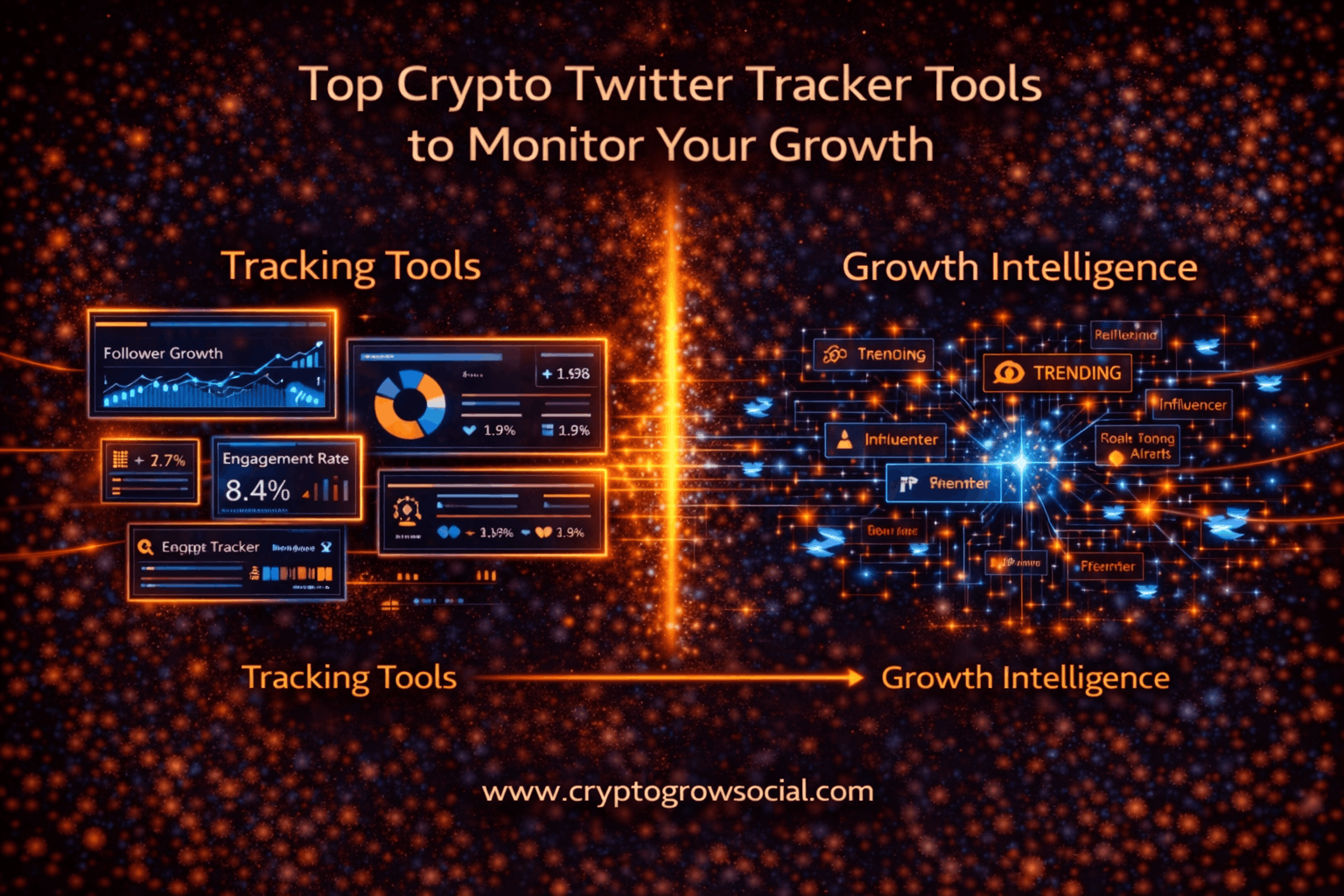
Crypto Twitter does not behave like normal social media. People are not there to be entertained. They are there to discover narratives early, follow capital, and spot opportunities before the rest of the market. This means that what matters is not how many people clicked “like,” but how far your story traveled.
A tweet that gets 50 likes but appears inside five trader reply threads is often more valuable than a tweet that gets 500 likes from inactive followers. A project that is mentioned organically by macro accounts, traders, and niche communities is building mindshare. A project that only posts on its own profile is just broadcasting into a void.
The job of analytics is to tell you whether your project is actually entering the network — or just talking to itself.
The Four Categories of Crypto Twitter Tracking
To understand how CryptoGrowSocial measures growth, it helps to break tracking into four distinct layers. Each layer answers a different question about how a project is performing inside the Crypto Twitter ecosystem.
1. Account Growth and Engagement Tracking
The first layer focuses on your own account. This includes follower growth, replies, quote tweets, profile visits, and outbound clicks. These signals indicate whether your account is becoming more active, more visible, and more relevant over time.
However, CryptoGrowSocial does not treat these metrics as end goals. They are baseline indicators. Strong engagement here suggests that your profile is healthy enough to participate in wider distribution, but it does not yet confirm that your message is spreading beyond your immediate audience.
Account-level metrics answer the question: “Is this account gaining traction on its own?”
2. Influencer and Network Propagation Tracking
The second layer looks outward. This is where growth becomes network-driven instead of self-contained.
CryptoGrowSocial tracks who is mentioning your project, how often those mentions occur, and what level of reach and influence those accounts have. A single mention from a highly connected account inside Crypto Twitter can matter more than dozens of likes on your own post.
This layer also analyzes reply chains and quote dynamics. When your project appears inside replies to large threads, it enters active discovery zones where new users encounter it organically.
Network tracking answers the question: “Who is carrying this project into other audiences?”
3. Narrative and Sentiment Tracking
The third layer focuses on meaning, not volume. It measures how your project is being framed inside conversations.
CryptoGrowSocial monitors recurring keywords, themes, and associations connected to your brand. Are people discussing your project as innovative, risky, promising, or questionable? Are you being linked to the narratives you want to own, or to ones you want to avoid?
Sentiment is evaluated in context. Crypto Twitter often uses irony, skepticism, or coded language. Simple positive/negative scoring is not enough. What matters is whether the dominant tone supports long-term credibility and adoption.
Narrative tracking answers the question: “What story is forming around this project?”
4. Competitor and Token Mention Tracking
The final layer compares your presence against others competing for the same attention.
CryptoGrowSocial tracks how often rival projects are mentioned, which narratives they are capturing, and whether their visibility is accelerating faster than yours. This reveals shifts in attention before they become obvious in price action or follower counts.
Token mentions are also tracked across discussions, not just announcements. A project that starts appearing organically in debates, comparisons, and recommendations is often gaining mindshare before metrics reflect it.
This layer answers the question: “Who is winning attention right now, and why?”
The Best Crypto Twitter Tracker Tools
If Crypto Twitter is where narratives are born and capital flows, then analytics tools are the radar that shows you whether your project is actually moving through that battlefield or just sitting still. Each class of tool plays a different role, and together they reveal whether you are building real presence or just creating noise.
Some tools tell you how well your account performs.
Some tell you whether the market is talking about you.
The best teams watch both.
TweetHunter & Hypefury — Understanding What Makes People Click
TweetHunter and Hypefury are not just scheduling tools. They are performance labs for Crypto Twitter.
They show you which tweets drive profile visits, which formats trigger replies, and how follower growth changes after specific posts. That matters because on Crypto Twitter, the profile click is the gateway. It is the moment someone moves from “I saw this” to “I want to know more.”
When you see that certain threads or certain tones consistently generate more profile visits, you are learning what makes people curious about your project. Over time, this allows you to reverse-engineer what actually converts attention into interest — not just engagement into vanity metrics.
For founders and growth teams, this is where content stops being creative guesswork and becomes a repeatable system.
Shield Analytics — Separating Real Momentum from Noise
Shield goes deeper than likes and retweets. It shows how impressions, replies, engagement, and reach evolve over time in relation to each other.
This matters because Crypto Twitter often produces fake signals. A giveaway tweet might spike impressions. A bot wave might inflate likes. But none of that means your narrative is working.
Shield lets you see patterns. If impressions are rising but replies are flat, it means people see you but do not care. If replies, profile visits, and impressions rise together, it means you are not just visible — you are pulling people into your ecosystem.
That distinction is everything in crypto. One creates noise. The other creates believers.
Hootsuite & Sprout Social — Knowing When the Market Talks About You
Your own account is only a small part of your real footprint on Crypto Twitter. The bigger signal is what happens when you are not posting.
Hootsuite and Sprout Social let you track mentions of your project name, token, brand, or keywords across Twitter. This shows you whether people are bringing you into conversations organically — in replies, in threads, in debates.
That is where real narrative traction happens.
If your mentions are rising even when you are not posting, your story is spreading. If they are flat, you are invisible outside your bubble, no matter how active your account looks.
LunarCrush — Measuring Whether Social Turns Into Market Attention
LunarCrush connects social activity to crypto market behavior. It tracks how often a token or project is mentioned, how much engagement those mentions get, and how that activity lines up with price, volume, and trend shifts.
This is critical because it answers the real question:
Is Crypto Twitter just talking about you, or is it starting to move money toward you?
When social mentions rise before price or volume, you are early in a narrative wave. When they rise after, you are chasing it. The projects that win learn to see that difference.
Santiment & Nansen Social — When Attention Becomes Capital
These platforms go one step further by linking Twitter chatter to on-chain behavior.
If people are talking about your project but no new wallets are appearing and no new holders are forming, your growth is cosmetic. If social spikes line up with wallet growth, trading activity, or staking behavior, your narrative is converting into real adoption.
This is where you see whether your Twitter presence is actually driving users and investors — or just entertaining an audience.
Kaito AI — Tracking Narratives, Not Just Mentions
Kaito is not about counting tweets. It is about mapping narratives.
It shows which topics are trending, which accounts are shaping them, and how projects are positioned inside those stories. If AI tokens, Layer 2s, or real-world assets are hot, Kaito tells you whether your project is being pulled into that conversation or left out of it.
This is crucial because Crypto Twitter does not reward isolated projects. It rewards projects that become symbols of a bigger theme. Kaito shows whether you are actually part of the story the market is telling.
How to Use These Tools Together?
The mistake most teams make is using only one type of data.
Your Twitter analytics tool might show that engagement is up. Your social listening tool might show that no one outside your followers is mentioning you. Your narrative tracker might show that your competitors are being associated with the trending story while you are not.
When you combine these views, you start to see the truth. You see whether your growth is real, whether your story is spreading, and whether you are gaining or losing mindshare.
This is how professional Crypto Twitter campaigns are managed.
Why Most Teams Still Misread Their Data?
Most crypto projects look at the wrong numbers. They celebrate likes, but ignore who is liking. They celebrate follower growth, but ignore whether those followers are active. They track engagement, but not where that engagement comes from.
Crypto Twitter is not about popularity. It is about positioning. If your project is being discussed by traders, builders, and narrative leaders, you are winning — even if your own posts look quiet.
How CryptoGrowSocial Tracks Growth Differently?
Most Twitter growth services measure success at the tweet level. They focus on surface metrics like likes, views, or follower count, without understanding how information actually spreads inside Crypto Twitter. CryptoGrowSocial approaches growth from a completely different angle: network distribution.
Instead of analyzing a single account in isolation, CryptoGrowSocial tracks how a project moves across connected accounts, threads, and conversations. Through systems like XLaunchPad and XLaunchPad Pro, growth is measured by how often a project is mentioned, how those mentions are positioned, and how narratives travel between influential clusters on Crypto Twitter.
Replies are not treated as engagement metrics, but as routing signals. When coordinated replies pull a project into trending threads or high-visibility discussions, CryptoGrowSocial tracks whether those replies lead to secondary mentions, quote tweets, and follow-up conversations elsewhere. This reveals whether attention is contained or expanding.
Narrative presence is another core metric. CryptoGrowSocial monitors how a project’s story appears across different segments of Crypto Twitter—traders, builders, influencers, and community accounts. Growth is evaluated based on whether messaging stays consistent, adapts naturally, or fragments as it spreads.
This is why CryptoGrowSocial does not ask, “Did this tweet get likes?” Likes are static. They stop at the tweet.
Instead, the real question is, “Did this story propagate?” Did it move from account to account? Did it enter new conversations? Did it survive beyond the original post?
That distinction—between isolated engagement and network-level distribution—is what separates traditional social media analytics from true growth intelligence.
Conclusion
Crypto Twitter tracker tools are not about vanity. They are about visibility, narrative, and capital flow. If you cannot see where your project appears, who is talking about it, and how often it is being repeated, you are flying blind in one of the most competitive attention markets in the world.
The projects that win are not the loudest. They are the ones that understand their data well enough to place their story exactly where the market is already looking.