
In today’s crypto market, one of the biggest challenges facing founders, token teams, and Web3 startups is not product development or fundraising, but distribution. Thousands of crypto projects launch every year, yet only a small fraction ever achieve meaningful attention on Crypto Twitter, which has become the primary platform where narratives are formed, trends are born, and capital begins to move. Without a scalable way to appear inside those conversations, even technically strong projects remain invisible to traders and investors.
This is why more crypto teams are now looking to build decentralized Twitter networks for promotion rather than relying on traditional influencer marketing or brand accounts. A decentralized Twitter network allows a project to distribute its story through many independent voices across Crypto Twitter, creating the appearance of organic market interest instead of paid advertising. In this guide, we will explain how decentralized Twitter networks work, why they outperform influencer-based growth, how crypto teams can build or access them, and how this infrastructure is now becoming the most powerful way to generate sustained narrative momentum and token attention in 2026.
What Is a Decentralized Twitter Network?
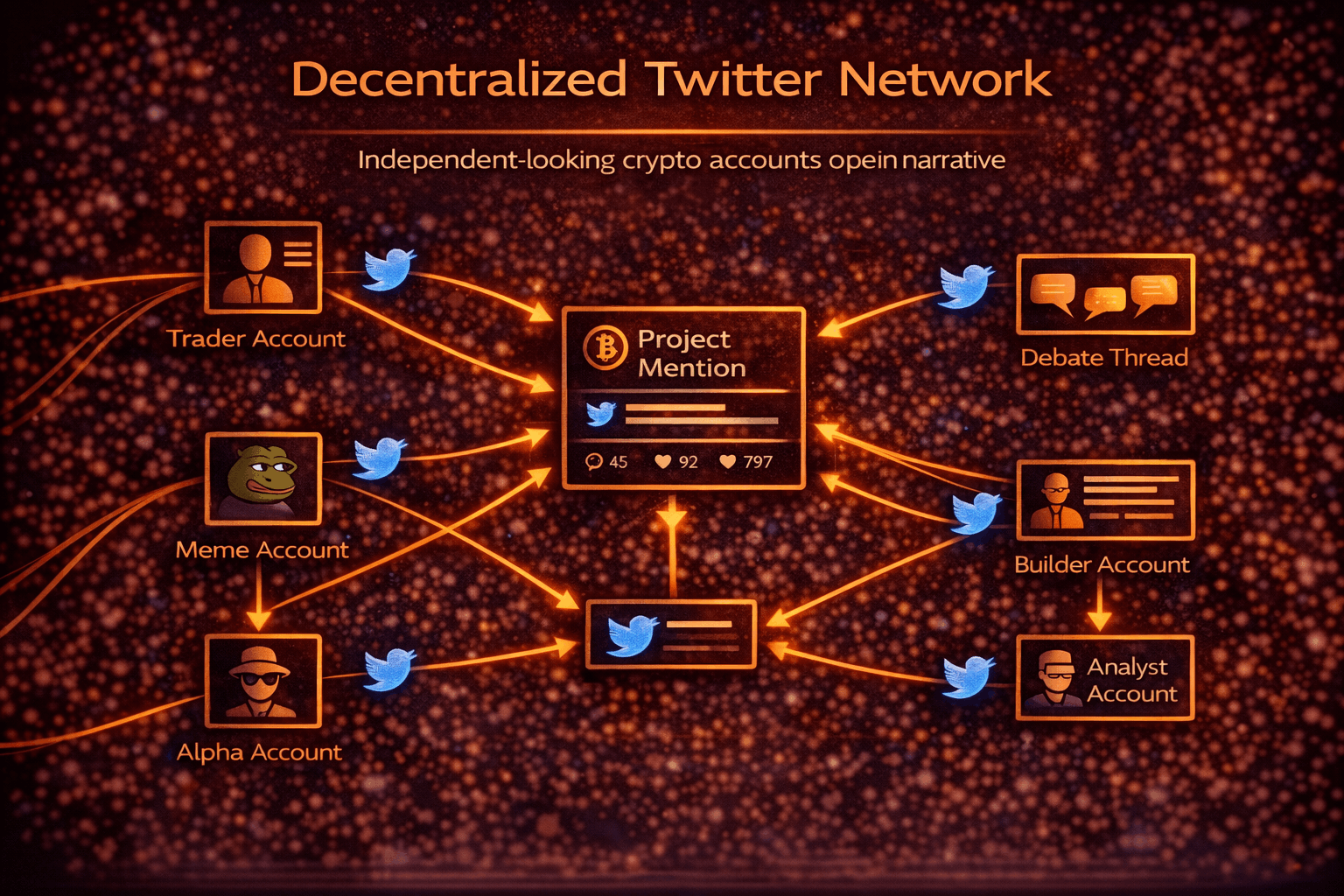
A decentralized Twitter network is not a collection of bots and it is not a group of paid influencers posting on command. It is a distributed system of independent-looking accounts that operate together to create, reinforce, and circulate narratives across Crypto Twitter. Each account functions as a social node with its own identity, posting history, tone of voice, and behavioral pattern, while the network as a whole functions as a coordinated narrative engine that can shape what the market is talking about at any given moment.
This structure is fundamentally different from traditional crypto marketing. In the influencer model, attention is concentrated in a few large accounts, and projects pay to temporarily rent that attention. In the decentralized network model, attention is spread across dozens or hundreds of smaller accounts that appear to be organic members of the ecosystem. Instead of one large blast of promotion, the market experiences a steady stream of discussions, debates, and mentions coming from many different voices. To the algorithm, this looks like organic interest. To traders, it feels like a trend is forming. To the project, it creates durable narrative presence that cannot be switched off by the loss of a single influencer.
Why Crypto Projects Need Decentralized Distribution?
Crypto projects operate inside a brutal attention economy where visibility and credibility decide whether a token grows or dies. On X (Twitter), the algorithm aggressively limits reach for anything that looks like promotion, especially when it comes from official brand accounts or founder profiles. When a project posts from its main account, it is usually shown only to existing followers, which creates what most teams experience as the Crypto Twitter bubble — a closed loop where you talk to people who already know you, while the wider market never sees your story.
This is why even technically strong crypto projects often fail to gain traction. The problem is not product quality. The problem is distribution.
Decentralized distribution exists to break this trap.
Instead of relying on one official voice, a decentralized Twitter network spreads your narrative through many independent-looking identities across the Crypto Twitter ecosystem. These accounts appear in trader threads, influencer replies, and market discussions, where attention already exists. To the algorithm, this looks like organic interest. To human traders, it looks like real people are paying attention.
That difference is everything.
How Decentralized Distribution Bypasses Algorithmic Suppression?
The X algorithm does not suppress projects — it suppresses patterns.
When one account repeatedly posts about the same token, it looks like promotion. When dozens of different accounts talk about the same idea in different places, it looks like a trend. The algorithm is designed to reward trends, not advertisements.
Decentralized distribution works because it creates:
- Multiple entry points into the market conversation
- Cross-thread visibility instead of isolated posting
- Narrative reinforcement from independent voices
When accounts that do not appear connected all reference the same idea, X’s ranking system treats it as rising organic interest and expands its reach. That is how a narrative escapes a single account’s follower base and enters the wider Crypto Twitter ecosystem.
Why Social Proof Is More Powerful Than Advertising?
Crypto markets do not move because someone sees a banner or a sponsored tweet. They move because traders believe other traders are paying attention.
Decentralized distribution creates this effect.
When a trader sees your project mentioned:
- In a macro thread
- In a trader’s reply chain
- In a meme account’s timeline
- In a market debate
their brain does not register it as marketing. It registers it as market chatter.
This creates social proof.
Social proof triggers:
- Curiosity
- Chart checking
- Telegram joins
- Early speculation
And once speculation starts, liquidity follows.
Why One Official Account Is Not Enough?
Most crypto teams try to grow through:
- A single brand account
- A founder account
- A few paid influencers
This creates a fragile system where all visibility depends on a handful of nodes. If those nodes are suppressed, ignored, or lose reach, the entire project disappears from the timeline.
A decentralized Twitter network removes this single point of failure.
Instead of one account pushing a story, many accounts pull it into the market from different directions. Some reply. Some quote. Some debate. Some casually mention. Together, they create the feeling that the market itself is talking about the project.
And in crypto, the market talking is what creates momentum.
The Architecture of a Crypto Twitter Network
A decentralized Twitter network is built on several interlocking layers that must work together in order to remain effective and undetectable. The first layer is the account layer, which consists of aged, phone-verified, and historically active Twitter accounts that already have some level of trust with the platform. These accounts must not look like they were created for marketing purposes, but rather like real people who have been using Twitter for months or years.
The second layer is identity and behavior. Each account needs a consistent personality, posting style, and interaction pattern that makes it believable as a real individual. Some accounts should be traders, others builders, others meme posters, and others casual observers of the market. This diversity is what prevents the network from looking artificial. The third layer is infrastructure, which includes proxies, device fingerprints, and browser isolation, ensuring that each account operates from a unique digital environment that cannot be clustered with others.
On top of this sits the narrative and engagement layer, which determines what ideas the network is pushing, how conversations are seeded, and how discussions are amplified over time. This is where the strategic value of the network is created, because the goal is not simply to post content, but to guide how the market thinks about a topic.
Narrative Seeding vs Shilling
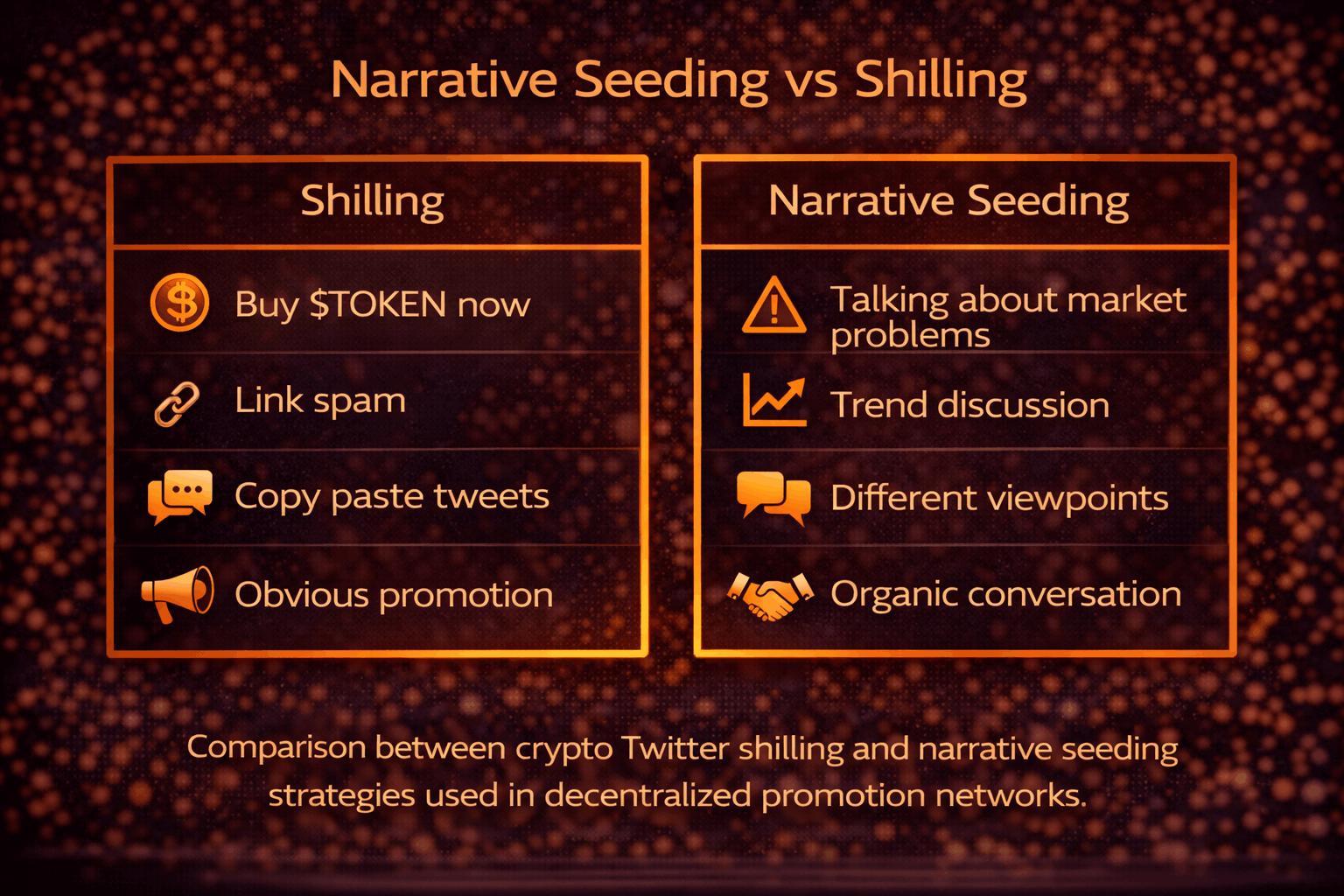
One of the most important distinctions in decentralized Twitter marketing is the difference between shilling and narrative seeding. Shilling is direct promotion, where accounts push links, token tickers, and project names in an obvious attempt to sell. This behavior is easily detected by both the algorithm and by human readers, which leads to suppression and loss of credibility.
Narrative seeding, by contrast, focuses on planting ideas rather than pushing products. The network first talks about problems in the market, then about why current solutions are failing, then about emerging trends, and only later introduces a specific project as a natural response to those trends. When done correctly, the project does not feel like an advertisement, but like the logical conclusion of a conversation that the market is already having. This is how decentralized networks build belief, which is far more valuable than short-term clicks.
How a Decentralized Network Moves Markets?
Crypto markets are not driven primarily by technology or fundamentals. They are driven by perception, timing, and collective belief. Traders do not buy what is objectively the best project. They buy what they believe other traders are about to care about. This second-order thinking is what creates every major rally in crypto.
A decentralized Twitter network exists specifically to shape this perception.
When a token, protocol, or narrative begins appearing in:
- Trader reply threads
- Influencer discussions
- Macro debates
- Meme timelines
- Casual market chatter
the human brain does not interpret it as marketing. It interprets it as emerging market interest.
That shift is critical.
From Repetition to Perception
One post does not move markets.
One account does not create belief.
But when dozens of independent-looking accounts reference the same idea across different parts of Crypto Twitter, something powerful happens: repetition becomes reality.
Traders begin to think:
- “I keep seeing this everywhere.”
- “Other people must be watching this.”
- “If I do not look now, I might miss something.”
This is not rational analysis. This is crowd psychology. And crypto is driven almost entirely by crowd psychology.
A decentralized network is designed to manufacture this feeling of ambient awareness, where a project is not aggressively promoted but quietly present everywhere.
How Attention Turns Into Price Movement?
The process always follows the same sequence:
- Narrative visibility increases across multiple accounts
- Traders notice repeated mentions in different contexts
- They open the chart “just to check”
- Speculation begins
- Volume appears
- Price starts to move
At no point does the network itself need to buy tokens.
Its role is to create the social environment in which humans decide to buy.
This is why decentralized networks are so effective. They do not try to persuade individuals directly. They shape the collective belief of the market.
And in crypto, collective belief is liquidity.
How to Build a Decentralized Crypto Twitter Network (DIY)?
Building a decentralized Twitter network from scratch is possible, but it is far more complex and expensive than most teams expect. The process begins with sourcing accounts, either by creating them manually or by purchasing pre-aged profiles. These accounts must then be warmed for at least 30 to 45 days, during which they behave like normal users by following accounts, liking posts, replying casually, and posting non-promotional content.
At the same time, each account needs a unique IP address, device fingerprint, and browser environment, which requires residential or mobile proxies and fingerprinting software. Once the accounts are ready, they must be connected to dashboards or automation systems that allow for posting, replying, and monitoring at scale. Content pipelines must be created to supply threads, talking points, and discussion prompts, and analytics tools are needed to track which narratives are gaining traction. This entire system requires constant maintenance, as accounts will be flagged, locked, or banned over time and must be replaced.
Why Most DIY Networks Fail?
Most DIY crypto Twitter networks do not fail because the model is wrong. They fail because execution is far more difficult than teams expect. Running a decentralized distribution system is not just a technical challenge. It is an operational and narrative challenge at the same time, and most teams underestimate all three.
The Infrastructure Trap
The first place most DIY networks collapse is infrastructure.
Teams assume that if they buy some aged accounts, some proxies, and a few automation tools, everything will work. In reality, every part of the stack introduces fragility:
- Accounts need to be warmed, maintained, and replaced
- Proxies expire, get flagged, or rotate incorrectly
- Fingerprints drift and get linked
- Automation scripts create behavioral patterns
Small mistakes compound. Posting the same text across multiple accounts, logging into several profiles from the same IP range, or running scripts on synchronized schedules creates exactly what the algorithm looks for: clusters.
Twitter does not ban bots.
It suppresses networks that behave like networks.
Once a cluster is detected, reach collapses across every connected account.
The Hidden Labor Cost
Even when the technical side is handled reasonably well, the human cost is usually what breaks the system.
A serious network requires:
- Monitoring account health
- Replacing dead or locked profiles
- Adjusting proxies and fingerprints
- Updating automation rules
- Reviewing performance
This is not a “set and forget” operation. It is a full-time growth machine. Most crypto teams do not have the time, staff, or focus to run this while also building a product, managing investors, and supporting a community.
The Narrative Collapse
The final failure point is the most damaging: lack of narrative control.
Many DIY teams treat their network like a megaphone. They push links, repeat the same slogans, and talk only about their own project. This instantly turns the network into spam. It kills engagement, reduces credibility, and trains the algorithm to ignore the entire cluster.
A decentralized network only works when it is telling a story:
- About the market
- About what is broken
- About where trends are moving
- And only then about your project
Without this structure, even perfect infrastructure becomes useless.
The Real Outcome
This is why so many teams spend:
- Thousands of dollars on accounts and proxies
- Months warming and testing
- Endless hours tweaking scripts
only to end up with a fragile system that barely reaches anyone.
The strategy is powerful.
But without professional execution, it becomes expensive noise.
Managed vs Owned Network Models
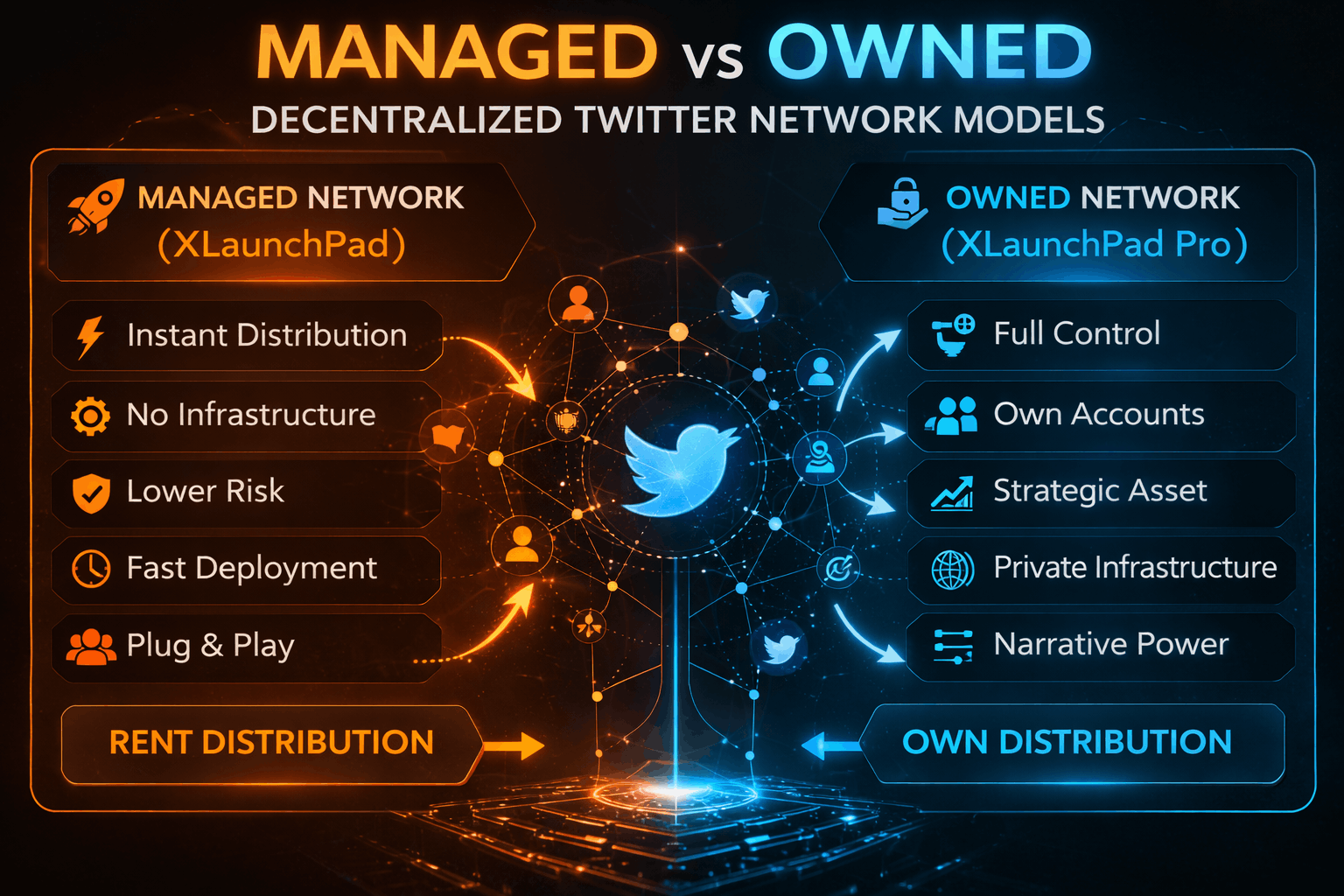
When crypto teams decide to use decentralized Twitter distribution, they are not just choosing a marketing tactic. They are choosing an operating model. At a high level, there are two ways to access this kind of network: you can rent distribution through a managed system, or you can own distribution by building and running your own infrastructure.
Each model solves a different problem, and understanding the trade-off is critical before committing capital, time, or narrative risk.
Managed Networks: Renting Distribution
A managed decentralized Twitter network is best understood as distribution as a service.
Instead of running accounts, proxies, and automation, your project plugs into an ecosystem of aged, crypto-native accounts that already exist inside Crypto Twitter. These accounts already follow traders, reply to influencers, and participate in market debates. They have social history, algorithmic trust, and behavioral credibility.
When you provide a narrative, it is injected into that ecosystem.
Your story appears:
- In trader reply threads
- Inside macro market debates
- Under influencer posts
- Across different timelines
To the outside world, it looks like organic market discussion. To the algorithm, it looks like independent actors reacting to a topic. That is what triggers distribution.
From the client’s perspective, this model has three major advantages:
Speed
You bypass the 30–60 day warming period completely. Your narrative can begin circulating immediately.
Safety
You are not exposed to account bans, proxy failures, or technical mistakes. The operator absorbs that risk.
Focus
Your team spends time on positioning, messaging, and product, not on maintaining infrastructure.
The trade-off is control. You do not own the accounts. You cannot move them elsewhere. You are paying for access to a living network rather than possession of one.
This model is ideal for projects that want results now and do not want to become infrastructure companies.
Owned Networks: Controlling Distribution
An owned decentralized Twitter network is the opposite philosophy.
Instead of renting reach, you build or acquire your own army of aged accounts, your own proxy infrastructure, your own fingerprinting systems, and your own automation stack. You control when narratives are deployed, how aggressively they spread, and which markets they target.
This gives you strategic power:
- You can launch narratives instantly
- You can defend your position against competitors
- You can pivot messaging as markets shift
- You are not dependent on any external operator
For large teams or well-funded protocols, this turns Twitter into something closer to a trading desk for attention. You are no longer asking for distribution. You own it.
But this power comes with real costs:
- High upfront spend on accounts and infrastructure
- Ongoing costs for proxies, software, and replacements
- Engineering and operational overhead
- Continuous risk of mistakes that trigger suppression
Most importantly, your team must be capable of running a complex system without breaking it.
This model only makes sense if you have the scale, capital, and discipline to operate it professionally.
The Strategic Choice
The real question is not which model is better.
The real question is what business you are in.
If you are building a token, a protocol, or a Web3 product, your core job is to ship, raise, and grow adoption. In that case, renting distribution through a managed network is usually the rational choice.
If you are running a large protocol, a launchpad, or a multi-token ecosystem where narrative control is mission-critical, owning your own network can become a strategic moat.
Both models work.
But they serve very different kinds of teams.
And in Crypto Twitter, choosing the wrong one can be far more expensive than not using a network at all.
How CryptoGrowSocial Provides Decentralized Twitter Infrastructure?
CryptoGrowSocial was built to solve a very specific problem that almost every serious crypto team eventually encounters: how to access decentralized Twitter distribution without becoming an infrastructure company. While many tools on the market promise automation, scheduling, or bot management, they all leave the most difficult parts of the problem in the hands of the client, including account warming, IP management, fingerprint isolation, detection avoidance, and long-term operational stability. CryptoGrowSocial was designed from the ground up to remove that entire burden.
Instead of selling software, CryptoGrowSocial provides working decentralized Twitter infrastructure. That infrastructure consists of aged crypto-native accounts, hardened operational systems, proxy and fingerprint routing, and engagement engines that already operate inside the real Crypto Twitter environment. These are not freshly created bot accounts, and they are not theoretical growth models. They are live identities that already participate in trader conversations, influencer replies, and ongoing market debates, which means they already possess algorithmic trust and social credibility.
This is what allows CryptoGrowSocial to offer something that most DIY solutions cannot: immediate, scalable, and low-risk access to decentralized distribution.
XLaunchPad — Managed Decentralized Distribution
XLaunchPad is designed for teams that want results without having to build or operate anything themselves. Instead of giving clients accounts or dashboards, XLaunchPad allows projects to plug their narrative directly into a professionally operated crypto Twitter network that is already live and active across the ecosystem.
In practical terms, this means that when a team provides its messaging, positioning, and strategic narrative, CryptoGrowSocial’s network places that story into real trader threads, influencer discussions, and market-relevant conversations where attention already exists. The project does not need to create accounts, warm them, manage proxies, or worry about detection. All of that complexity is handled by the infrastructure layer.
Because the accounts are aged, distributed, and behaviorally realistic, the algorithm treats their activity as organic market interest rather than coordinated promotion. This allows a project to appear in many places at once, creating social proof and narrative momentum without exposing itself to the risks that normally destroy DIY networks.
For founders and token teams, this effectively turns decentralized distribution into a service that can be used immediately, safely, and at scale.
XLaunchPad Pro — Full Network Ownership
XLaunchPad Pro exists for teams that want to go one step further and actually own their decentralized Twitter infrastructure rather than renting access to it. Instead of plugging into a shared managed network, these teams receive a fully built and warmed system that includes aged accounts, automation engines, fingerprint isolation, proxy routing, and narrative deployment tools.
This allows the team to control every aspect of how their network behaves. They decide which narratives to push, when to activate engagement, how aggressively to defend their market position, and how to coordinate launches, trend hijacks, or competitive responses. What would normally take months of engineering, testing, and risk-filled experimentation is delivered as a ready-to-deploy distribution layer.
For large protocols, well-funded startups, and long-term ecosystem builders, this transforms Twitter from a marketing channel into a strategic asset, because distribution is no longer rented or hoped for, but owned and controlled.
When to Use XLaunchPad vs XLaunchPad Pro?
The choice between XLaunchPad and XLaunchPad Pro is not about which product is better. It is about which operational model makes sense for your team.
XLaunchPad is ideal for founders, token teams, and Web3 startups that want fast, low-risk access to real Crypto Twitter distribution without taking on any technical or operational complexity. It allows teams to focus on narrative, positioning, and product while CryptoGrowSocial handles all of the infrastructure that makes decentralized engagement possible.
XLaunchPad Pro is designed for teams that see narrative control as a long-term strategic advantage and are willing to invest in owning their own distribution layer. For these teams, having an internal, decentralized Twitter network provides the ability to launch, defend, and scale market perception without being dependent on any external platform or influencer.
In both cases, the underlying principle is the same: CryptoGrowSocial gives crypto projects access to the one thing that matters most in modern markets, which is real, decentralized attention at scale.
Conclusion
For crypto teams that understand this shift but do not want to spend months building fragile infrastructure, CryptoGrowSocial provides a direct path into this new attention economy. Through XLaunchPad, projects can plug their narrative into an existing decentralized network of aged Crypto Twitter accounts that already operate inside real trader conversations. Through XLaunchPad Pro, teams can own a fully built and professionally warmed network that gives them long-term control over how their story spreads. In both cases, CryptoGrowSocial turns decentralized distribution from a theory into a working growth engine that delivers visibility, credibility, and sustained market-level reach without the operational burden.