Crypto Twitter is no longer a place where good projects get discovered organically. It is a competitive attention marketplace where thousands of new tokens, protocols, and founders fight for the same limited distribution inside an algorithm that only rewards conversation, velocity, and repetition. If your project is not showing up across timelines, replies, and trending threads, it effectively does not exist, no matter how strong the technology behind it may be.
This is why Crypto Twitter networks — often called farms — have become standard infrastructure for serious crypto marketing. They are not about spamming links or faking popularity. They are about controlling distribution. A well-built network allows a project to insert itself into market conversations, shape narratives, and appear everywhere that traders, investors, and communities are already paying attention. In this guide, you will learn how these networks actually work, how they are built, and why they have become one of the most powerful tools in crypto growth.
Why Crypto Twitter Networks Exist?
Crypto markets are driven by narratives long before they are driven by fundamentals. Traders buy stories, communities form around beliefs, and liquidity follows whatever feels like it is becoming important. Twitter is where those stories form in real time. It is where traders debate trends, where builders defend their designs, and where investors decide what is worth watching.
The problem is that Twitter is no longer a neutral platform. It is an algorithmic system that distributes content based on engagement, not truth or quality. Tweets that spark replies, quotes, and back-and-forth discussion are pushed into more timelines. Tweets that sit quietly disappear. This creates a brutal feedback loop: projects that already have distribution get more distribution, while new projects are invisible.
Crypto Twitter networks exist to break that loop. They provide a way for new or mid-size projects to inject themselves into the flow of conversation so the algorithm can see that people are talking. Once that happens, organic users begin to encounter the project, react to it, and amplify it further. The network creates the initial spark that lets the market take over.
What a Crypto Twitter Network Actually Is?
Most people imagine a crypto Twitter farm as a bunch of fake accounts posting the same link. That is not what real networks look like. A professional crypto Twitter network is a distributed group of aged, active, human-looking accounts that live inside different niches of the platform.
Some accounts look like traders.
Some look like DeFi analysts.
Some look like NFT collectors.
Some look like meme posters.
Each one has its own followers, posting style, and history. They are not synchronized clones. They are independent social nodes that can be coordinated when needed.
The power of a network comes from distribution. Instead of one account trying to reach the world, dozens or hundreds of accounts each reach their own micro-audience. When they begin referencing the same narrative, it feels to the market like something is happening everywhere at once. That is how narratives are born.
The Three Layers of a Crypto Twitter Farm
Every serious crypto Twitter network is built on three layers that must all function correctly for the system to work.
The identity layer is the accounts themselves. These are the profiles that appear on Twitter. They must look real, behave naturally, and already have some level of trust with the algorithm.
The infrastructure layer is what keeps those accounts alive. This includes proxies, IP rotation, browser fingerprints, phone verification, and session management. Without this layer, accounts get flagged and die.
The narrative layer is the content and behavior. This is how the network talks about markets, reacts to trends, and introduces your project into conversations. This is where strategy lives.
Most failed farms collapse because one of these layers is weak.
Account Creation vs Account Acquisition
The first decision when building a crypto Twitter network is whether to create accounts yourself or buy them already aged.
Creating accounts from scratch is possible, but expensive and slow. Each account needs a phone number, a clean IP, a browser fingerprint, a profile, and weeks of warm-up behavior before it can safely touch crypto content. Even before warming, a properly created account can cost several dollars in SMS, proxy time, and labor. When you multiply this by dozens or hundreds of accounts, the cost quickly becomes significant.
Buying aged accounts is how most professional networks start. These are accounts that already have posting history, followers, and behavioral trust. Depending on quality, they cost anywhere from $15 to $50 per account. Higher-end accounts that are phone-verified, geo-targeted, and crypto-aged cost more.
Even when you buy accounts, replacement is constant. Accounts get locked, flagged, or burned over time. A real farm always budgets for attrition.
How to Warm Crypto Twitter Accounts Properly?
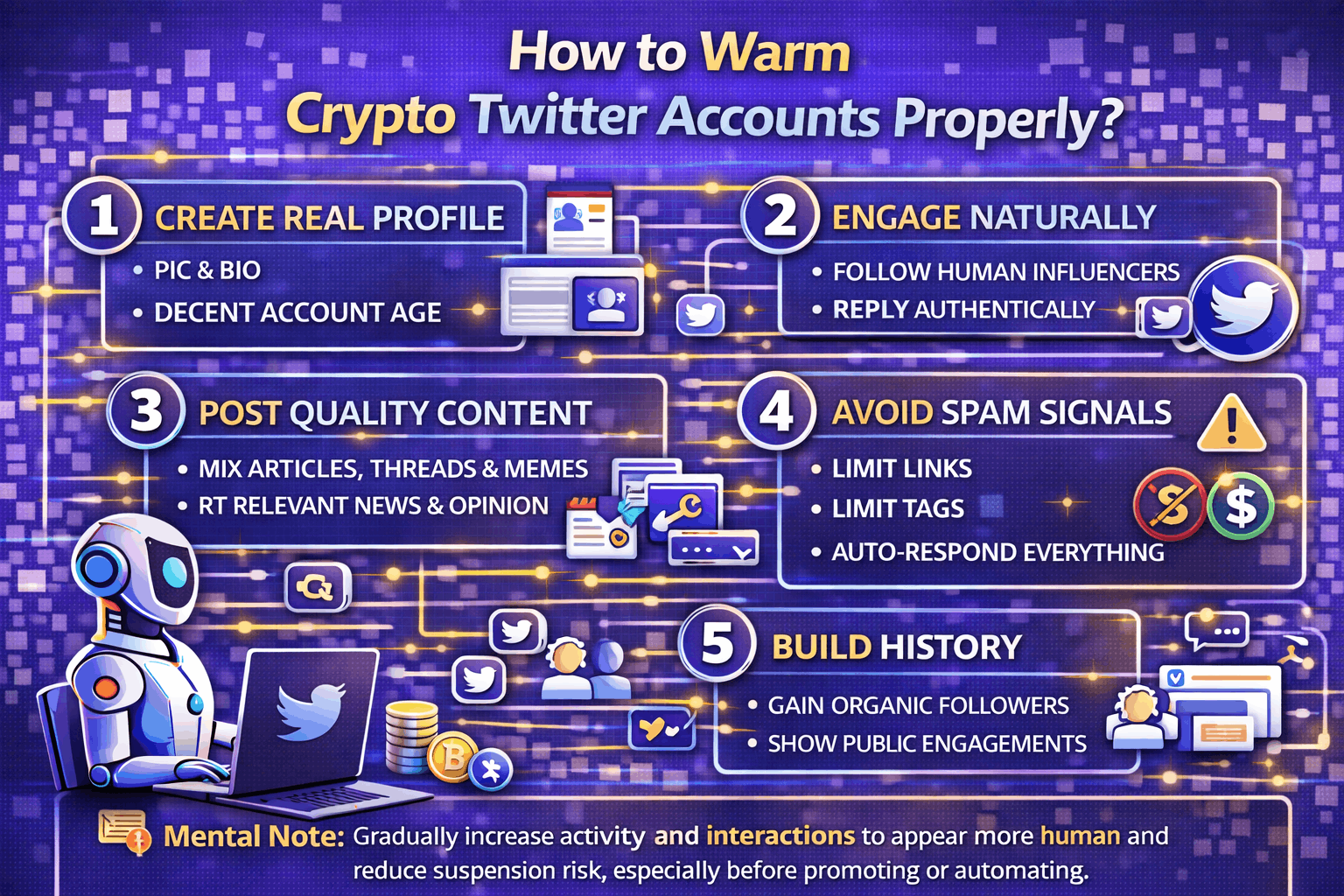
Warming a crypto Twitter account is not about making it “old.” It is about making it believable.
The X algorithm does not trust age. It trusts behavioral history. An account that sat idle for two years and then suddenly starts posting about tokens, charts, and launches looks more suspicious than a brand-new account that slowly evolves into crypto over time. What matters is whether the account looks like it belongs to a real person who naturally drifted into the market.
That is what warming actually means: building a digital identity that the algorithm accepts as authentic.
Why most crypto accounts fail before they even start?
The majority of crypto Twitter farms are born dead.
Teams buy aged accounts, change the bio, start posting links, and wonder why their reach collapses. From the algorithm’s perspective, this looks exactly like what it is: a dormant profile suddenly hijacked for promotional activity. That pattern triggers throttling, shadowbans, or outright locks.
Warming is what prevents this.
It tells the platform a story about who this account is, what it cares about, and how it behaves. Without that story, no amount of proxies, software, or clever wording will save you.
The 30–45 day behavioral foundation
A real warm-up period takes at least one month, often closer to six weeks for crypto-focused accounts.
During this phase, the account must do everything a real person would do long before ever talking about a token:
- Follow accounts slowly, not in bursts
- Like posts from a mix of crypto and non-crypto users
- Reply casually to threads without promoting anything
- Retweet opinions, jokes, and news
- Post original thoughts that are not salesy
The goal is not volume. It is consistency.
The platform builds a behavioral model for every account: how often it posts, what it interacts with, how long it stays active, what types of users it follows, and how those patterns change over time. A good warm-up teaches the algorithm that this account is a normal crypto-interested person, not a marketing instrument.
Why crypto behavior must be introduced gradually?
One of the most common mistakes is going full crypto on day one.
If a brand-new or recently repurposed account starts following only traders, only liking charts, and only talking about tokens, it creates a narrow and artificial footprint. Real people do not behave that way. They have hobbies, opinions, random interests, and off-topic interactions.
A proper warm-up blends crypto into a wider digital life.
For example:
- Early days might include tech, memes, or general finance
- Then a few crypto follows appear
- Then some replies to blockchain threads
- Then a retweet of a market discussion
- Only later do more focused crypto conversations appear
This gradual shift is exactly how real users evolve. The algorithm expects to see it.
Why warming is really about fingerprints, not activity?
Every account has a behavioral fingerprint.
This fingerprint includes:
- Posting times
- Writing style
- Interaction types
- Account connections
- Engagement patterns
- Topic drift over time
When that fingerprint looks human, the account is trusted. When it looks synthetic or abruptly changed, it is suppressed.
Good warming is not about avoiding automation. It is about using automation in a way that produces human-like randomness. Some days the account is active. Some days it barely does anything. Sometimes it replies. Sometimes it only scrolls and likes. That inconsistency is exactly what makes it believable.
Perfect consistency is suspicious. Controlled chaos is safe.
When an account is truly ready?
A warmed crypto account is not just older. It is embedded.
It should:
- Have a network of crypto followers
- Have replied to real people
- Have been part of conversations
- Have a posting rhythm
- Have non-promotional history
At that point, when it starts participating in narratives about new projects, trends, or market shifts, it does not look like marketing. It looks like a trader or builder expressing opinions.
That is the moment when an account becomes valuable.
Not because it can post — but because it can be heard.
Proxy & Fingerprint Infrastructure

Every account inside a crypto Twitter farm must exist in its own digital universe.
To X, an account is not just a username and a password. It is a bundle of signals: IP address, device type, browser version, operating system, screen resolution, fonts, timezone, and dozens of other variables that together form a fingerprint. When multiple accounts share too many of these attributes, the platform does not see “a team.” It sees coordination — and coordination is what triggers suppression and bans.
That is why infrastructure matters more than software.
Why IPs decide whether an account lives or dies?
The IP address is the strongest identity signal in Twitter’s detection system. If twenty accounts log in from the same IP, they are instantly connected in the backend, no matter how different their usernames or bios are.
This is why serious farms never use datacenter proxies.
Datacenter IPs are:
- Cheap
- Fast
- Mass-produced
- Easily fingerprinted
They belong to hosting providers, not real households. X knows this. When crypto promotion comes from datacenter ranges, it gets throttled almost immediately.
Instead, farms use residential and mobile proxies.
Residential IPs come from real home internet connections.
Mobile IPs come from carrier networks like 4G and 5G.
These are what normal people use, so they carry algorithmic trust. When a warmed account posts from a mobile IP that stays in the same city every day, it looks exactly like a real trader tweeting from their phone.
That consistency is critical.
A good farm pins each account to:
- One country
- One region
- One proxy subnet
The IP should change slowly, if at all. Jumping from New York to Berlin to Singapore in three hours is not human behavior. That pattern alone can kill an account, no matter how good the content is.
Why fingerprints are more important than you think?
Even if every account has a different IP, X can still link them through device fingerprints.
When you log into Twitter, your browser leaks dozens of tiny signals:
- Screen size
- Installed fonts
- WebGL profile
- OS version
- GPU type
- Timezone
- Language settings
Together, these form a near-unique identity. If 50 accounts all have the same fingerprint, X knows they are the same machine pretending to be 50 people.
This is why professional farms use browser profile isolation tools.
Each account runs inside its own virtual browser:
- Different OS signatures
- Different resolutions
- Different font sets
- Different timezone and language
- Different hardware profiles
To Twitter, these look like 50 unrelated laptops and phones, scattered around the world, each operated by a different human.
Without this layer, your entire network is one click away from being mapped and wiped.
Why consistency matters more than randomness?
Many people think stealth means constantly rotating everything. In reality, that is backwards.
Real users do not change devices every day. They do not log in from five countries in a week. They do not switch screen sizes and operating systems randomly.
A safe farm assigns:
- One proxy
- One fingerprint
- One region
to each account — and keeps it that way.
The goal is to make every account look boringly normal. The more stable the environment, the more trust it accumulates. And that trust is what allows the account to later participate in crypto narratives without being suppressed.
This is the invisible layer that makes everything else work
Posting bots, reply engines, and narrative systems are useless without this foundation. You can have the smartest automation in the world, but if Twitter can see that all of your accounts come from the same place, the same machine, and the same patterns, the entire network collapses.
Proxy and fingerprint infrastructure is not glamorous.
It does not generate engagement.
It does not create narratives.
But it is the bedrock that everything else depends on.
Without it, you do not have a farm. You have a short-lived experiment that will be erased the moment it starts to matter.
Automation Stack for a Crypto Twitter Network
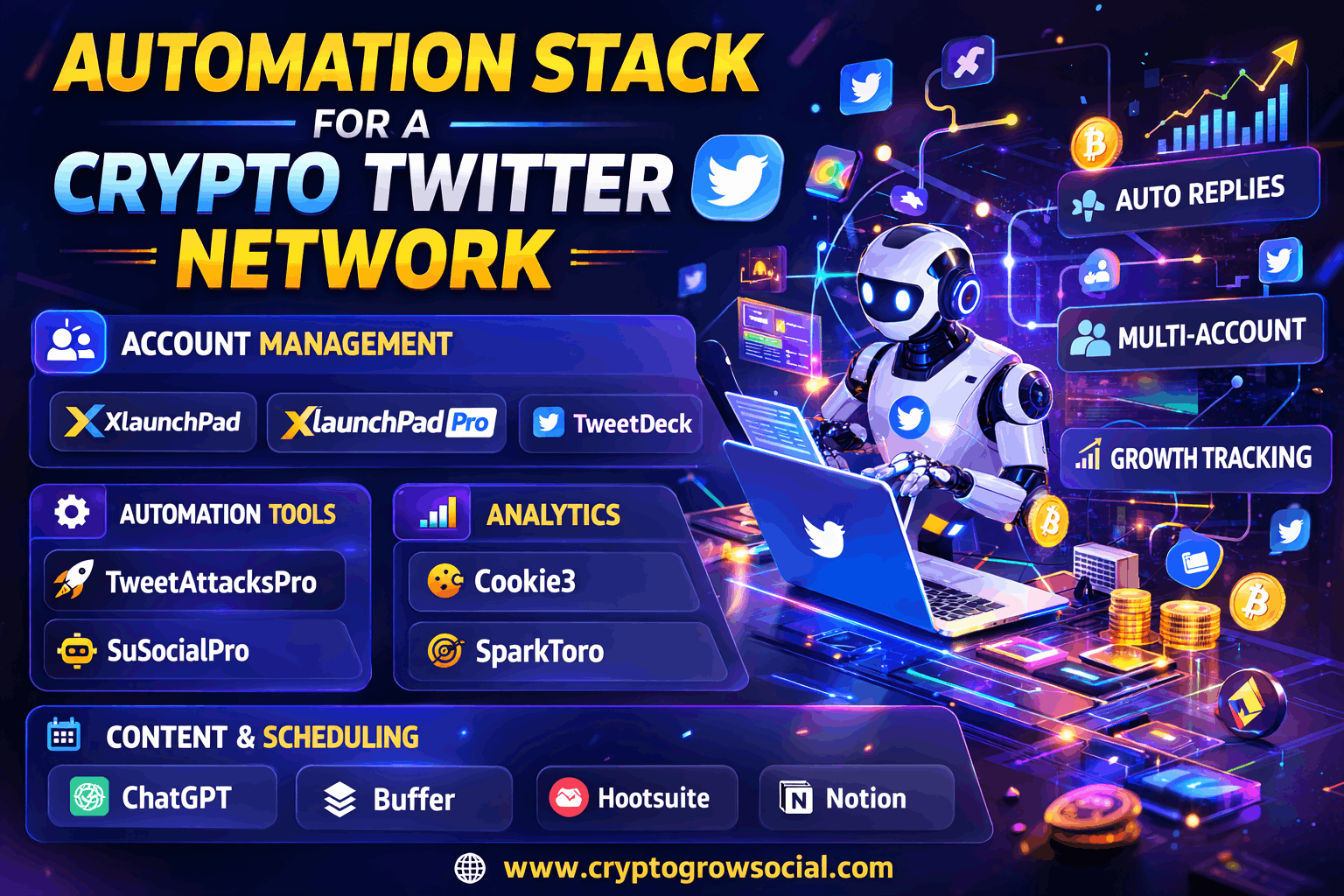
A professional crypto Twitter network is not built on a single tool. It operates on a layered automation stack designed to simulate the behavior of a living, thinking, decentralized online community. Each layer performs a different function, and when they are combined correctly, they create the one thing the X algorithm cannot ignore: continuous, distributed conversation.
Most failed farms rely on one or two crude bots that simply push posts or spam links. That does not create influence. It creates patterns, and patterns are exactly what modern moderation systems are designed to suppress. Real distribution comes from coordinated behavior across multiple account types, each behaving differently but reinforcing the same underlying narrative.
This is where the automation stack becomes critical.
Posting Bots — Creating the raw content layer
Posting bots are responsible for publishing original tweets from accounts in the network. These are not simple repost engines. Their role is to make the network look like it is constantly generating new opinions, observations, and ideas about the market.
These bots handle things such as:
- Scheduling tweets at human-like intervals
- Posting different content formats (text, charts, threads, quotes)
- Rotating writing styles and tone
- Avoiding repetitive structures that trigger detection
This layer is where narratives begin. A posting bot might publish a thread about why a particular sector of crypto is undervalued, a short comment about a market shift, or a casual observation about what traders are starting to notice. None of it looks promotional on its own. It looks like real people sharing what they think.
Without this layer, a network has nothing to talk about.
Reply Bots — Injecting accounts into live conversations
Reply bots are the most powerful component of a crypto Twitter network.
They do not talk to themselves.
They talk to the market.
Their job is to place your network’s accounts inside trending threads, influencer discussions, and high-attention conversations. This is how narratives move beyond your own follower base and into the wider Crypto Twitter ecosystem.
Reply bots:
- Monitor keywords, accounts, and trending topics
- Select appropriate network accounts
- Generate contextual replies that fit the conversation
- Vary tone, length, and style to avoid repetition
When a major trader posts about a market theme and ten different accounts reply with slightly different takes that all point in the same direction, the algorithm reads this as real engagement. That increases distribution for the original post, but it also spreads the network’s ideas into thousands of additional timelines.
This is how a project moves from being a private account to being part of public discourse.
Engagement Bots — Triggering algorithmic amplification
X does not boost content because it exists. It boosts content because people interact with it.
Engagement bots are designed to create that initial momentum.
They handle actions such as:
- Liking
- Retweeting
- Quote tweeting
- Clicking profiles
- Interacting with specific posts
Their purpose is not to inflate vanity metrics. It is to push posts over the algorithmic threshold that determines whether a tweet stays invisible or gets distributed to more users.
Early engagement is especially important. If a tweet receives multiple interactions quickly from different accounts with different behavioral profiles, the platform assumes something interesting is happening and expands reach automatically.
This is what turns a network from a group of accounts into a distribution engine.
Warm-up Bots — Preserving account health
Most crypto Twitter operations fail not because their narratives are weak, but because their accounts are not trusted.
Warm-up bots exist to maintain that trust.
They perform actions such as:
- Liking random posts
- Following new accounts
- Replying to non-crypto content
- Posting casual, off-topic updates
- Browsing timelines and clicking profiles
These actions simulate a normal digital life. To the platform, each account looks like a real human with interests, habits, and idle behavior. That is what allows the network to safely participate in high-value crypto conversations without being flagged.
Without this layer, even the best narrative operation collapses under detection.
Narrative Bots — Enforcing message consistency
Narrative bots are what turn noise into influence.
They do not repeat the same text. They repeat the same ideas.
These bots ensure that across dozens or hundreds of accounts, the same themes appear in slightly different forms:
- The same problem is described in different words
- The same trend is referenced in different contexts
- The same project is mentioned from different perspectives
This is how belief forms. When traders see a concept echoed across unrelated accounts, in different threads, at different times of day, they assume it reflects broader market thinking.
That assumption is what drives:
- Chart checks
- Research
- Speculation
- Capital flow
At that point, the network is no longer just posting. It is shaping what the market believes is happening.
How to Seed Narratives Across Crypto Twitter?
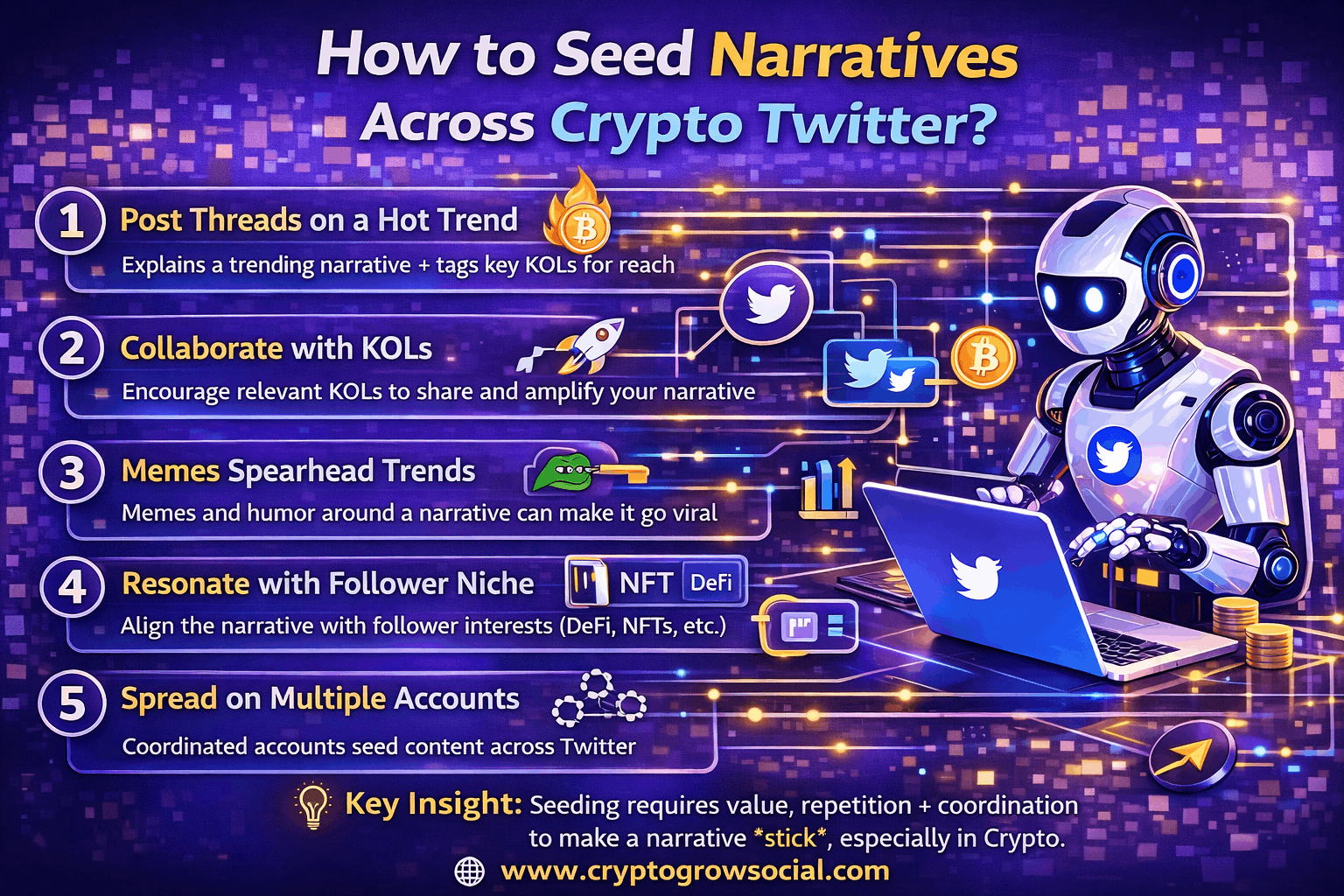
The real power of a crypto Twitter network is not its ability to post. It is its ability to shape what the market is talking about.
Most projects make the mistake of pushing their token or product first. That almost always fails, because no one buys solutions they do not yet believe they need. Crypto Twitter does not respond to advertising. It responds to stories about what is broken and what is coming next.
Narrative seeding follows a predictable sequence.
Start with the pain
Before a project can gain attention, the network must create awareness of a problem.
Accounts should begin by posting and replying about:
- Why current protocols are inefficient
- Why traders are frustrated with existing platforms
- Why capital is not flowing the way it used to
- Why some part of the ecosystem feels “stuck”
These are not sales messages. They are market observations. When dozens of accounts across different parts of Crypto Twitter start expressing the same frustration, it feels organic — because in many cases it actually is.
The goal is to make traders think:
“Yeah, that really is a problem.”
Once that belief exists, the market becomes open to change.
Introduce the emerging trend
After the problem is established, the network shifts to discussing what might replace it.
Now the conversation moves toward:
- New architectures
- New primitives
- New trading models
- New narratives like AI, modular blockchains, RWA, restaking, or on-chain social
This stage is critical. It gives people something to look toward, not just something to complain about. When Crypto Twitter begins to repeat the same themes about what is “next,” it creates a sense that a new wave is forming.
Traders start looking for early exposure.
That is where positioning happens.
Place your project inside the narrative
Only after the problem and the trend are established does your project appear.
Not as an ad.
Not as a pitch.
But as an example.
Accounts begin to mention your project in context:
- “This is why things like [your protocol] are starting to make sense.”
- “Projects building around this new model are probably going to outperform.”
- “I’ve been watching [your token] quietly gain traction in this narrative.”
Now your project does not feel like marketing. It feels like market discovery.
People do not resist it. They lean into it, because it fits a story they already believe.
Reinforce through distributed repetition
Narratives only become real when they are repeated by different people in different places.
This is where a network matters.
One account cannot create belief.
Ten accounts create noise.
A hundred accounts create a market signal.
When traders see the same idea echoed in:
- Reply threads
- Quote tweets
- Influencer discussions
- Trading conversations
…they begin to assume something is happening, even if they cannot yet explain it.
That assumption is what drives:
- Chart checks
- Telegram joins
- DEX trades
- Early accumulation
The network is not telling people to buy. It is telling them what everyone else is starting to notice.
That is how real crypto narratives are born.
How to Avoid Detection and Shadowbans?
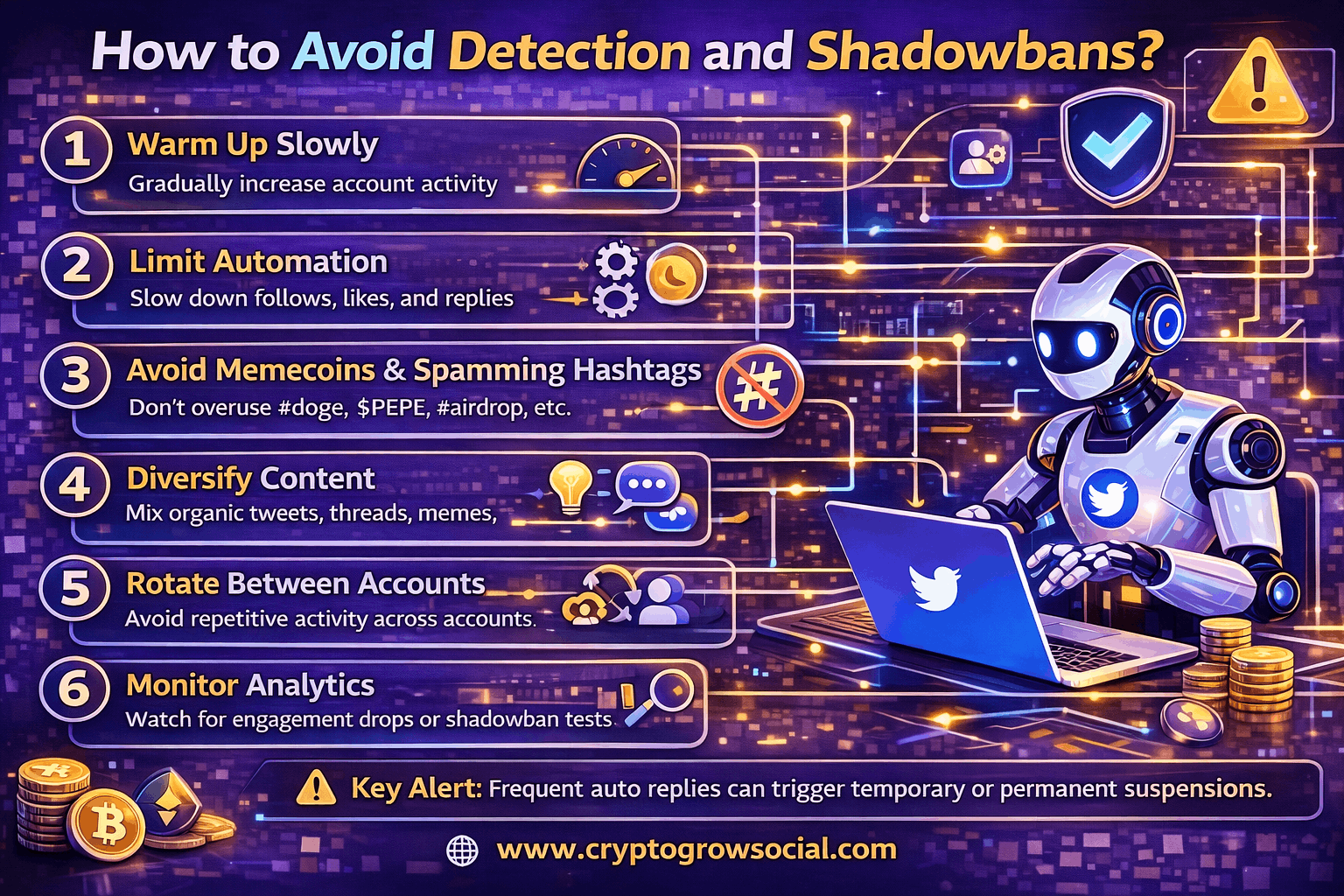
X does not police automation in the way most people think. It does not try to decide whether an account is human or a bot. What it actually detects are statistical patterns that do not exist in real human networks.
Humans are inconsistent.
They post at different times.
They use different words.
They change interests.
They disappear and come back.
Bad bot farms do the opposite. They behave too cleanly, too synchronized, and too predictable. That is what gets them suppressed.
The fastest way to get shadowbanned is to make multiple accounts:
- Post identical or near-identical text
- Engage at the same moments
- Reply with the same sentence structures
- Operate from related IP ranges
- Show no unrelated activity
From the algorithm’s point of view, that does not look like coordination. It looks like manipulation.
A professional network is designed around behavioral entropy — what we can think of as controlled randomness.
Some accounts should be highly active.
Some should barely post.
Some should focus on trading.
Some should argue in threads.
Some should disappear for days.
Even within the same campaign, not every account should participate. That variation is what makes the system believable to both the algorithm and human users.
Content must also vary. Instead of repeating the same talking point, accounts should express the same idea in different voices — sarcastic, analytical, casual, skeptical, enthusiastic. This creates the illusion of a real market debating something, not a machine promoting it.
Timing is just as important. Replies should appear minutes apart, not seconds. Quotes should arrive at unpredictable intervals. Engagement should feel asynchronous, not orchestrated.
The goal is not perfection.
The goal is realism.
When your network looks like a messy, living community instead of a synchronized army, it stops being visible to detection systems — and starts being rewarded by the algorithm.
That is what keeps narratives alive.
How Networks Drive Liquidity and Token Attention?
Crypto markets do not move because something is objectively good. They move because traders believe other traders are about to care.
This is the core engine behind every pump, every breakout, and every narrative cycle.
When a project begins to appear across Crypto Twitter — in trader replies, macro debates, meme accounts, and casual timeline chatter — it creates a very specific psychological effect: it looks like something is forming. No one sees the entire network, but everyone sees fragments of it, and those fragments add up to perceived momentum.
That perception changes behavior.
A trader who sees your token mentioned twice in one day ignores it.
A trader who sees it five times, in different contexts, from different accounts, starts to open the chart.
A trader who sees it ten times starts to assume other traders are already positioning.
This is how attention turns into speculation.
Once people start checking the chart, a second feedback loop begins. Some buy small “just in case.” That creates volume. Volume attracts scanners and bots. Scanners bring more traders. More traders bring more mentions. The network amplifies itself.
None of this happens because someone was told to buy.
It happens because the market believes a story is spreading.
This is why networks matter so much more than individual influencers or single viral tweets. One account can create a spike. A network creates continuity — the sense that your project is not a one-off mention but an emerging topic.
Liquidity follows continuity.
And because Crypto Twitter is where traders first encounter narratives, the teams that control distribution there are the teams that get first access to capital. The network does not purchase tokens itself. It does something more powerful: it convinces the market that everyone else is about to.
That is how attention becomes price.
The True Cost of Building a Crypto Twitter Farm
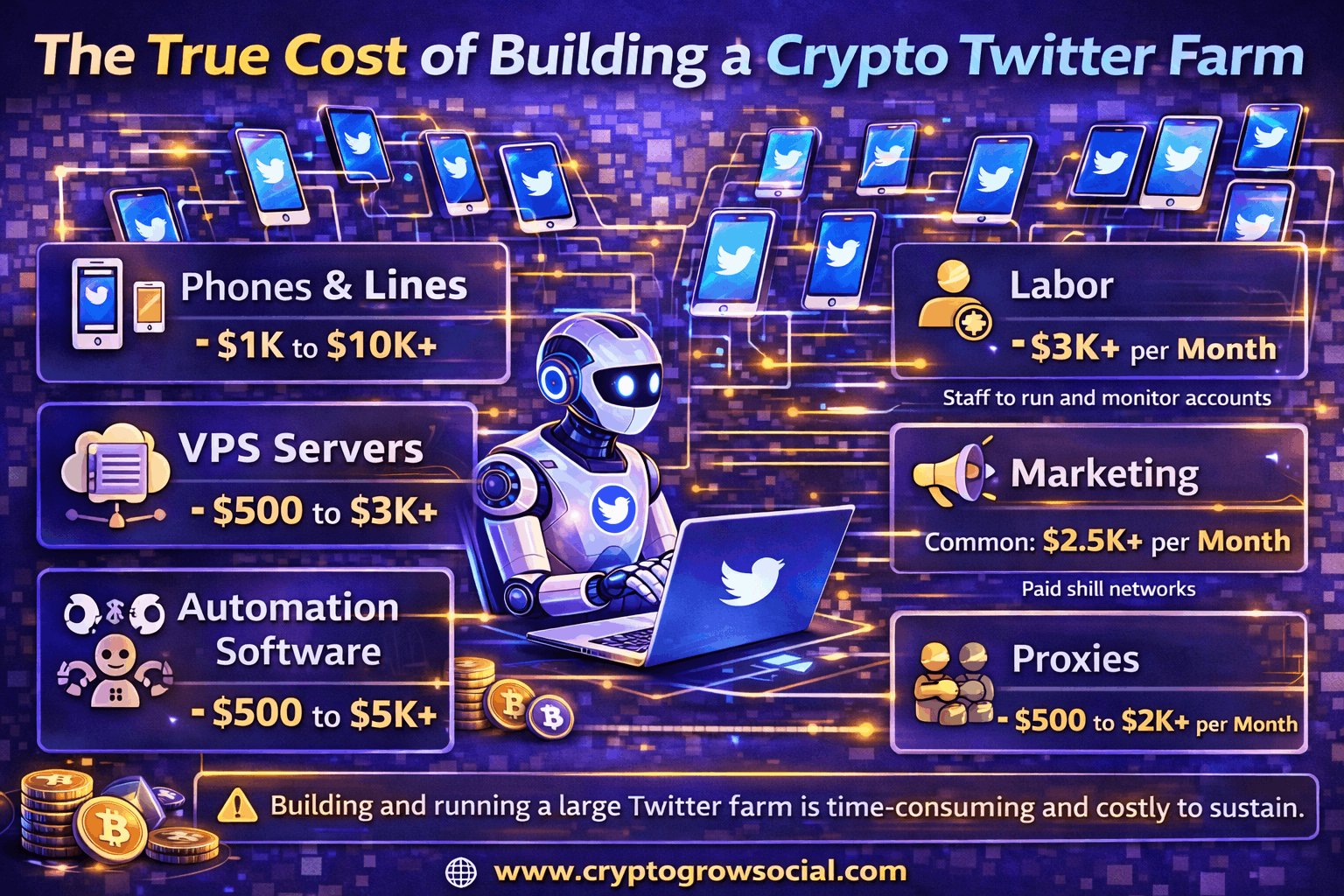
What most teams call a “Twitter farm” is usually a few bots and some aged accounts. What the market actually responds to is something very different: a living, breathing distribution network that behaves like a real community. Building that kind of system is far more expensive than most founders realize.
The first cost is accounts. You cannot use empty or freshly created profiles. Real farms require aged, phone-verified, active accounts that already follow crypto traders and participate in discussions. High-quality aged accounts cost real money, and they are disposable. They get locked, flagged, or burned over time and must be continuously replaced.
Then come proxies and infrastructure. Each account needs its own clean IP environment, often mobile or residential, with fingerprint isolation so accounts do not appear connected. These are not one-time costs — they are recurring monthly expenses, and the more accounts you run, the more you pay.
Next is software. To keep accounts alive and coordinated without triggering detection, you need automation platforms for posting, replying, warming, and engagement — plus monitoring tools to see what is being suppressed. None of this is free, and cheap tools get networks burned.
Then there is labor. Someone has to write prompts, adjust narratives, review logs, replace dead accounts, rotate proxies, and manage bans. Whether you hire operators or engineers, this becomes a permanent payroll expense. The moment you stop maintaining the system, it begins to decay.
Finally, there is attrition. Accounts die. IPs get flagged. Campaigns misfire. Networks must be constantly rebuilt. A professional-grade farm is not a one-time setup — it is an ongoing operational machine.
When all of this is added together, even a relatively small network of 50 well-run accounts easily costs thousands of dollars per month. Larger farms cost much more. And a single mistake — poor proxy hygiene, bad posting patterns, a failed warm-up cycle — can wipe out months of investment overnight.
That is the reality of building distribution from scratch.
Most teams do not fail because they do not try hard enough. They fail because they underestimate what real distribution actually costs.
Build vs Plug Into an Existing Network
In theory, building your own Crypto Twitter network sounds attractive. You control the accounts. You control the automation. You own the infrastructure. But in practice, this path only makes sense for a very small category of teams.
To build a real network, you need engineers who understand proxy infrastructure, browser fingerprinting, automation logic, and account health management. You need operators who can monitor bans, rotate assets, and constantly replace burned accounts. You also need time — not days, but months — because warming, testing, and stabilizing a network cannot be rushed without killing it.
Even when everything is done correctly, risk never disappears. Accounts die. Proxies get blocked. Software breaks. The Twitter algorithm changes. A single mistake can wipe out weeks of work. This means you are constantly paying not just with money, but with attention that could have been spent building your product, talking to investors, or growing your community.
For most crypto teams, this is not a good trade.
Plugging into an existing professional network solves all of these problems at once. The accounts are already aged. The proxies and fingerprints are already stable. The behavioral systems have already been tested against the algorithm. Instead of waiting 30 to 90 days for accounts to become usable, your narrative can start circulating immediately.
More importantly, you are not just buying accounts — you are buying access to an ecosystem. A real network already lives inside Crypto Twitter. It already follows traders. It already replies to influencers. It already appears in market threads. That means when your project enters that network, it does not start from zero. It starts from inside the conversation.
This is why, in practice, plugging into an existing Crypto Twitter network is not only faster and safer — it is also cheaper. You avoid the endless cycle of account replacement, software subscriptions, proxy costs, and engineering overhead. You pay for what actually matters: distribution.
In a market where attention moves faster than development cycles, the teams that win are not the ones that build everything themselves. They are the ones that deploy into working infrastructure and start shaping narratives immediately.
How CryptoGrowSocial Solves This?
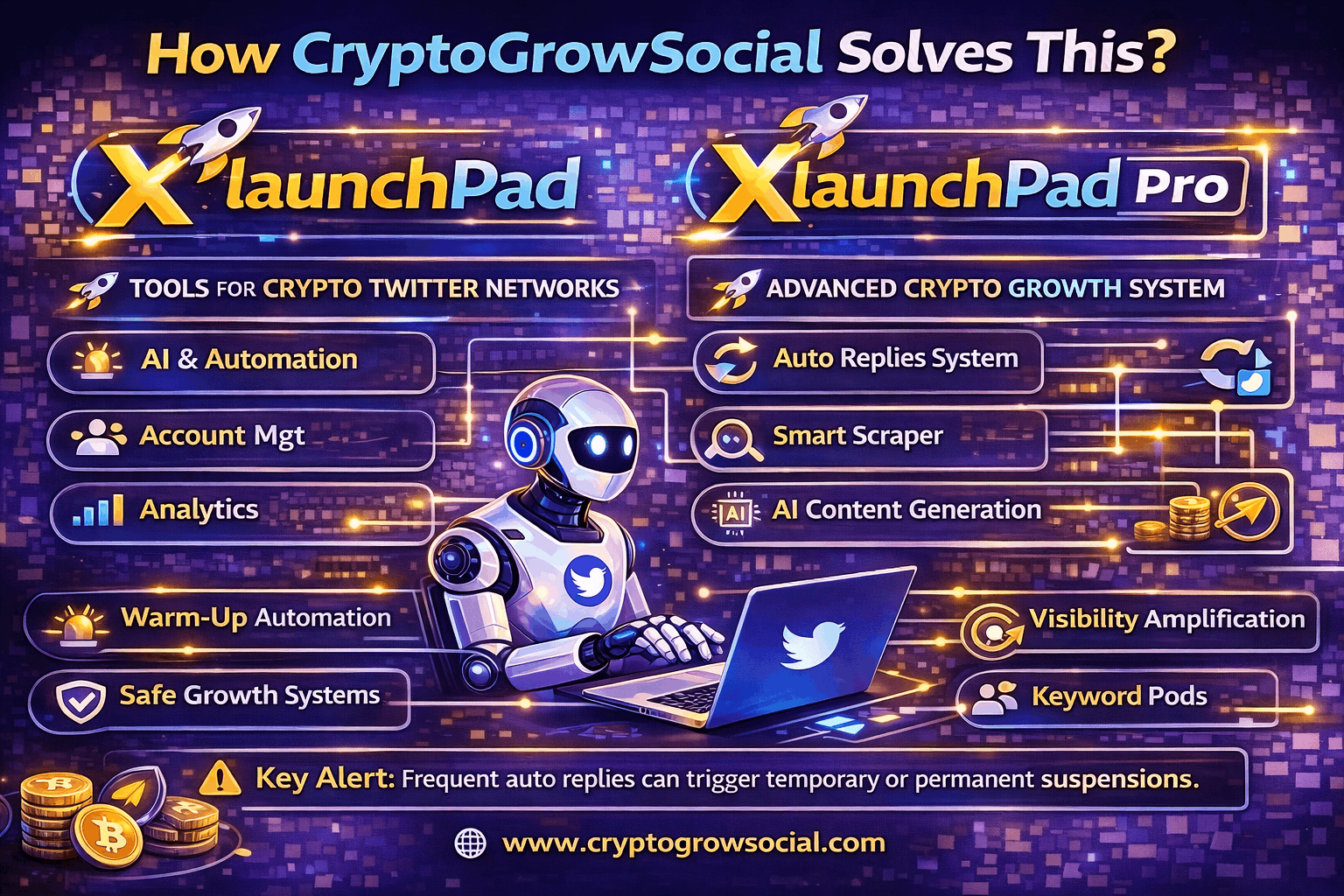
CryptoGrowSocial was built to eliminate the single biggest bottleneck in Crypto Twitter growth: distribution infrastructure.
Most teams fail not because their product is weak, but because their message never escapes their own account. Building a real Twitter network requires months of account aging, proxy management, behavioral tuning, and constant maintenance. During that time, narratives pass, competitors capture attention, and opportunities disappear.
CryptoGrowSocial removes that entire layer.
XLaunchPad — Instant Market Presence
XLaunchPad connects your project to an existing, professionally maintained Crypto Twitter network. These are not empty accounts or spam bots. They are aged profiles that already follow traders, interact with key influencers, and actively participate in market conversations.
When your founder posts a thread or your project introduces a new narrative, it does not sit in isolation. It is immediately picked up, echoed, and discussed across multiple corners of Crypto Twitter. Replies, quote tweets, and organic-looking engagement push your message into timelines where real investors and traders already pay attention.
You do not run accounts.
You do not manage proxies.
You do not warm anything.
You provide the story. The network ensures it spreads.
XLaunchPad Pro — Your Own Narrative Engine
For teams that want full control, XLaunchPad Pro delivers the same infrastructure — but in your hands.
Instead of renting access to a network, you receive the complete operational stack: warmed accounts, automation systems, behavioral models, and distribution logic. Your team can deploy narratives, support launches, and dominate discussions without waiting months to build credibility from zero.
This turns Twitter into a strategic asset rather than a marketing channel. When the market shifts or a new opportunity appears, you can push your project into that conversation immediately, with the same reach and stealth as established players.
Both systems exist for one reason: to give crypto teams what normally takes years to build — a functioning distribution layer inside Crypto Twitter.
Because in today’s market, the teams that control distribution do not just get noticed.
They define what the market believes.
Conclusion
Crypto Twitter is not just about posting content — it is about distribution power. Projects without networks struggle to be noticed, while projects with strong networks can amplify their message and shape the narrative around their token.
A well-built crypto Twitter network acts as a promotion engine. It allows projects to coordinate posts, boost visibility, and create momentum during launches, announcements, and marketing campaigns.
However, a network alone is not enough. Each account inside the network still needs to know how to grow a crypto Twitter account effectively in order to build real engagement and credibility.
When both elements work together — a strong network and strong individual accounts — crypto projects gain the reach and influence needed to stand out in a crowded market.
Related Guides:
- Setting Up a VPS Farm for Crypto Twitter Projects
- Best Proxy Providers for Crypto Twitter Farming (2026 List)
- Top Tools for Managing a Crypto Twitter Farm (Automation Stack)
- How to Automate Posting Across 100+ Crypto Twitter Accounts?
- How to Connect Multiple Twitter Accounts to One Dashboard?
- Best Practices for Multi-Account Engagement Without Detection
- Crypto Twitter System Architecture: Complete Setup Guide
- Scaling Your Twitter Network for Multiple Crypto Projects
- Security Measures for Protecting Large Crypto Twitter Networks