
Crypto Twitter has become the primary battlefield for attention, narratives, and capital. Every new token, protocol, and Web3 startup launches into the same crowded timeline, all competing for visibility inside an algorithm that only amplifies what people are actively talking about. In this environment, a single Twitter account — no matter how well managed — is not enough to create sustained momentum. The projects that dominate Crypto Twitter are not louder. They are wider. They appear everywhere at once, across trader threads, influencer replies, and ongoing market debates.
This is why serious crypto teams no longer rely on manual posting. They operate networks. Instead of pushing one account to go viral, they coordinate dozens or even hundreds of Twitter accounts to seed, repeat, and reinforce the same narrative. The result is not spam. It is algorithmic distribution. In this guide, you will learn how posting across 100+ crypto Twitter accounts actually works, what infrastructure it requires, how professional teams avoid shadowbans, and how modern crypto marketing has evolved into a network-driven discipline.
Why Crypto Projects Need Mass Account Automation?
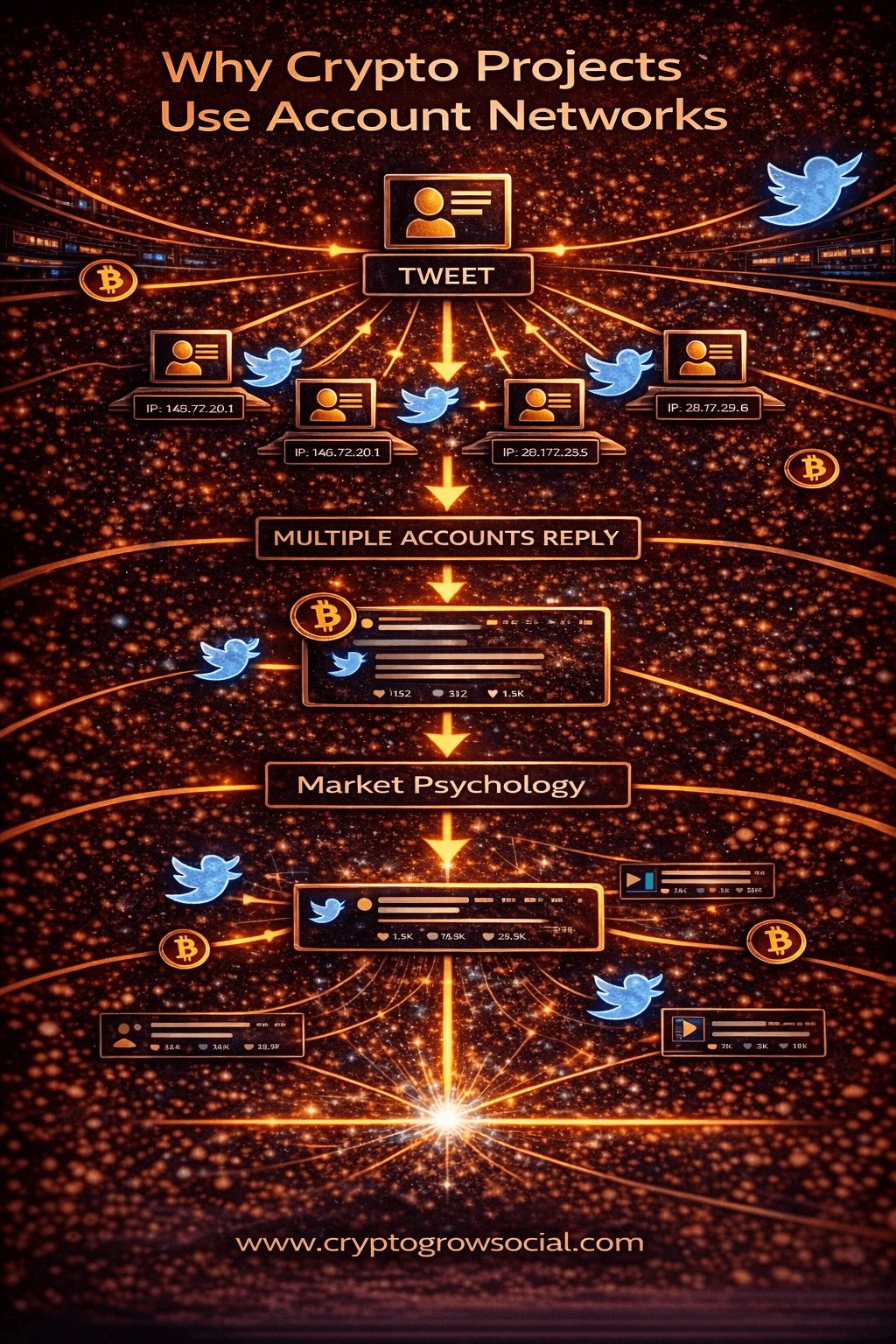
The biggest misconception in crypto marketing is that content wins. It does not. Distribution wins. You can write the best thread on Layer 2 scaling, AI agents, or DeFi composability, but if only a few hundred people see it, it might as well not exist.
The X (Twitter) algorithm rewards one thing above all else: conversation velocity. When multiple independent accounts reply, quote, and debate the same topic, the platform assumes something important is happening and expands reach. When only one account posts into silence, the algorithm treats it as low-interest content and cuts distribution.
Crypto projects need mass account automation for three strategic reasons.
First, algorithmic leverage. A network of 100 accounts can make one tweet look like the center of a market discussion. That forces X to push it into more timelines, where real traders encounter it.
Second, narrative dominance. Crypto is driven by stories: AI, restaking, L2s, modular blockchains, RWAs, memes. The teams that win are the ones whose project becomes attached to a narrative before everyone else. That only happens when your name appears repeatedly across unrelated conversations.
Third, market psychology. Traders do not buy what is best. They buy what they think others are about to notice. When your project keeps showing up in replies, quote tweets, and timeline chatter, it creates the feeling of momentum. That feeling turns into chart checks, speculation, and eventually liquidity.
One account cannot do this. One hundred coordinated accounts can.
How Twitter Allows Multi-Account Automation?
Running large numbers of Twitter accounts is not hacking or exploiting the platform. X was designed for agencies, brands, and large teams. It supports multi-account operation through an official system called OAuth and the Twitter API.
OAuth allows third-party platforms to connect to your Twitter accounts without needing your password. When you add an account to a dashboard like TweetDeck, Hootsuite, Sprout Social, or Buffer, you log into Twitter and approve access. The tool receives a token that lets it post, read, and interact on your behalf.
This is how professional social media teams run dozens or hundreds of accounts legally and safely. You can:
- Connect unlimited accounts
- Post from them centrally
- Revoke access anytime
- Keep passwords private
Twitter recognizes this activity as legitimate because it flows through approved infrastructure. For crypto teams, this is the foundation of scale. Without OAuth-based tools, managing 100 accounts would be impossible.
The Core Architecture of a 100+ Account System
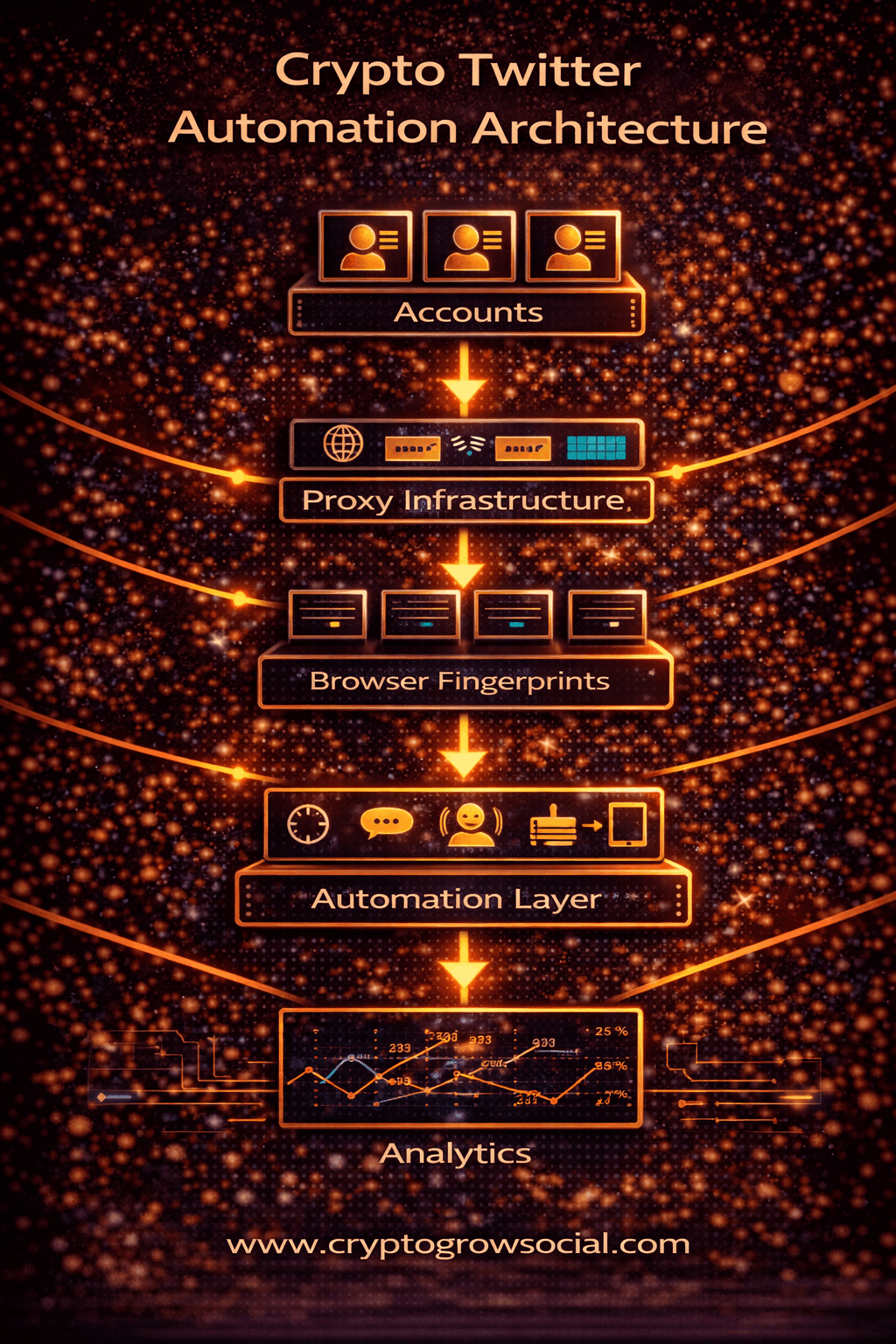
A real crypto Twitter automation system is not one tool. It is an ecosystem of layers working together to create believable, distributed activity.
The first layer is accounts. Each account must look real: profile, bio, history, followers, and posting behavior. Empty or freshly created accounts get no reach.
The second layer is proxies and IPs. Every account must operate from a unique residential or mobile IP so Twitter sees them as separate people.
The third layer is browser fingerprints. Tools like Multilogin or GoLogin ensure each account appears as a different device with unique fonts, screen sizes, and system profiles.
The fourth layer is the dashboard. This is where accounts are connected via OAuth and controlled centrally for posting and monitoring.
The fifth layer is automation. This includes scheduling engines, reply bots, engagement systems, and narrative scripts.
The final layer is analytics. Without measuring which narratives spread and which accounts generate discussion, the network cannot evolve.
Together, these layers turn Twitter into a programmable distribution machine.
Posting vs Distribution Automation
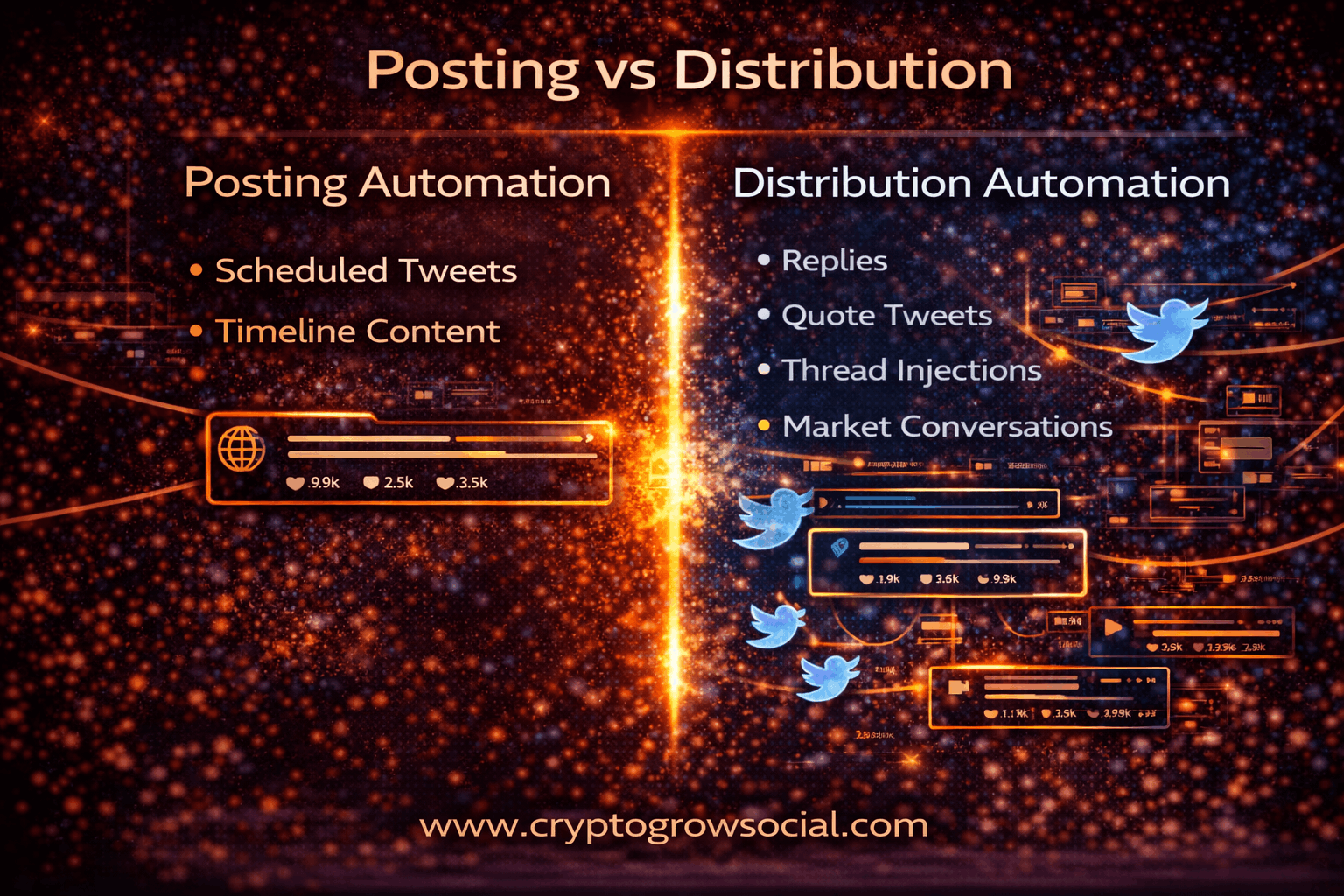
Most people think automation means scheduling tweets. That is only 10% of the picture.
Posting automation simply puts content on timelines. Distribution automation puts content into conversations.
Crypto Twitter is driven by replies, quotes, and debates. When a thread receives ten replies from ten different crypto accounts discussing the same idea, X interprets that as organic interest. When it receives one reply, nothing happens.
A professional network does not just schedule tweets. It:
- Injects accounts into trending threads
- Replies under influencer posts
- Quotes narratives with different angles
- Creates back-and-forth discussion
This is what creates algorithm lift. It is not about how often you post. It is about how often the market sees your idea inside real conversations.
Step-by-Step: How to Automate 100+ Twitter Accounts
Running more than a hundred Twitter accounts is not about “scheduling tweets.” At that scale, you are operating a distribution system that has to survive algorithmic scrutiny, maintain credibility, and move narratives across the platform without collapsing into detectable patterns. Each layer of the workflow exists to solve a different structural problem.
Account Preparation Is the Foundation of Everything
Before any automation is turned on, accounts must already look and behave like real people inside Crypto Twitter. The algorithm does not decide whether something is a bot — it decides whether something has behavioral credibility.
That credibility comes from history.
During the 30–45 day warm-up phase, each account must behave like a normal crypto user. That means:
- Following traders, founders, and analysts
- Liking and bookmarking posts
- Replying with short, casual reactions
- Retweeting market commentary
- Posting occasional neutral takes
Nothing should be promotional. Nothing should look coordinated. Some accounts should be more active than others. Some should disappear for days and come back. That randomness is what creates a believable digital identity.
An old account that suddenly starts shilling crypto is suspicious. A newer account that gradually becomes interested in crypto looks natural. The goal of warming is not to hide automation — it is to create a behavioral fingerprint that the algorithm trusts.
Without this phase, everything that comes later will be suppressed no matter how sophisticated the tooling is.
IP, Proxies, and Fingerprints Turn Accounts Into Real “People”
Twitter does not evaluate accounts in isolation. It clusters them based on technical signals. If fifty accounts share the same IP range, browser fingerprint, or login pattern, they become a single entity in the system’s eyes.
That is why every account must operate inside its own digital bubble.
A professional setup uses:
- Residential or mobile proxies so each account has a real-world IP
- Persistent IP assignments so accounts log in from the same region
- Browser fingerprinting so every account looks like a different device
- Isolated sessions so cookies and data never mix
This makes each account appear to be a unique human logging in from their own phone or laptop in their own city.
Cheap data-center proxies, shared browsers, or sloppy VPS setups destroy farms. Twitter does not ban bots — it bans clusters. Infrastructure exists to prevent clustering.
One Dashboard, Many Identities
Once accounts are warmed and technically isolated, they must be connected into a single command layer.
This is done through OAuth-based dashboards. These are the same systems used by agencies, brands, and media companies. Each account authorizes the platform to post and read on its behalf without sharing passwords.
Inside the dashboard, you can:
- Group accounts by persona (trader, NFT, DeFi, meme, etc.)
- Assign posting roles
- Monitor all mentions in one place
- Schedule content across many accounts at once
This is where a collection of individual Twitter profiles becomes an operational network.
You are no longer logging in and out of accounts manually. You are directing a system.
Content Pipelines Replace Ad-Style Promotion
At scale, content must be structured. You are not just tweeting — you are feeding a narrative machine.
Crypto networks typically run multiple content streams in parallel:
- Founder threads that introduce ideas
- Market commentary that connects to trends
- Memes that make narratives shareable
- Short reactions that keep accounts active
- Debate posts that invite replies
These are stored and organized so that automation can pull from them based on timing, persona, and context.
Instead of “posting about your project,” you are building a world of ideas that accounts can express from different angles.
That is what prevents the network from sounding robotic.
Posting Waves Create Distribution, Not Spam
One of the fastest ways to get suppressed is to have 50 accounts post at the same time. Humans do not behave that way.
Posting must be staggered across:
- Time zones
- Hours
- Account groups
- Content types
A proper wave might look like this:
One account posts a founder thread.
Twenty minutes later, two trader accounts reply.
An hour later, a meme account quotes it.
Later in the day, a DeFi account references the same idea in another conversation.
To the algorithm, this looks like a narrative spreading organically through the network. To humans, it feels like something people are starting to talk about.
That is distribution.
Engagement Logic Turns Tweets Into Conversations
Posting alone does not create reach. Engagement does.
Reply bots, quote bots, and interaction logic are designed to:
- Ask questions
- Disagree politely
- Add context
- Reference related trends
- Echo key ideas
This is what creates conversation depth, which is the strongest signal in the X algorithm.
A tweet with five likes and no replies dies.
A tweet with ten replies that lead to back-and-forth gets pushed.
Automation exists to start those conversations so that real users later join them.
Feedback Loops Decide What the Network Amplifies
Finally, everything must be measured at the narrative level, not the post level.
You are watching for:
- Which ideas get replies from real users
- Which threads are quoted organically
- Which topics lead to profile visits
- Which narratives start appearing outside your own network
When something starts to break out, the network shifts more energy toward it. More replies. More quotes. More mentions.
That is how a 100-account system becomes a self-reinforcing attention engine.
Tools Required for Running a Crypto Twitter Network
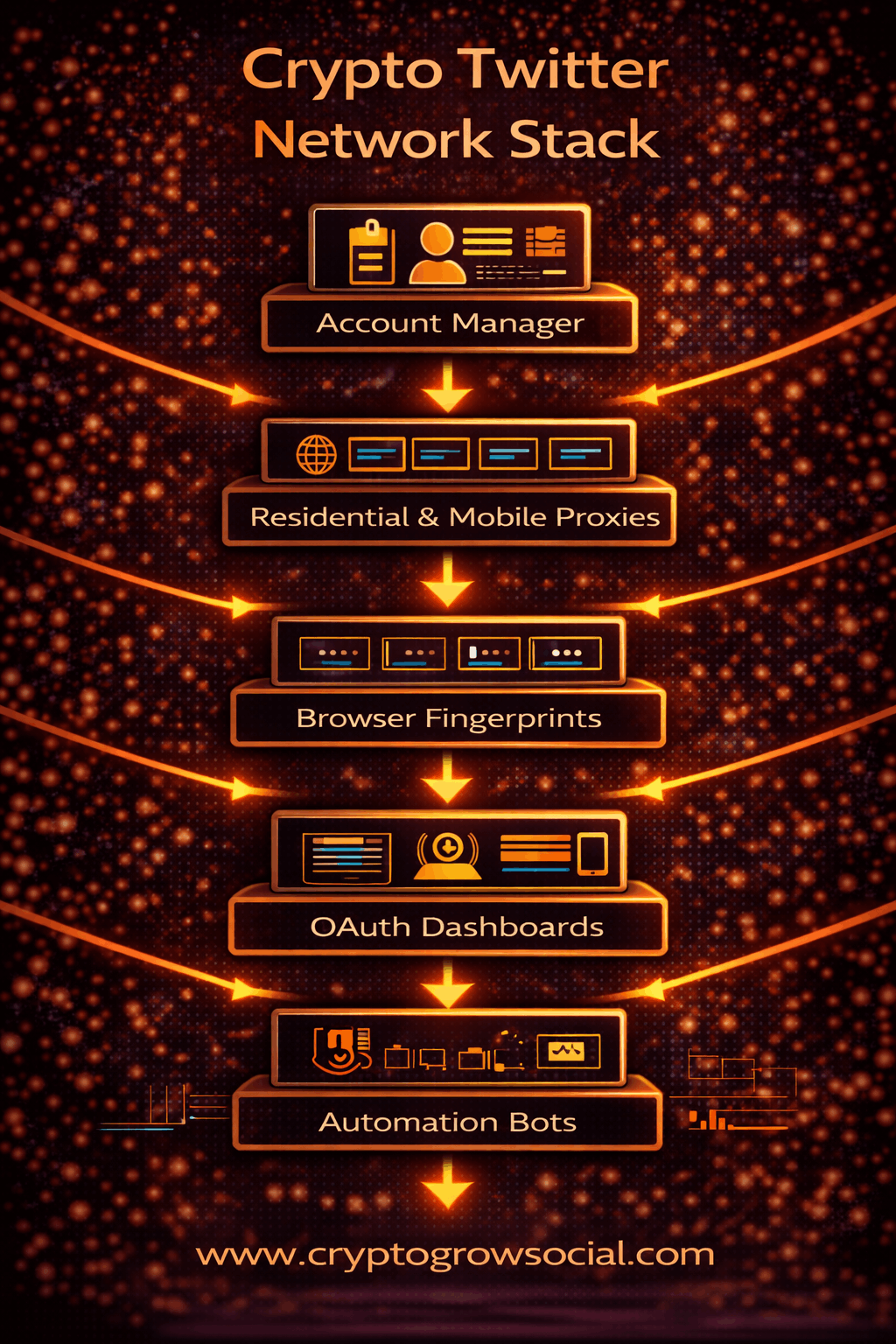
A crypto Twitter network is not a bot. It is a stack of systems that must behave like hundreds of independent humans while still being controlled as a single operation. Each tool in the stack exists because Twitter looks for a different kind of pattern. If any one layer is weak, the whole network collapses.
This is why most DIY farms do not fail because “Twitter is hard.” They fail because the stack is incomplete, misconfigured, or badly integrated.
Let’s break down what is actually required.
Account Management Systems
When you run 50, 100, or 300 Twitter accounts, you cannot rely on spreadsheets and browser bookmarks.
You need an account manager that tracks:
- Username and handle
- Email and phone
- Proxy assigned
- Fingerprint profile
- Creation date
- Warm-up status
- Strike or restriction history
Without this, you lose accounts simply by mislogging in, using the wrong IP, or forgetting which browser profile belongs to which account.
This layer exists to prevent human error, which is one of the largest causes of mass bans.
Residential & Mobile Proxies
Twitter does not care how clever your automation is if all your accounts appear to come from the same type of IP.
Residential and mobile proxies give your accounts:
- Real household IP addresses
- Mobile carrier identities
- Geographic consistency
These IPs are expensive and billed monthly. They also require rotation control so accounts don’t suddenly jump countries or networks.
Cheap data-center proxies are a death sentence. They are already flagged, heavily reused, and clustered by Twitter’s systems.
This layer is what makes your accounts look like they belong to real people in the real world.
Browser Fingerprinting Systems
Even if you have unique IPs, Twitter can still link accounts if they look like they are using the same device.
Fingerprinting tools create separate digital identities with different:
- Screen sizes
- Fonts
- GPUs
- OS versions
- Canvas signatures
- WebGL data
- Time zones
Each account lives inside its own fake “laptop” or “phone.”
Without this, your farm becomes a cluster — and clusters get wiped.
OAuth Dashboards for Control
Logging into accounts manually does not scale and creates security risk.
OAuth dashboards are the command center of the network. They allow you to:
- Add accounts without sharing passwords
- Post from any account
- Schedule content
- Read mentions and replies
- Assign accounts to team members
This is how agencies and brands manage hundreds of social profiles legitimately — and it is the only way to manage a large crypto network without chaos.
Automation & Engagement Systems
Posting is only the surface.
A real crypto network needs systems for:
- Auto-replies
- Quote tweet logic
- Thread amplification
- Narrative reinforcement
- Warm-up behavior
- Inactivity simulation
These bots do not just “spam.”
They create conversation structure — pushing tweets into threads, debates, and trending topics where real users will see them.
This is what turns tweets into algorithmic signals.
Narrative & Analytics Platforms
Finally, you need to know what is working.
At scale, you are not tracking likes — you are tracking:
- Which narratives spread
- Which topics pull real users
- Which posts cause profile visits
- Which ideas move into organic Crypto Twitter
Analytics tools show you which stories the market is responding to so the network can push those harder.
This is how farms evolve instead of stagnating.
Why DIY Farms Collapse?
Every one of these tools:
- Costs money
- Needs configuration
- Needs maintenance
- Breaks in different ways
- Proxies get burned.
- Fingerprints drift.
- Dashboards disconnect.
- Bots misfire.
- Accounts get restricted.
Most teams build 70% of the stack and think they’re done. Twitter only needs the other 30% to be missing to wipe everything.
That is why DIY farms feel cheap at the start and become incredibly expensive over time — not because posting is hard, but because keeping hundreds of digital humans alive is.
If you want, send me the next section you’re working on and I’ll help you expand it the same way.
How to Avoid Shadowbans When Running 100+ Accounts
Twitter does not moderate content first. It models behavior.
Every account on X is constantly scored based on how closely it resembles a real human. When you operate 100+ accounts, the danger is not that one account looks fake — it’s that many accounts start to look similar.
Similarity is what triggers shadowbans.
That is why “don’t spam” is useless advice. The real rule is: do not form a pattern.
Staggered Activity Cycles
Real people do not post on schedules.
Some wake up early.
Some scroll at night.
Some disappear for days.
A professional network divides accounts into behavioral clusters:
- High-activity traders
- Casual observers
- Meme posters
- Silent lurkers
- News repliers
Each group has different posting frequency, online times, and interaction depth.
When Twitter sees this mix, it sees a population, not a botnet.
Text and Intent Diversity
Shadowbans are not triggered by words.
They are triggered by repetition.
If 40 accounts say the same thing about your token, it looks like manipulation.
If 40 accounts say different things that imply the same idea, it looks like a movement.
Professional systems vary:
- Sentence length
- Vocabulary
- Tone
- Grammar
- Position in threads
Some accounts criticize.
Some ask questions.
Some joke.
Some defend.
This creates debate, which is what the algorithm rewards.
IP and Device Stability
Accounts must look like they belong to specific people.
That means:
- Same IP region every time
- Same device fingerprint
- Same behavior rhythms
Random IP hopping is more dangerous than no proxies at all.
Professional farms assign each account a digital home and never let it move.
Imperfect Behavior
Clean automation is deadly.
Real people:
- Forget to reply
- Miss days
- Post off-topic
- Scroll without interacting
So good farms simulate:
- Inactivity
- Missed actions
- Irrelevant posts
- Random gaps
This “noise” is what hides the signal. Shadowbans do not come from being aggressive. They come from being too perfect.
How Professional Crypto Teams Use Account Networks?
Large crypto teams do not use Twitter networks to “shill.”
They use them to control perception.
Markets do not move on fundamentals.
They move on what traders think other traders are about to care about.
Account networks are how that belief is manufactured.
1. Token Launches
When a token launches, speed matters more than size.
Networks:
- Fill influencer replies
- Push early chart screenshots
- Ask questions about the project
- Create FOMO before ads even start
By the time organic traders arrive, the token already feels “discovered.”
2. Narrative Warfare
Crypto is a story market.
Is L2 hot?
Is AI hot?
Is Solana back?
Is Ethereum dead?
Networks inject ideas into conversations until they start to echo.
Once traders see the same thesis from multiple accounts, they stop questioning it — and start trading it.
3. Trend Hijacking
When something trends, networks swarm it.
A trending topic is not about relevance — it’s about visibility.
Accounts jump into viral threads and slide their narrative into the flow of attention.
This is how tiny projects get seen by huge audiences without paying for ads.
4. Liquidity Bootstrapping
Networks do not buy tokens.
They create reasons for humans to buy.
They create:
- Chart curiosity
- Social proof
- Discussion volume
- Fear of missing out
That drives real traders to check, speculate, and trade — which creates real liquidity.
A crypto Twitter network is not a spam machine. It is a perception engine.
When built correctly, it makes your project feel inevitable — and inevitability is what markets trade on.
How CryptoGrowSocial Replaces This Entire Stack?
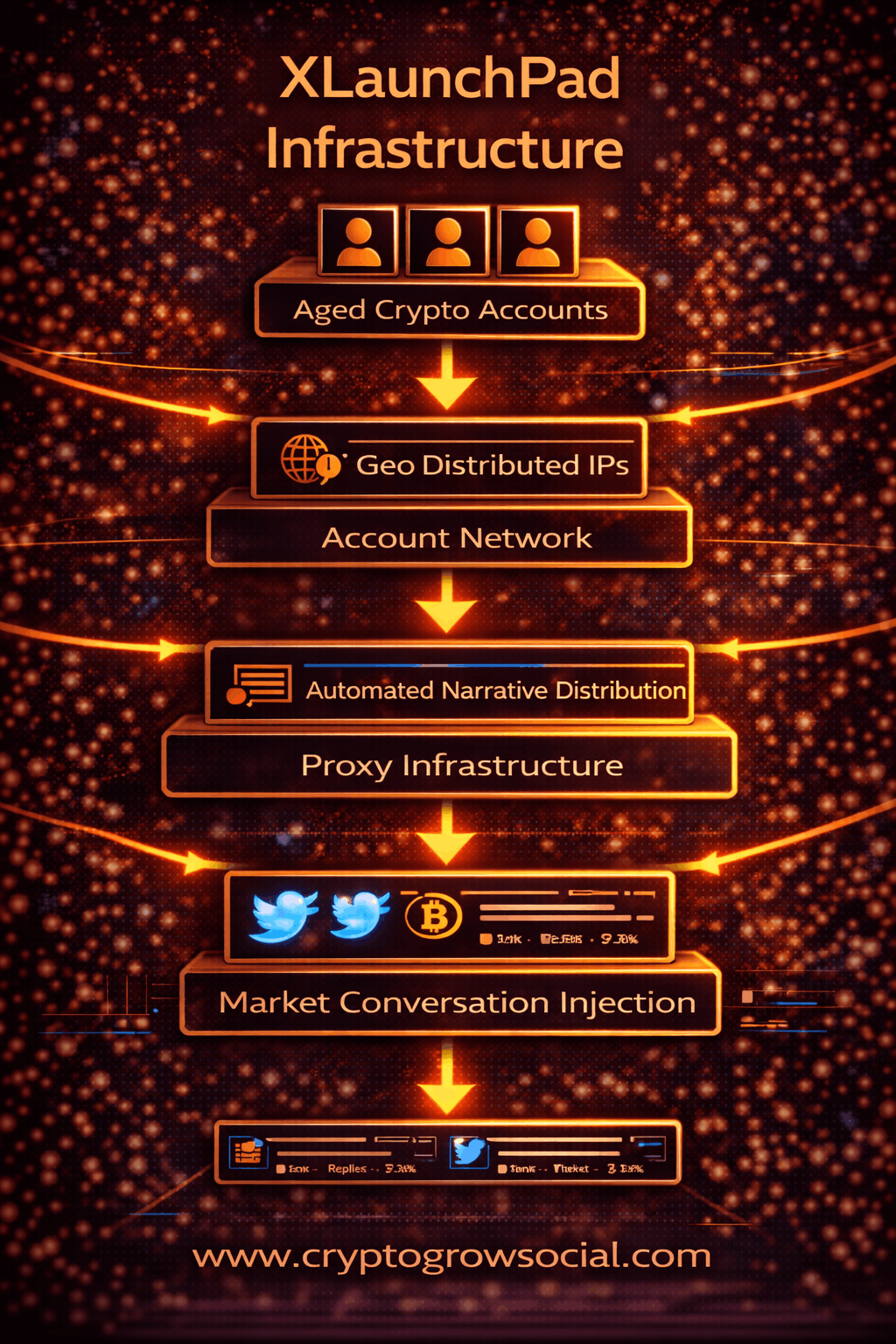
Building a real crypto Twitter network is not just about running scripts. It requires accounts, behavioral systems, infrastructure, stealth, content coordination, and constant maintenance. Each layer adds cost, complexity, and risk. One mistake can burn hundreds of accounts and months of work.
CryptoGrowSocial exists to remove all of that.
Instead of forcing crypto teams to become social-media engineers, CryptoGrowSocial provides Twitter distribution as a service — a ready-made attention engine built specifically for Web3 markets.
You do not assemble tools.
You do not warm accounts.
You do not fight bans.
You plug into a system that already works.
XLaunchPad — Managed Crypto Twitter Distribution
XLaunchPad is a fully managed narrative network.
Your project is inserted into a live ecosystem of aged, trusted crypto Twitter accounts that already operate inside:
- Trader timelines
- Influencer reply threads
- Market debates
- Token discussions
- Narrative clusters
These are not empty profiles.
These accounts already have history, followers, and algorithmic trust.
You do not touch accounts, proxies, fingerprints, or bots.
You only provide what you want the market to think about.
CryptoGrowSocial’s network handles:
- Where your narrative appears
- Which accounts introduce it
- How it spreads through replies and discussions
- How it is reinforced without repetition or detection
Your story is placed inside conversations that already have attention, which is where Twitter’s algorithm actually distributes reach.
This lets you go from zero to visible immediately — without waiting months for warming, testing, and failure.
XLaunchPad Pro — Your Own Professional-Grade Twitter Farm
XLaunchPad Pro is for teams that want full control.
Instead of renting access to a network, you receive an entire one that is already built, warmed, and optimized.
This includes:
- Aged crypto Twitter accounts
- Behavioral and warming systems
- Posting, reply, and engagement automation
- Proxy and fingerprint infrastructure
- Narrative distribution logic
In other words, everything it takes to run a professional-grade crypto Twitter operation — delivered ready to use.
You decide:
- What narratives to push
- When to activate the network
- How aggressively to scale
- Which campaigns to run
But you do not start from zero. You start with a working machine that normally takes years and massive capital to build.
Build vs Buy: Which Is Rational for Crypto Teams?
Choosing between building your own Twitter automation network and buying access to an existing one is not a technical decision. It is a strategic and financial decision. Most crypto teams frame it as “control vs cost,” but the real tradeoff is time-to-market vs infrastructure burden.
When you build your own system, you are not just building bots. You are building:
- Account acquisition pipelines
- Warming and aging workflows
- Proxy and fingerprint infrastructure
- Automation logic
- Detection-avoidance systems
- Replacement and recovery processes
- Monitoring and analytics
This is an engineering project, not a marketing task.
Who Building Actually Makes Sense For?
Building only makes sense if you are operating like a growth lab or a marketing-tech company, not a typical crypto project. You need:
1. Engineering capacity
Someone has to maintain VPS servers, proxy rotation, fingerprint browsers, API connections, and automation scripts. When something breaks — and it will — you need people who can fix it immediately.
2. Long time horizons
It takes 30–45 days just to warm accounts before they can even touch crypto. It takes months to refine behavior patterns that do not trigger suppression. If you need traction now (token launch, fundraise, narrative push), building will make you miss the window.
3. High tolerance for failure
Accounts die. Proxies get flagged. Tools stop working. Twitter changes detection rules. You will lose parts of your network constantly. That is not a bug — it is the cost of running underground infrastructure.
If you do not accept that some months you will lose thousands of dollars in accounts and have to rebuild, you should not be building.
Why Buying (Plugging Into a Network) Is Rational for Most Teams?
Most crypto teams are not growth-infrastructure companies. They are:
- Founders building protocols
- DAOs running ecosystems
- Token teams launching markets
- Funds promoting theses
For them, Twitter distribution is a means, not the business.
Plugging into an existing, professional network gives you three massive advantages:
1. You skip the dead time
No 30–45 day warming period. No waiting for accounts to mature. Your narrative starts moving today.
2. You avoid infrastructure risk
You do not care about proxies, IPs, fingerprints, or bans. That risk belongs to the network operator, not you.
3. You get immediate market presence
Instead of one account talking into the void, your project enters conversations that already have reach, trust, and attention.
This is the same logic behind using liquidity providers instead of running your own exchange, or using market makers instead of trading manually. You are buying positioning, not tools.
The Real Question Is Not Control – It Is Opportunity Cost
Yes, building gives you control.
But it also locks you into months of setup, constant maintenance, and technical debt.
Buying gives you less control — but it gives you speed, scale, and focus.
In crypto, narratives move faster than engineering cycles. By the time most DIY farms are ready, the narrative window they wanted to capture is already gone.
That is why in practice:
Teams that want to win markets buy distribution. Teams that want to build tools build infrastructure.
Most crypto teams should not confuse those two goals.
How to Get Market-Level Distribution Without Building Infrastructure?
By 2026, competing on Crypto Twitter is no longer about who writes the best threads or posts the most frequently. The platform has matured into a fully developed attention market, where narratives spread not because they are good, but because they are distributed through networks that already sit inside trader timelines, influencer replies, and ongoing market conversations. Without access to those networks, even the strongest projects are functionally invisible, no matter how well they communicate.
This is the structural problem most crypto teams face. Building real distribution requires aged accounts, behavioral history, proxy and fingerprint infrastructure, automation systems, and months of careful warm-up. Every one of those layers is expensive, fragile, and easy to get wrong. Even teams with engineering talent quickly discover that running a functional Twitter farm is not a side project; it is an entire operational discipline with constant maintenance, replacement, and risk management.
CryptoGrowSocial was created to remove that burden. Instead of forcing projects to assemble and operate their own distribution machinery, it provides direct access to working attention networks that already exist inside Crypto Twitter. Whether a team wants managed reach or full control, the goal is the same: to place their narrative where the market is already looking, without having to build the machinery that makes that placement possible.
For teams that want immediate exposure without operational complexity, CryptoGrowSocial provides managed distribution through its existing crypto-native account ecosystem, where narratives can be injected directly into threads, replies, and discussions that traders are already reading. For teams that want long-term strategic control, CryptoGrowSocial also provides full ownership of professionally built infrastructure that allows them to operate their own narrative engine without starting from zero. These are not shortcuts; they are replacements for years of technical and operational work that most teams will never realistically complete on their own.
In both cases, what projects are really gaining is not software or bots, but access to market-level distribution. They gain the ability to appear repeatedly, naturally, and credibly inside the conversations that shape sentiment, liquidity, and valuation. In an attention-driven market like crypto, that capability is what separates projects that struggle to be noticed from those that become impossible to ignore.
Conclusion
Crypto Twitter has evolved into a competitive attention marketplace where visibility is no longer created by individual effort, but by coordinated narrative infrastructure. Projects that rely on organic posting alone are competing against networks that have been engineered to dominate timelines, replies, and discussions at scale.
This is exactly why solutions like XLaunchPad and XLaunchPad Pro exist. For teams that need instant access to live distribution, XLaunchPad provides immediate placement inside existing crypto conversation networks. For teams that want long-term control and ownership, XLaunchPad Pro delivers a fully built narrative engine that replaces years of infrastructure work with a single, operational system.