
Crypto Twitter has become one of the most competitive attention markets in the entire digital economy. Every day, thousands of new tokens, protocols, and founders launch into the same algorithmic arena, all trying to capture visibility inside a platform that rewards velocity, repetition, and conversation rather than just quality. In this environment, running a single Twitter account, no matter how good the content is, almost always results in being ignored by the wider market.
As a result, professional crypto teams no longer think in terms of “accounts.” They think in terms of networks. These networks are powered by infrastructure that allows dozens or hundreds of accounts to operate at the same time without being linked, detected, or suppressed by X (Twitter). At the heart of that infrastructure sits one critical component: the VPS farm.
This guide explains how VPS farms work, why they are essential for crypto Twitter growth, how to build them properly, and why most teams either fail or burn massive amounts of capital trying to maintain them.
What a VPS Farm Actually Means in Crypto Twitter?
A VPS, or virtual private server, is a cloud-based machine that behaves like a physical computer. It has its own operating system, network interface, memory, and hardware profile. To Twitter, a VPS looks exactly like a real laptop or desktop being used by a real person in a real location.
A VPS farm is simply a collection of these machines operating together.
In crypto Twitter marketing, VPS farms are used to run large numbers of Twitter accounts, automation systems, browser fingerprints, and proxy connections without allowing Twitter to link those accounts together. Each VPS acts as a separate digital identity hub, meaning that the accounts running on one VPS appear to be controlled by completely different humans than the accounts on any other VPS.
This separation is everything.
Twitter does not only track IP addresses. It tracks browser fingerprints, operating systems, login behavior, timing patterns, and hardware-level signals. If multiple accounts appear to be controlled from the same device, even if they use different proxies, they are clustered and suppressed. A VPS farm breaks this clustering by giving each group of accounts a different machine, different environment, and different digital fingerprint.
This is how professional crypto networks survive while amateur farms get wiped out.
Why Crypto Twitter Networks Cannot Run on a Single Machine?
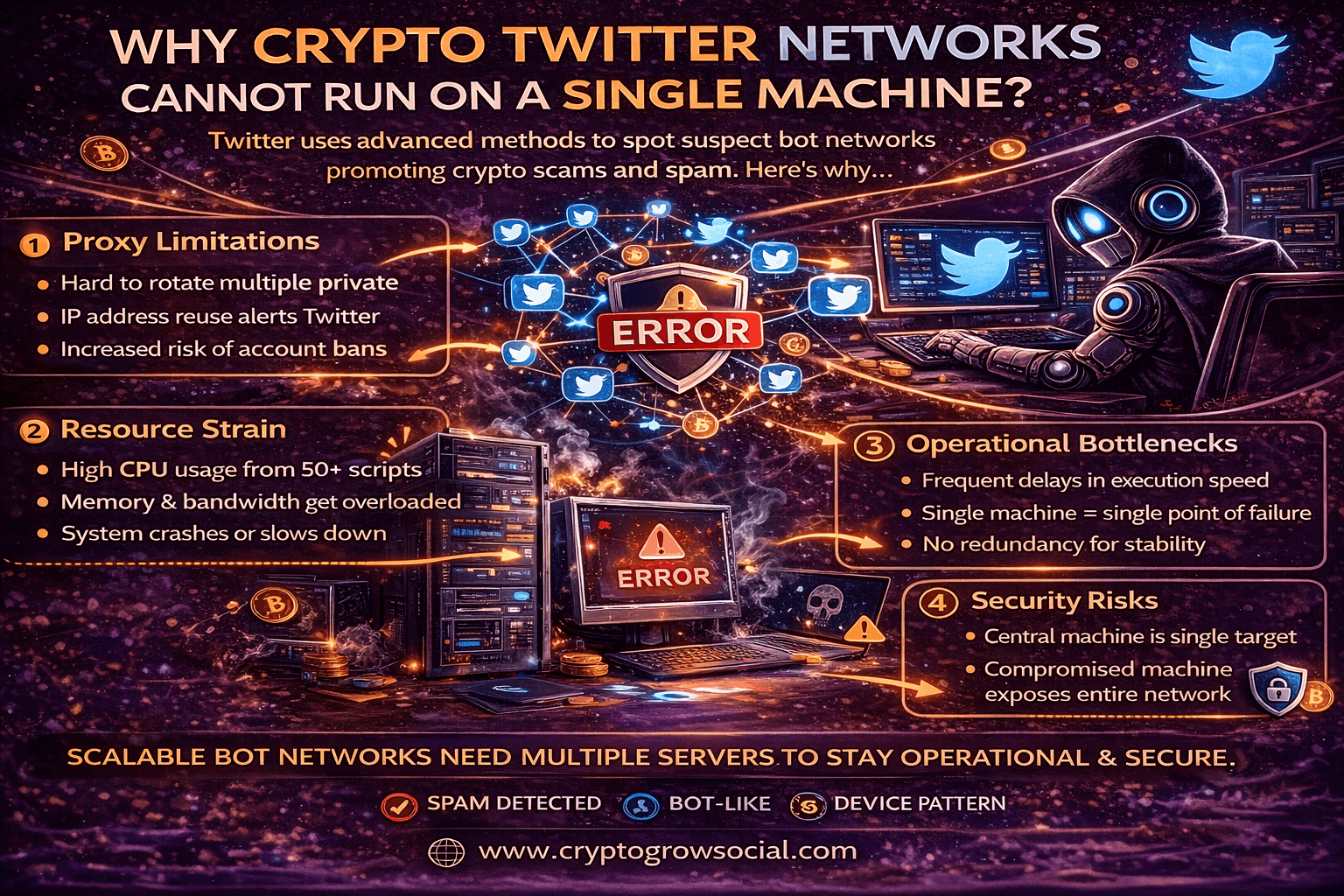
Most beginners try to operate multiple Twitter accounts from one computer. They might use different browsers, incognito windows, or even simple virtual machines. None of this works for long.
Twitter’s detection systems are designed to identify shared infrastructure. Even if you use ten different proxies, if all of those accounts connect from the same hardware fingerprint, they are still seen as one operator. The system can see shared screen resolutions, graphics drivers, font libraries, operating system builds, and even subtle timing patterns that humans cannot perceive.
This is why proxy-only setups fail.
A VPS farm solves this by giving each group of accounts its own digital body. Instead of one computer pretending to be many users, you have many computers each acting like one user. When Twitter analyzes the network, it sees hundreds of independent devices spread across different environments, not one coordinated operation.
This is not a trick. This is simply how large-scale social networks are run.
Core Infrastructure Inside a Crypto Twitter VPS Farm
A real VPS farm is not just a pile of servers. It is a layered system designed to mimic the structure of a real social network.
At the base are the VPS nodes themselves. Each VPS is a separate Linux or Windows machine hosted in a data center. Professional farms typically run anywhere from ten to several hundred of these machines, depending on scale. Smaller operations might host five to ten accounts per VPS, while high-risk networks may limit it to one or two.
On top of that sit residential or mobile proxies. These give each Twitter account a real-world IP address, often from home or cellular networks. Data center IPs are cheap, but they are heavily flagged. Real crypto farms use residential or mobile proxies so each account looks like it belongs to a person browsing from a real location.
Next comes browser fingerprinting. Each account needs a unique digital device. This includes fonts, screen size, time zone, WebGL data, audio stack, and dozens of other signals. Fingerprinting tools create isolated browser profiles so that even two accounts on the same VPS look like they are being run from different laptops or phones.
Finally, automation and control systems sit on top. These are the bots and scripts that log in, read timelines, post tweets, reply to threads, and engage with other users. The VPS farm does not create content. It executes behavior.
Together, these layers create something far more powerful than simple automation. They create the illusion of a distributed human community.
How VPS Farms Enable Narrative Control?
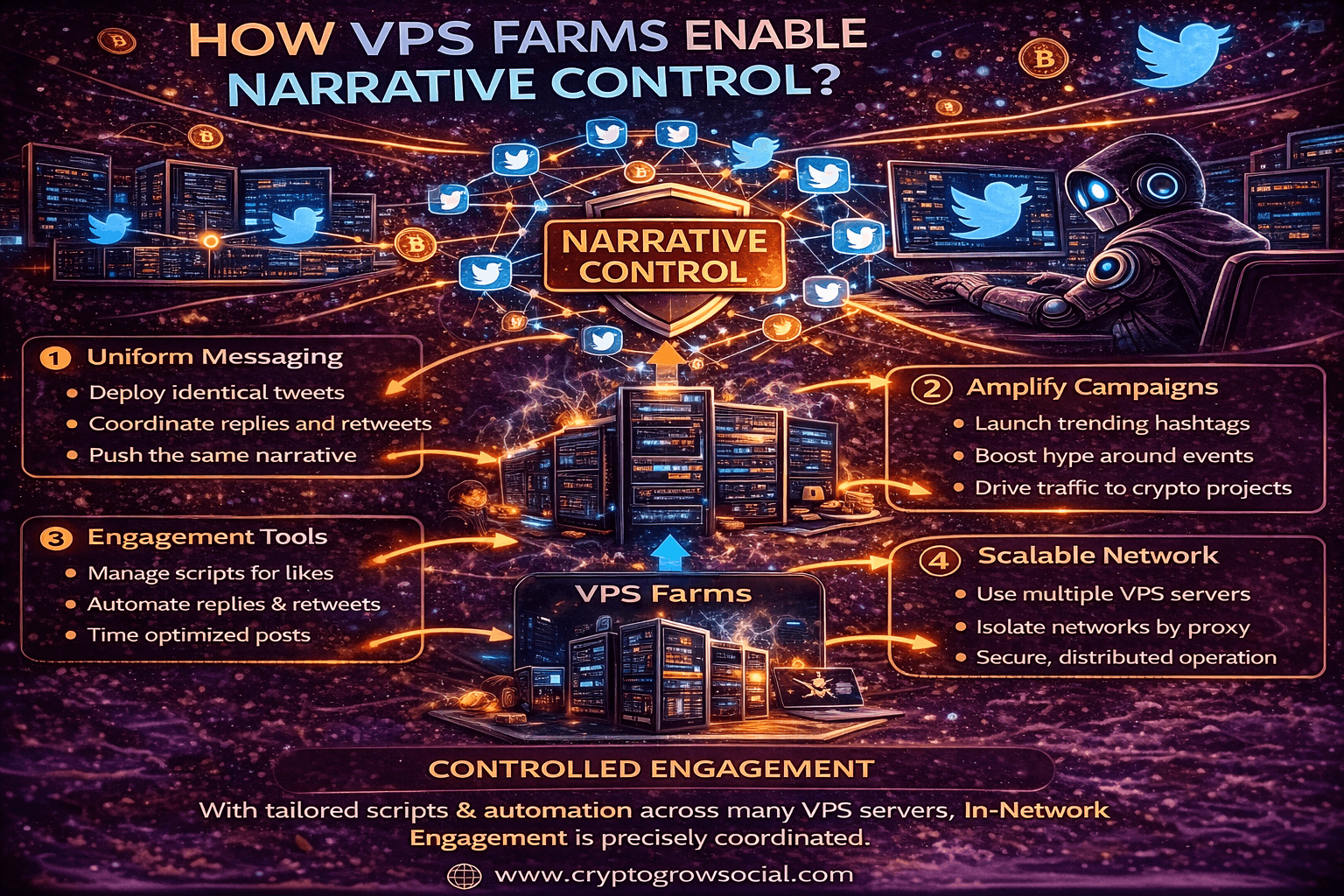
Crypto Twitter is not about who posts the best content. It is about who controls the conversation.
The algorithm pushes tweets that generate replies, quote tweets, and long discussion threads. That means if ten different accounts reply to the same idea from different angles, Twitter assumes something important is happening and distributes it further.
A VPS farm allows this to be done at scale.
When a founder posts a thread, dozens of network accounts can engage with it from different machines, IPs, and personas. One account might agree. Another might challenge. A third might add context. A fourth might quote it into a different narrative. To Twitter, this looks exactly like a real market waking up around a topic.
This is how narratives are born.
Without a VPS farm, all of this activity would be clustered and suppressed. With one, it spreads like wildfire.
Scaling From Ten Accounts to Hundreds
One of the most important advantages of a VPS farm is horizontal scaling. Instead of increasing risk on a single machine, you simply add more machines.
If you run ten accounts on one VPS and that VPS is flagged, all ten accounts die. If you run two accounts on five VPS, and one VPS is flagged, only two accounts are lost.
Professional farms are designed so that failure is localized, not catastrophic.
As your operation grows, you simply add more VPS nodes, each with its own proxy pool and fingerprint stack. This creates a modular network where pieces can fail without collapsing the whole system.
This is exactly how professional crypto Twitter networks survive long term.
Why Proxies Alone Are Not Enough?
Many teams think they can skip VPS farms by using proxies on their own machines. This is a fatal mistake.
A proxy only changes your IP address. It does not change your device. Twitter can still see that all of your accounts are coming from the same browser, the same operating system, the same graphics driver, and the same hardware fingerprint.
A VPS changes all of that.
It gives each group of accounts a completely different digital body. That is why farms built on VPS infrastructure survive while proxy-only farms get wiped out.
Common Failures in DIY VPS Farms
Most DIY VPS farms do not fail because the concept is flawed. They fail because the execution is amateur.
Running a crypto Twitter farm is not about spinning up servers — it is about controlling correlation. Twitter does not look for “bots.” It looks for networks of accounts that behave, connect, and move in ways that reveal they are operated by the same entity.
The most common mistakes include:
Overloading VPS nodes
Many teams run 20, 50, or even 100 accounts on a single VPS. This creates identical device fingerprints, OS profiles, and behavioral signatures. To Twitter, this looks like one person running dozens of accounts — an instant red flag.
Using cheap, flagged data center IPs
Data center proxies are cheap for a reason. They are heavily abused and already marked as automation infrastructure. When dozens of crypto accounts appear from the same hosting provider, suppression happens even if the content looks natural.
Skipping fingerprint isolation
Without proper browser and device fingerprinting, every account shares the same fonts, screen resolution, WebGL profile, and system entropy. Twitter links them together silently, even if the IPs are different.
Synchronized bot schedules
Many DIY farms use basic cron jobs or simple automation tools that fire at predictable times. Accounts wake up together, post together, reply together, and sleep together. That timing alone is enough to expose the network.
Manual logins from home or office IPs
One of the fastest ways to destroy a farm is logging into multiple VPS-hosted accounts from the same residential IP. This immediately connects every account to the same operator, collapsing the entire cluster.
None of these mistakes look dramatic in isolation.
But together they create exactly what Twitter is built to detect: clusters.
Twitter does not ban bots. It bans networks that behave like a single entity.
When a DIY VPS farm is sloppy, all accounts become statistically connected — and once that happens, suppression, shadowbans, and mass locks are inevitable.
A professional farm is not defined by how many servers it has. It is defined by how well it hides the fact that those servers are connected at all.
How CryptoGrowSocial Replaces the Entire VPS Farm Layer?
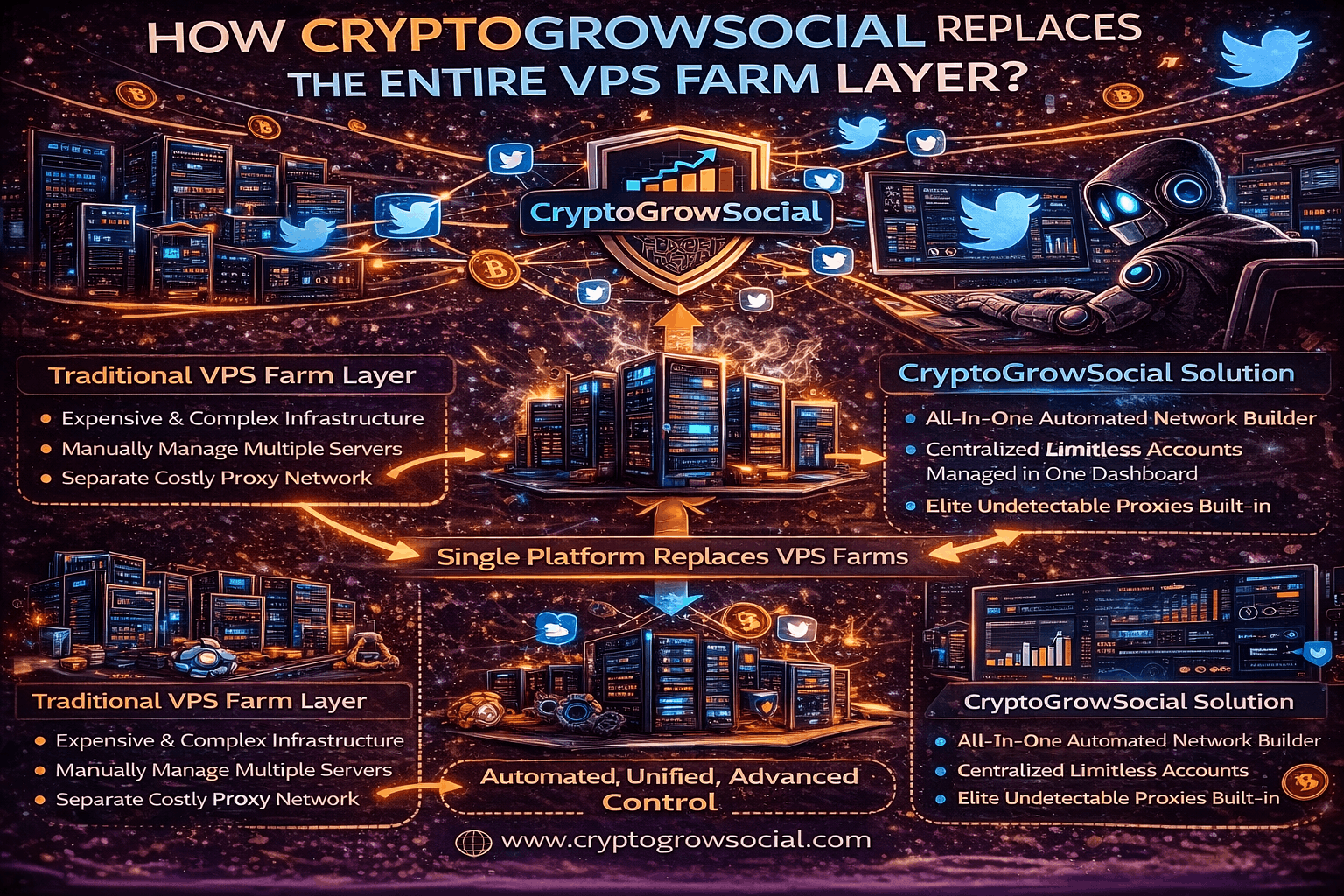
Building a VPS farm in-house is one of the most expensive and failure-prone things a crypto team can attempt. You are not just renting servers — you are trying to recreate an invisible infrastructure layer that large crypto growth desks have spent years perfecting.
To do it properly, you need:
- Dozens or hundreds of VPS nodes
- Residential and mobile proxy pools
- Browser fingerprinting systems
- Account aging and warming workflows
- Automation and orchestration software
- Full-time operators to monitor bans, locks, and failures
And even after all of that, most DIY farms still collapse because Twitter detects subtle behavior patterns, infrastructure overlap, or account correlations that no single tool can fix.
This is the problem CryptoGrowSocial was built to solve.
Instead of forcing crypto teams to become infrastructure engineers, CryptoGrowSocial gives them something much more valuable: a working Twitter distribution layer that already exists.
XLaunchPad — Managed Distribution Without Infrastructure

XLaunchPad is designed for teams that want results, not complexity.
When you use XLaunchPad, you are not renting servers or running bots. You are plugging your project into a live, aged crypto Twitter ecosystem that is already active inside the parts of Twitter that move markets: trader threads, macro debates, alpha accounts, and community conversations.
Behind the scenes, this ecosystem runs on:
- Professionally managed VPS clusters
- Long-aged, high-trust crypto accounts
- Residential and mobile IP infrastructure
- Advanced fingerprint isolation
- Narrative-driven engagement systems
But you never touch any of that.
You do not create accounts.
You do not warm them.
You do not manage proxies.
You do not fight bans.
You give CryptoGrowSocial your narrative — your positioning, your story, your key themes — and the XLaunchPad network places that narrative inside real Crypto Twitter conversations in a way that looks organic, distributed, and market-driven.
When your founder posts a thread, the network engages it from different angles.
When traders debate a sector your project fits into, the network surfaces your name in the replies.
When narratives begin to trend, your project appears naturally inside them.
To the algorithm, this looks like organic market interest.
To human users, it looks like your project is everywhere.
That is what replaces a VPS farm: you no longer need to build distribution when you can plug into it.
XLaunchPad Pro — Your Own Professional-Grade Farm
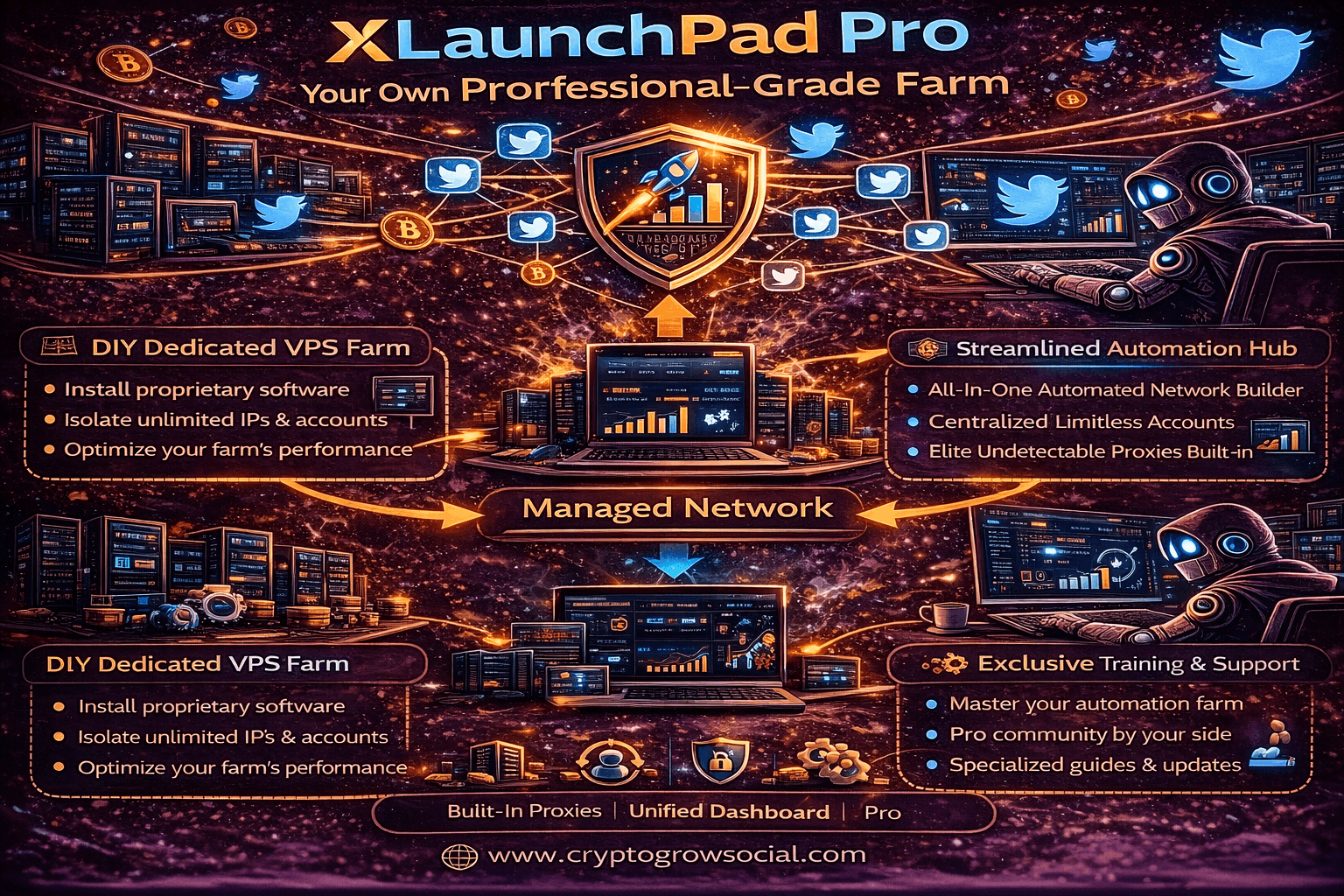
XLaunchPad Pro is for teams that want control, ownership, and long-term leverage.
Instead of renting access to a managed network, you receive the same type of infrastructure that elite crypto growth desks operate internally — but without spending years or millions to build it.
With XLaunchPad Pro, you get:
- Fully warmed, aged crypto Twitter accounts
- VPS-based account hosting environments
- Proxy and fingerprint infrastructure
- Automation layers for posting, replying, and engagement
- Narrative deployment systems
- Behavioral controls to avoid clustering and detection
In other words, you are not getting “bots.”
You are getting a complete Twitter distribution engine.
This allows your team to:
- Deploy new narratives whenever the market shifts
- Launch token campaigns without warming delays
- Counter competitors in real time
- Scale attention across dozens or hundreds of accounts
- Own your growth instead of renting it
What takes most teams years of trial, bans, and burned capital, XLaunchPad Pro delivers in a ready-to-run system.
The difference between building a VPS farm yourself and using CryptoGrowSocial is the same as the difference between building your own data center and using AWS.
Yes, you could build it. But you would waste time, money, and opportunity doing so.
CryptoGrowSocial gives crypto teams what they actually need: immediate, reliable, narrative-level distribution on Crypto Twitter — without the technical debt, operational risk, or constant infrastructure failure.
You are not buying bots. You are buying a functioning attention network. And in crypto, attention is what turns projects into markets.
Conclusion
A VPS farm is the invisible backbone behind every serious Crypto Twitter operation. It is what allows automation to look human, what allows networks to survive, and what turns isolated tweets into market-wide narratives. Without it, crypto Twitter marketing is guesswork. With it, distribution becomes predictable.
But building this infrastructure yourself is expensive and dangerous. Most teams burn time, money, and accounts trying to do it.
That is why CryptoGrowSocial exists: to give crypto projects access to professional-grade Twitter distribution without forcing them to become infrastructure companies.
In a market where attention decides valuation, the teams that control their distribution layer are the ones that win.