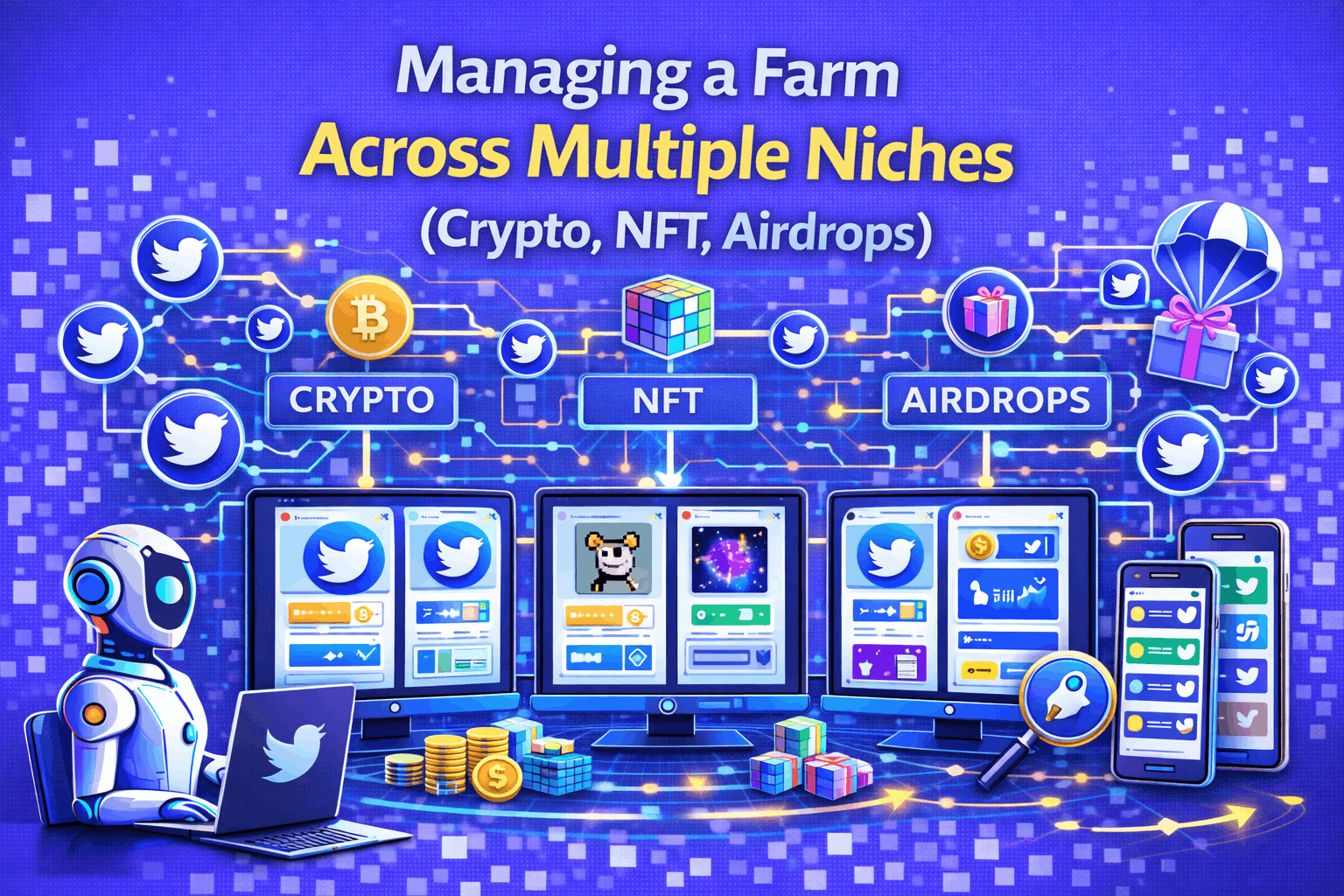
This guide explains how to manage a multi-niche Twitter farm across Crypto, NFTs, and Airdrop communities in a way that preserves algorithmic trust while maximizing market-level reach. As X (formerly Twitter) becomes the primary battlefield for crypto attention, projects can no longer rely on a single account or a single audience. Crypto traders, NFT collectors, and airdrop hunters behave differently, engage with different content, and live inside separate algorithmic bubbles.
This article shows how professional farms structure, segment, and operate networks across these niches to drive narrative dominance, engagement, and liquidity without triggering suppression or dilution.
Why Running One Generic Twitter Farm No Longer Works?
In the early days of Crypto Twitter, it was possible to run a single network of accounts that posted broadly about crypto and still achieve decent reach across the ecosystem. That era is now over. The X algorithm has evolved into a highly sophisticated interest-graph system that categorizes users, accounts, and conversations into tightly defined topical clusters. Accounts that post about too many unrelated subjects are no longer rewarded with wide distribution; instead, they are penalized with reduced visibility because the algorithm cannot clearly determine who should see their content.
Crypto traders, NFT collectors, and airdrop farmers do not behave the same way, consume the same content, or engage for the same reasons. When a single account mixes chart analysis, NFT art drops, and airdrop links, it signals confusion to both the algorithm and human readers. This reduces topical authority, weakens engagement metrics, and ultimately causes the account to fall out of relevant recommendation loops. A generic farm that treats all niches the same becomes algorithmically invisible, even if it is technically large.
Understanding the Three Core Niches
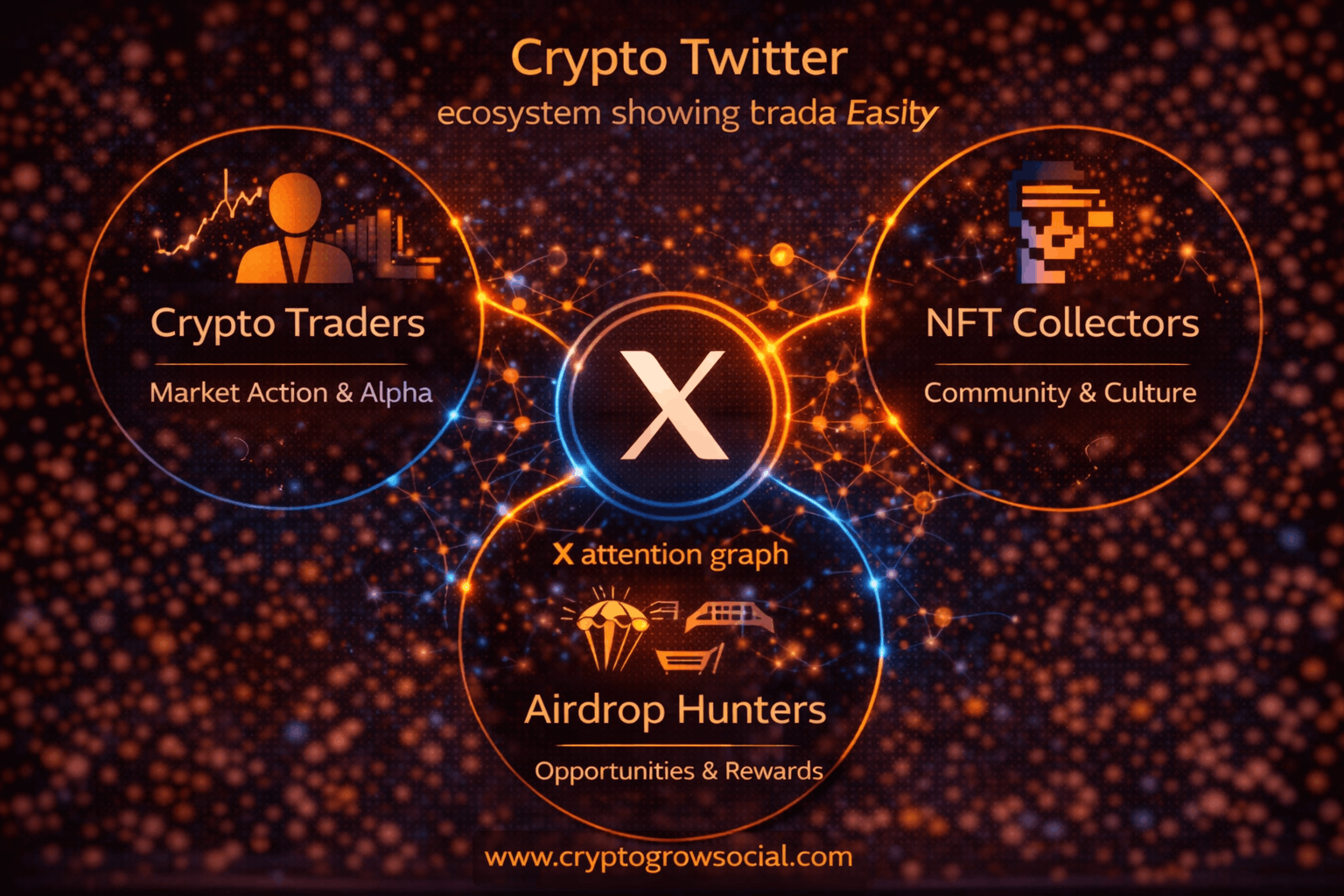
When managing a multi-niche Twitter farm, it is critical to understand that Crypto Twitter is not one audience. It is a collection of separate attention markets, each with its own incentives, engagement patterns, and algorithmic signals. Treating them as one group leads to diluted reach and unstable distribution, which is why professional networks always segment these niches before deploying any narrative.
Crypto Traders
Crypto traders form the most liquidity-driven niche on X. Their behavior is shaped primarily by price action, evolving market narratives, macro sentiment, and the constant pursuit of alpha. They spend most of their time reading threads, debating thesis changes, and tracking how narratives shift around tokens, Layer-2s, and new protocols.
For this audience, credibility is not built through visuals or hype, but through perceived insight and consistency. Accounts that appear to understand why the market is moving, not just that it is moving, earn replies, debate, and algorithmic weight. This makes crypto traders the most important niche for driving real volume and liquidity, because they are the group that ultimately decides whether a narrative turns into capital flow.
NFT Collectors
NFT collectors operate inside a fundamentally different social and cultural ecosystem. Their attention is shaped by identity, creators, memes, and a sense of belonging to digital tribes rather than by pure financial analysis. They follow people, not charts, and they care deeply about which communities are forming, which artists are gaining recognition, and which trends are becoming culturally relevant.
Engagement in the NFT niche tends to happen through quote tweets, creator conversations, and visual content that reinforces social identity. Social proof matters more than technical depth, which means that when a project is discussed by multiple NFT-native accounts, it gains legitimacy far faster than if it were promoted directly. For multi-niche farms, NFT networks are how projects build brand gravity and cultural recognition.
Airdrop Hunters
Airdrop hunters represent the most opportunistic segment of Crypto Twitter. Their primary motivation is to find, farm, and qualify for future token distributions before the rest of the market catches on. They follow accounts that provide actionable information, step-by-step guides, early alerts, and protocol updates that can be turned into financial upside.
Engagement in this niche is fast, transactional, and highly reactive. Retweets, tags, and link clicks dominate, because users are constantly moving from opportunity to opportunity. While this audience can create enormous short-term visibility for a project, it must be handled carefully, because excessive airdrop-style activity can damage long-term algorithmic trust if it spills into other niches.
This is why professional farms isolate airdrop networks from trader and NFT networks, allowing them to extract visibility without contaminating core distribution layers.
Why Mixing Niches Inside One Account Destroys Algorithmic Trust ?
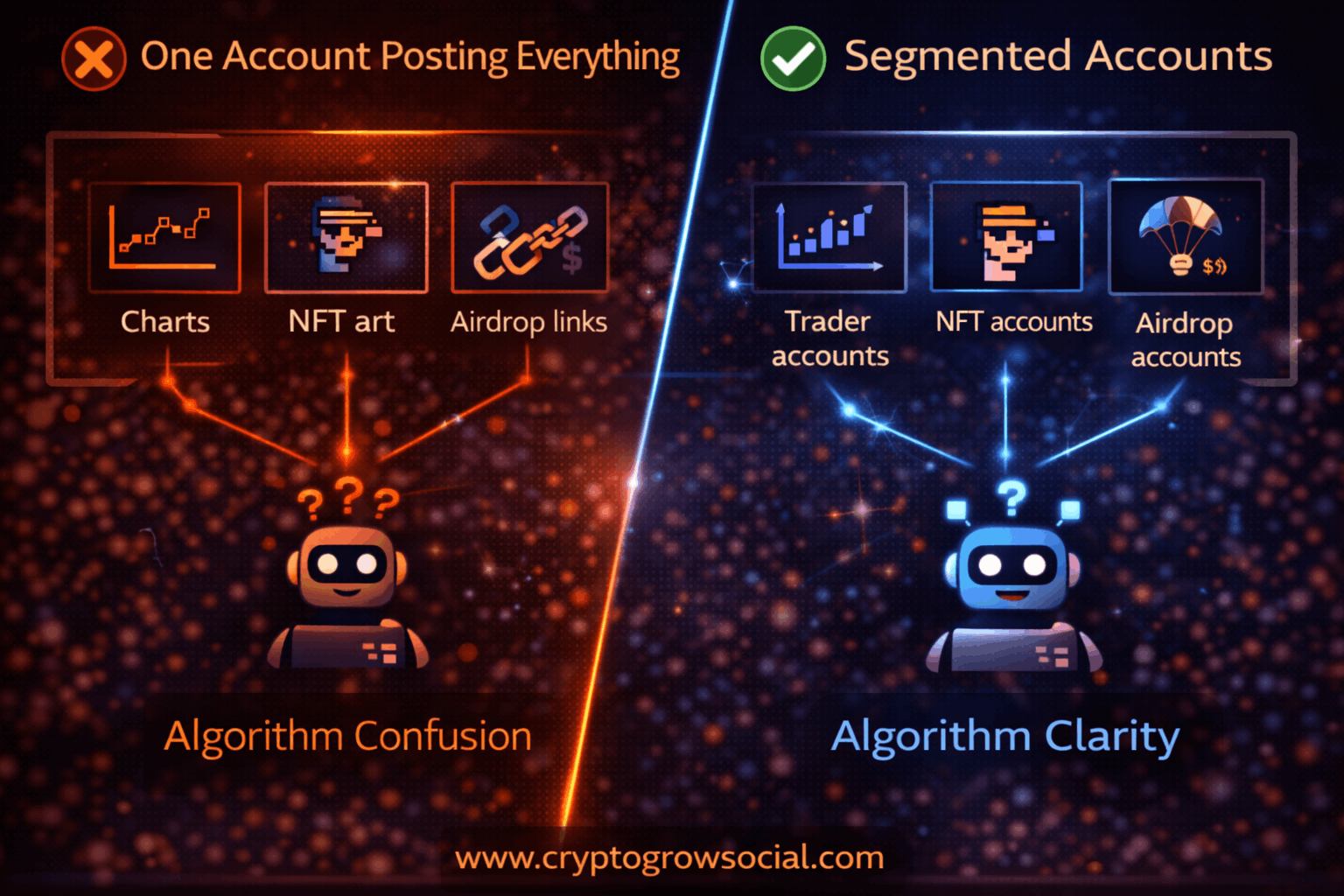
The X algorithm builds highly detailed interest graphs for every account on the platform. It tracks what topics an account posts about, which audiences engage with it, and how consistent those interactions are over time. When a single account jumps between unrelated niches such as crypto trading, NFTs, and airdrops, it sends conflicting signals into that system. The result is topical dilution, where the algorithm no longer knows which audience to show the content to, so it shows it to fewer people in all categories.
From a human perspective, the damage is just as severe. A crypto trader does not want to follow an account that suddenly starts posting NFT artwork or airdrop farming guides, and an NFT collector is unlikely to engage with chart analysis or macro market threads. This mismatch creates follower churn, weak engagement, and shrinking distribution over time.
Professional farms avoid this problem by enforcing strict niche purity at the account level, ensuring that every identity maintains a clear, stable topic profile that the algorithm and the audience can both trust.
How Professional Farms Segment Their Networks?
Elite crypto farms treat each niche as its own independent distribution layer rather than as a single blended audience. This means they build separate clusters of accounts that never cross-pollinate followers, IPs, or behavioral patterns. Accounts designed for crypto traders stay embedded inside market discussion threads and alpha-seeking communities. NFT-focused accounts remain active inside creator circles, collector groups, and cultural conversations. Airdrop-focused accounts operate almost exclusively inside farming networks and early-access ecosystems.
This strict segmentation allows each cluster to maintain strong topical authority and high algorithmic relevance. When a narrative is pushed through the crypto layer, it reaches traders who care about price action and market structure. When the same idea is adapted for the NFT layer, it spreads through cultural and creator-driven communities. When it is framed as an opportunity, it travels through airdrop networks that prioritize fast discovery.
The result is that one project can dominate multiple niches simultaneously without any single account breaking character or confusing the algorithm.
Narrative Architecture for Multi-Niche Farms
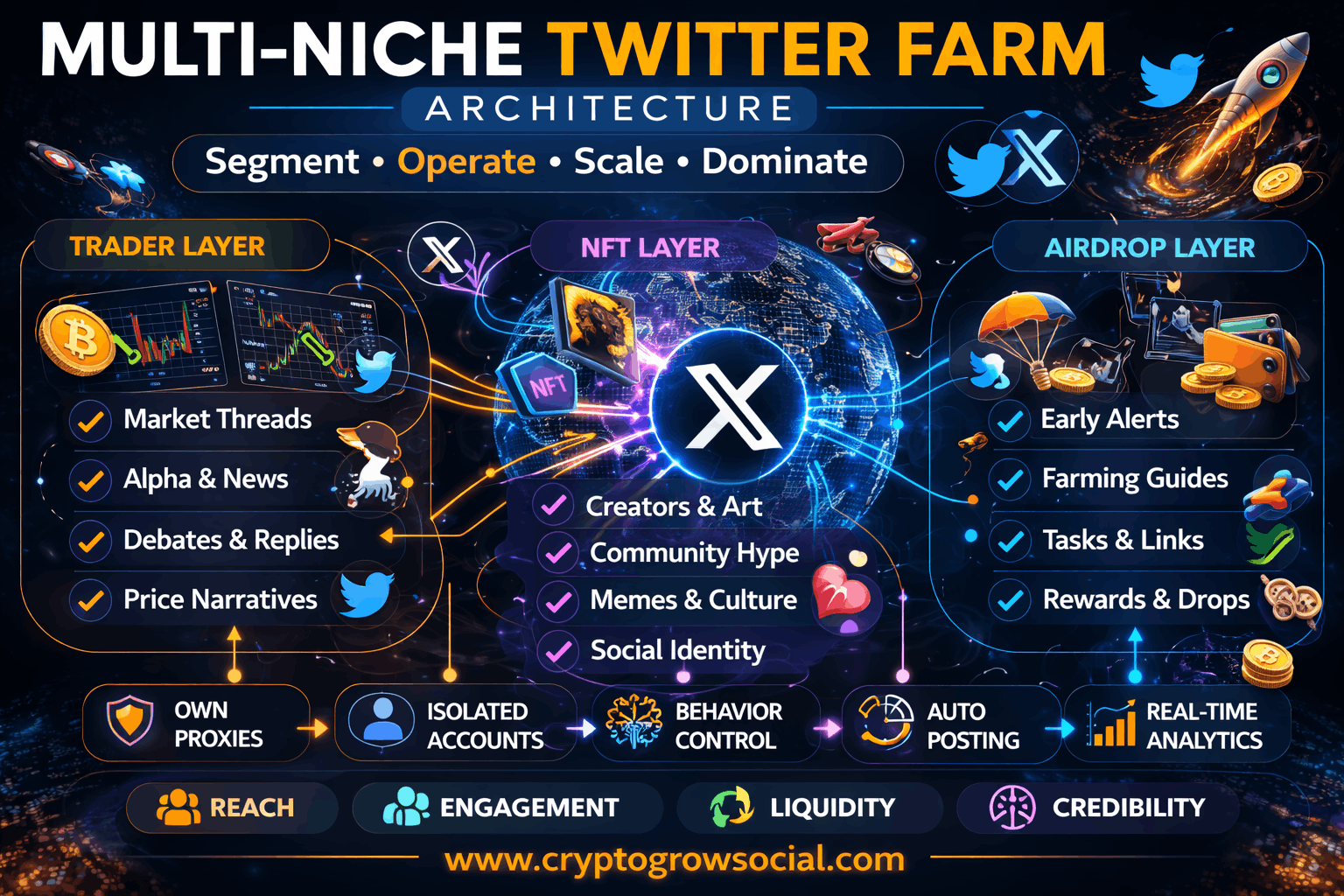
A multi-niche farm does not repeat the same message everywhere. Instead, it reframes the same underlying project through different narrative lenses. For crypto traders, the narrative is about market positioning, token economics, and future demand. For NFT collectors, it is about brand, culture, and creative identity. For airdrop hunters, it is about early access and potential upside.
This layered narrative architecture allows a project to feel native inside each niche while still reinforcing the same core story. Over time, these narratives converge in the wider market, creating the perception that the project is being discussed everywhere for different reasons, which dramatically amplifies attention and credibility.
Content Strategy for Each Vertical
Running a multi-niche crypto Twitter farm only works when each vertical operates as its own content engine. The algorithm does not reward raw activity. It rewards topical authority and consistent audience alignment. That means crypto traders, NFT collectors, and airdrop hunters must each be addressed through different narratives, formats, and engagement styles, even when they are ultimately supporting the same project.
Crypto Content Engine
Accounts that target crypto traders must function like market commentators rather than promoters. Their role is to sit inside real trading conversations and continuously reinforce the narrative environment that makes a project feel inevitable.
This includes posting threads about macro trends, sector rotations, infrastructure shifts, and emerging market narratives. It also means reacting in real time to competitor failures, protocol outages, governance drama, and changes in on-chain data. By doing this, these accounts position themselves as informed observers of the market, which builds trust with trader audiences.
Equally important is how these accounts engage. They should be highly active in the replies under influential traders, analysts, fund managers, and well-known crypto personalities. This is where most of the real attention on Crypto Twitter concentrates. When a project is repeatedly referenced, defended, or discussed inside these high-traffic threads, it becomes embedded in the market conversation rather than isolated on its own timeline.
Over time, this creates the impression that the project is not being marketed, but being discovered by the trading community itself. That perception is what turns curiosity into chart checks, and chart checks into liquidity.
NFT Content Engine
NFT-focused accounts operate in a completely different psychological environment. This audience is driven by identity, culture, and community far more than by financial analysis. For them, what matters is whether something feels like it belongs inside their creative and social ecosystem.
These accounts should therefore focus heavily on visual culture, creator engagement, and community interaction. Sharing artwork, reacting to new collections, participating in meme culture, and engaging with artists and collectors are the primary forms of activity. The goal is not to sell, but to belong.
Within this cultural flow, the project is woven in subtly. It might appear as a tool for creators, a platform that supports community building, or a new way to express ownership or identity. Because it appears inside genuine cultural conversations, it does not feel like an advertisement. Instead, it feels like part of the evolving NFT landscape.
This emotional and social integration is what gives projects staying power inside NFT communities. It turns a brand into something people identify with, not just something they speculate on.
Airdrop Content Engine
Airdrop accounts serve a very different function. They are designed for speed, discovery, and volume. Their audience consists of highly opportunistic users who are constantly scanning Twitter for early access, qualification steps, and new farming opportunities.
These accounts focus on distributing practical, step-by-step content. That includes guides on how to qualify for airdrops, alerts about new programs, reminders about deadlines, and breakdowns of potential rewards. This type of content generates fast engagement through retweets, tags, and link clicks, which creates sudden spikes in visibility.
Used correctly, this traffic is extremely powerful. It can be deployed around launches, testnet releases, or major announcements to flood the ecosystem with attention in a short period of time. However, because this audience is more transactional, it must be managed carefully and not mixed with long-term narrative channels.
When kept in its own vertical, the airdrop engine becomes a tactical amplifier that can be turned on when rapid awareness is needed, without damaging the credibility of the trader or NFT networks.
Engagement Logic Across Niches
Crypto engagement relies on replies and debates because those create dwell time and algorithmic value. NFT engagement leans toward quote tweets and community interaction, which spreads content socially. Airdrop engagement prioritizes retweets and mentions, which generate fast distribution.
A professional farm never uses the same engagement strategy across all niches. Each layer is optimized for how its audience and the algorithm interact with that type of content.
How Multi-Niche Farms Avoid Detection?
Because each niche operates as a separate ecosystem, professional farms use different proxy pools, fingerprint profiles, and behavioral rhythms for each layer. Crypto accounts may be active during trading hours, NFT accounts during cultural peak times, and airdrop accounts during campaign windows. There is no shared infrastructure that could allow the platform to cluster them together.
This separation is what allows the farm to scale across niches without creating detectable patterns.
Common Failures When Teams Try to Run Multi-Niche Networks
Most teams fail because they try to do everything with the same accounts, the same proxies, and the same content templates. This leads to algorithmic clustering, audience confusion, and rapid suppression. Without proper segmentation and narrative design, even large farms collapse into ineffective noise.
Build vs Buy Multi-Niche Infrastructure
When a crypto project decides to operate across traders, NFT collectors, and airdrop communities at the same time, it is no longer choosing a marketing tactic. It is choosing an operational model. At this level, the question is not whether a multi-niche Twitter network is useful, but whether it should be built internally or accessed through a professional distribution layer.
Building It Yourself
Building a real multi-niche farm means becoming an infrastructure company in addition to being a crypto team. You are not just running Twitter accounts. You are operating a distributed system of identities that must survive algorithmic scrutiny, remain topically pure, and stay active across multiple market segments.
To do this properly, a team needs residential or mobile proxy infrastructure for IP isolation, fingerprint browsers to prevent account clustering, account management systems to track hundreds of identities, automation software for posting and engagement, analytics to monitor narrative spread, and operators who understand both crypto culture and platform risk. On top of this, every account must be aged, warmed, and continuously maintained. Accounts will get locked, banned, or flagged, which means replacement and re-warming never stops.
Now multiply that across three different niches. Crypto trader accounts must live in trading threads and macro discussions. NFT accounts must live in creator and collector circles. Airdrop accounts must operate inside farming networks. Each layer needs different behavior, different posting styles, different engagement rhythms, and different follower graphs. Any contamination between them weakens topical authority and destroys reach.
Most teams underestimate how quickly this becomes unmanageable. Costs compound, failures cascade, and one operational mistake can collapse an entire layer of the network. This is why DIY farms often look impressive on paper but collapse in practice.
Using a Professional Distribution Layer
A professional multi-niche distribution layer already has all of this complexity solved. The infrastructure exists, the accounts are aged, the behavior patterns are tuned, and the niche segmentation is already in place. Instead of trying to build three separate farms, a project simply plugs its narrative into a system that is already embedded inside trader communities, NFT culture, and airdrop networks.
This changes the economic and strategic equation completely. Instead of paying for proxies, software, engineers, and account replacement, a team pays for access to working distribution. Instead of spending months warming accounts and testing risk, they can launch narratives immediately. Instead of worrying about detection, they can focus on positioning, storytelling, and product-market fit.
Most importantly, professional networks already have credibility. They already follow the right people. They already appear inside the right conversations. That social capital would take years to build organically, but it can be accessed instantly through a managed or owned distribution layer.
For most crypto projects, especially those trying to compete across multiple niches at once, buying or renting professional infrastructure is not a shortcut. It is the only rational way to operate at market scale without destroying time, capital, and momentum.
How CryptoGrowSocial Handles Multi-Niche Distribution?
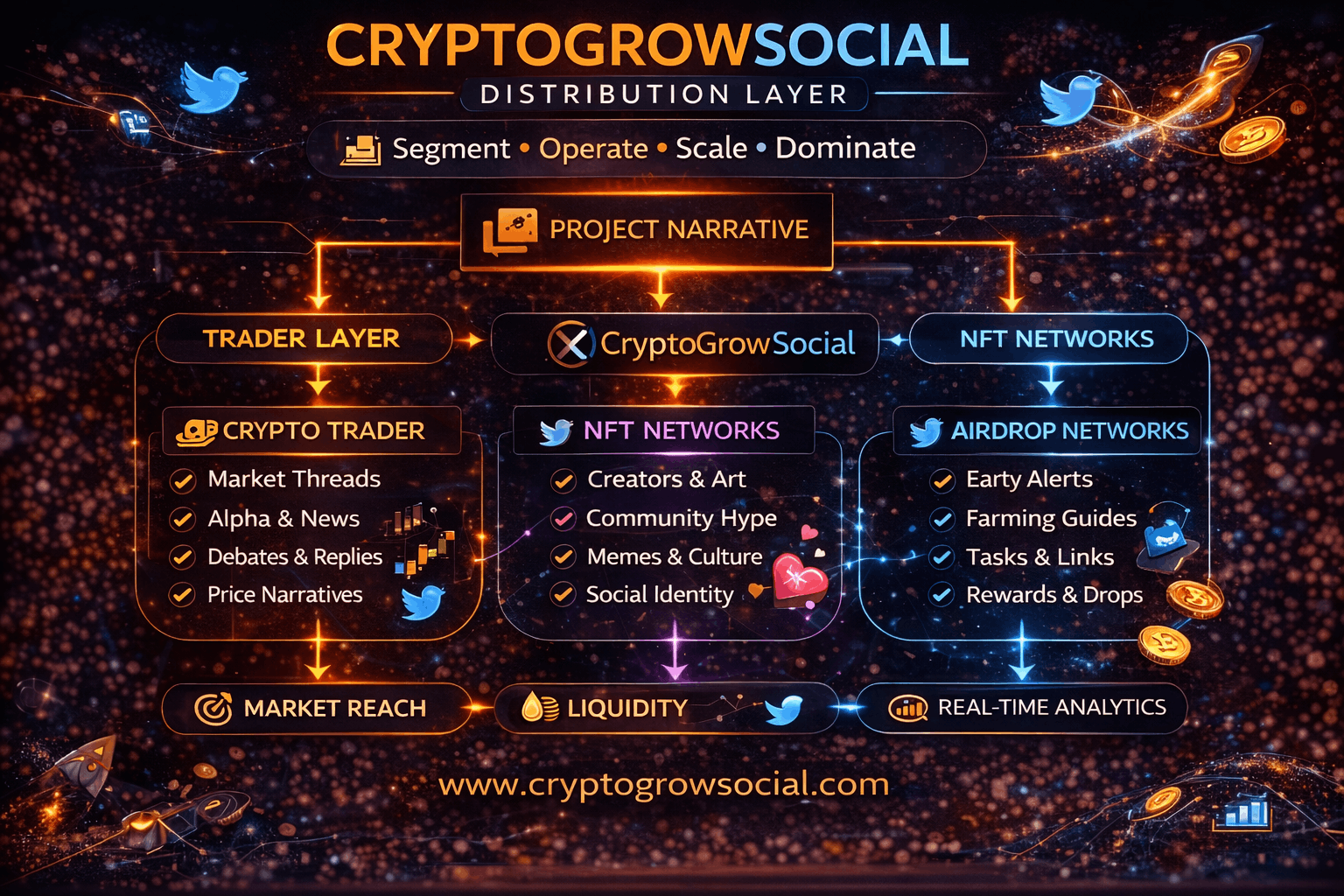
CryptoGrowSocial was built to solve the exact problem that breaks most multi-niche Twitter farms: how to operate trader networks, NFT communities, and airdrop channels at the same time without diluting authority or triggering algorithmic suppression. Instead of forcing teams to engineer and manage this complexity themselves, CryptoGrowSocial provides a ready-made distribution layer through two complementary systems that cover both speed and long-term control.
Through XLaunchPad, projects gain access to a live, professionally segmented network of crypto-native accounts that are already embedded inside the three core attention layers of Crypto Twitter: trader threads, NFT culture, and airdrop discovery channels. Each layer operates independently with its own accounts, posting rhythms, and behavioral patterns, which means narratives can be deployed into all three ecosystems at once without any single account breaking character or confusing the algorithm. This allows a project to appear simultaneously in trading debates, collector communities, and opportunity feeds, creating the impression that it is everywhere the market is looking.
For teams that want to go beyond access and actually own their distribution infrastructure, XLaunchPad Pro provides a fully built, warmed, and operational multi-niche network. This includes aged accounts for each vertical, automation and engagement systems, proxy and fingerprint isolation, and narrative control tools that allow teams to coordinate how stories move between trader, NFT, and airdrop audiences. Instead of renting reach, teams gain the ability to run launches, defend narratives, and orchestrate market attention on their own terms, using the same kind of decentralized infrastructure that elite crypto projects rely on.
In both cases, the core advantage is the same: CryptoGrowSocial turns fragmented niche communities into a single, coordinated attention engine. Rather than fighting the algorithm or hoping for organic virality, projects gain a structured way to inject their narrative into every part of Crypto Twitter that matters, which is what ultimately converts awareness into liquidity, community, and long-term market relevance.
How to Get Market-Level Reach Across Crypto, NFTs, and Airdrops?
Achieving true market-level reach across Crypto Twitter, NFT communities, and airdrop networks is no longer something that can be done through a single account or a single content strategy. Each of these audiences lives inside its own algorithmic and social ecosystem, with different behavior patterns, different content expectations, and different trust signals. When projects try to address all three from one place, the result is diluted reach, confused audiences, and suppressed distribution.
This is why professional crypto growth teams rely on segmented distribution layers rather than individual accounts. A properly structured network separates crypto traders, NFT collectors, and airdrop hunters into independent clusters of identities that each operate natively inside their own niche. Traders see market-driven discussions and analytical threads. NFT collectors see cultural participation, creators, and visual storytelling. Airdrop hunters see opportunity feeds and qualification guides. To the algorithm and to users, each cluster looks natural, credible, and deeply embedded in its own ecosystem.
By using a professionally built and operated distribution layer such as CryptoGrowSocial, projects can access all of these ecosystems at once without having to build or maintain the underlying infrastructure themselves. Instead of spending months warming accounts, managing proxies, configuring automation, and fighting suppression, teams simply provide their narrative and positioning, and that narrative is injected into trader conversations, NFT culture, and airdrop discovery channels through networks that already have trust, history, and reach.
This allows a project to compete at the highest level of the crypto attention economy from day one. It can be seen by traders looking for the next narrative, by collectors searching for emerging cultural signals, and by airdrop farmers hunting for the next opportunity, all without any single account revealing that these conversations are coordinated. That is what turns a project from a small voice into a market-wide presence, and it is why segmented distribution networks have become the foundation of serious crypto growth strategies in 2026 and beyond.
Conclusion
Winning in crypto is no longer about having the best product alone, but about controlling how that product is perceived across multiple attention markets. A well-managed multi-niche Twitter farm allows a project to dominate conversations in crypto trading, NFT culture, and airdrop ecosystems at the same time, creating narrative gravity that converts directly into liquidity, credibility, and long-term brand power.
This is exactly where CryptoGrowSocial becomes a strategic advantage. Through XLaunchPad, teams can instantly plug their project into existing, professionally segmented networks that already live inside trader threads, NFT communities, and airdrop discovery channels. Through XLaunchPad Pro, more advanced teams can own their own multi-niche distribution infrastructure, giving them permanent control over narrative, timing, and scale. In both cases, the result is the same: your project stops competing for attention and starts commanding it across the entire crypto ecosystem.