
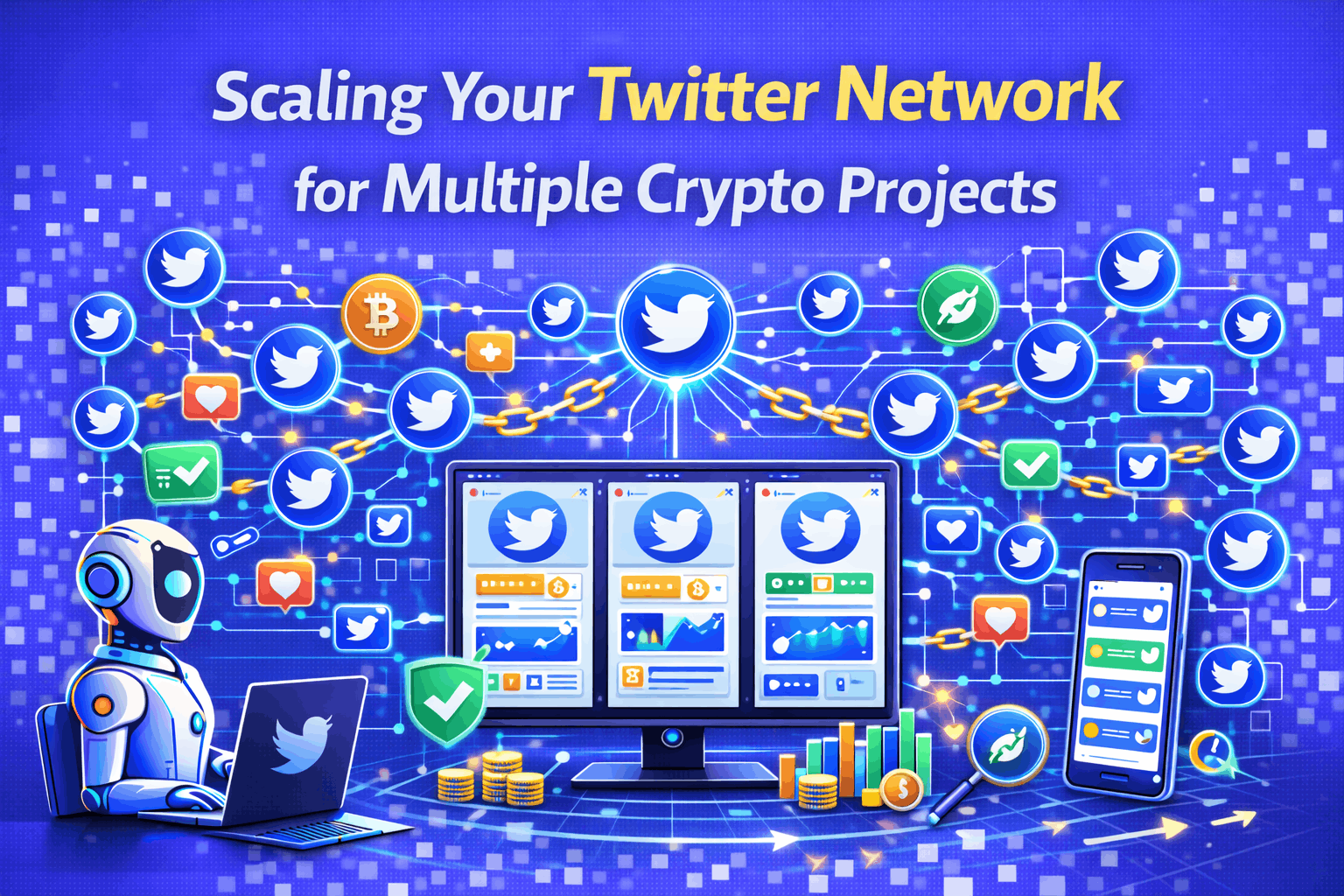
Scaling a Twitter network for crypto projects is no longer a tactical decision. It is a strategic one that directly affects how much visibility, credibility and capital a Web3 brand can capture. When you move from promoting one token to managing several launches, communities and narratives at the same time, everything becomes more complex. Engagement that once looked organic can start to collide. Audiences that once felt focused can become diluted. Without a proper system for scaling your Twitter network for crypto projects, even strong marketing teams find themselves losing momentum, burning accounts or sending mixed signals to the market. What worked for a single campaign often collapses when applied to multiple projects running in parallel.
This article is written to show how scaling really works. This guide will walk you through the architecture, the risks, and the professional methods used by crypto launchpads, agencies and growth teams that successfully manage multiple projects on Crypto Twitter. Instead of abstract theory, this article focuses on how networks are designed, how accounts are segmented, how automation is controlled and why professional systems outperform DIY setups. By the end, you will understand not just how to scale, but how to scale without destroying trust, safety or long term growth.
Why Scaling for Multiple Crypto Projects Is a Different Game?
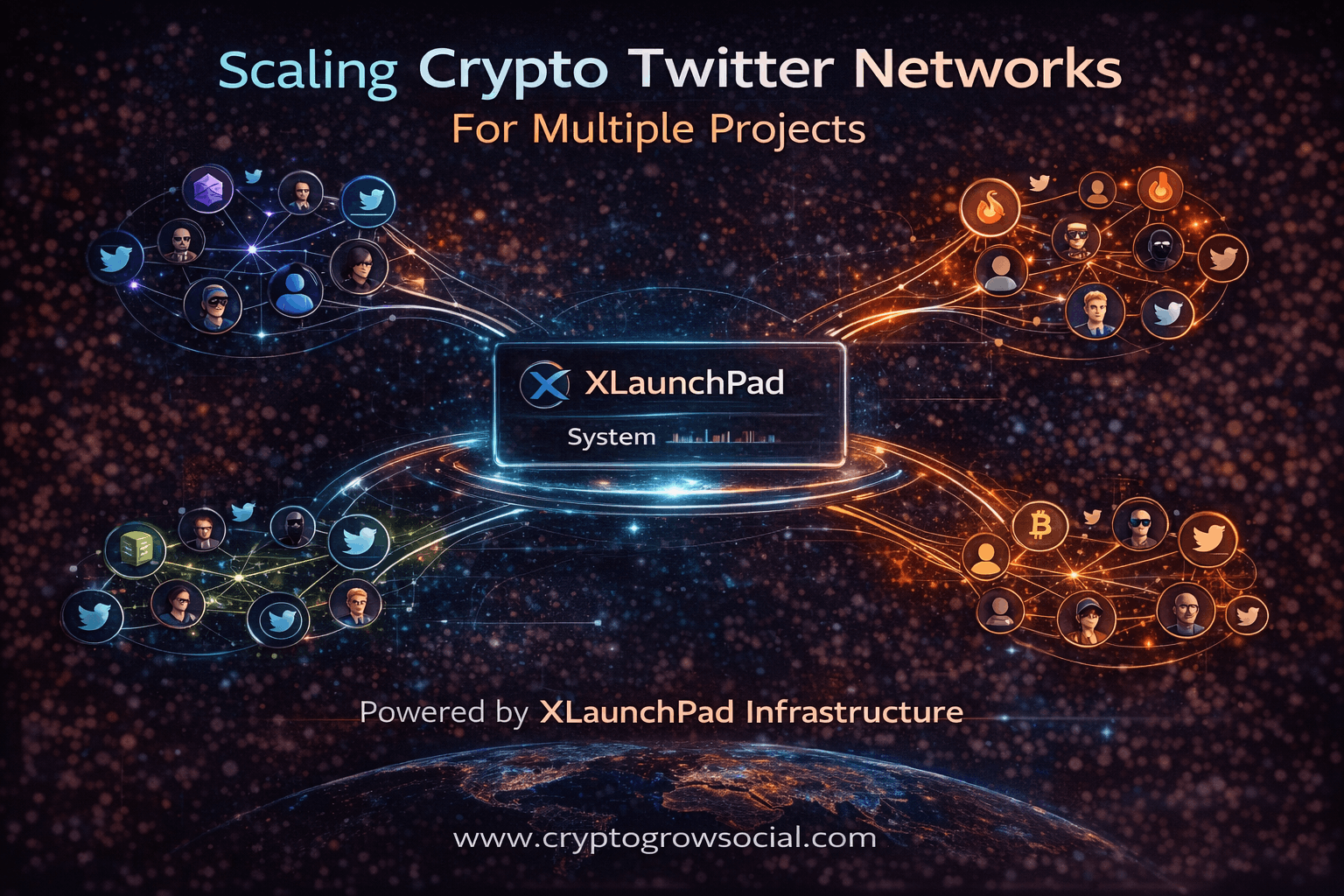
When a crypto team runs a single project, most of their Twitter growth can be driven by focus. One narrative, one community, one token and one roadmap. All engagement supports the same story. The moment a team starts running two, three or ten projects at once, that simplicity disappears. Suddenly, every tweet, retweet and reply has to be placed into the right context. Audiences overlap. Accounts get reused. Narratives collide. This is why scaling a Twitter network for multiple crypto projects is not simply about adding more bots or more accounts. It is about restructuring the entire growth system.
The first major difference is audience fragmentation. Crypto Twitter is made up of many micro communities. DeFi traders, NFT collectors, meme coin hunters, airdrop farmers, infrastructure builders and VC accounts all behave differently. A single project can target one or two of these segments. Multiple projects often target several at once. If you use the same account network to promote all of them, you confuse the audience and weaken engagement signals. People start ignoring posts because the feed no longer feels relevant.
The second difference is narrative conflict. Every crypto project has its own story. One might be about a Layer 2 network. Another might be a gaming token. Another could be a meme coin. If the same accounts are pushing all of them without separation, the storytelling breaks. It becomes obvious that the engagement is not organic. The algorithm notices this, and users do as well.
The third difference is risk exposure. When one project uses a risky tactic, it can contaminate the entire network. For example, if a token launch uses aggressive reply automation or controversial messaging, and the same accounts are used for a different project, those accounts may get limited. Now both projects suffer. Scaling increases the surface area for failure.
There is also an operational difference. When running one campaign, a team can manually monitor what is happening. When running many, this becomes impossible. You need systems to manage timing, pacing, targeting and account health across all campaigns.
Some of the challenges that appear when scaling include:
Accounts being reused too frequently across unrelated campaigns
Followers getting mixed messages from the same profiles
Automation schedules overlapping and creating unnatural behavior
Difficulty measuring which project is performing well
Increased chance of shadowbans and rate limits
This is why scaling for multiple crypto projects is a different game. It requires a different architecture, not just more activity.
Common Mistakes When Scaling Twitter Networks Across Projects

Most teams fail at scaling because they approach it with the same mindset they used for their first campaign. They simply duplicate what worked before. This creates a long list of predictable mistakes that slowly destroy the network.
One of the most common mistakes is using the same accounts for every project. At first this seems efficient. You already have accounts with followers and engagement history. Why not use them again. The problem is that these accounts develop an identity. When they suddenly start promoting completely different tokens, their audience stops trusting them. Engagement drops, and the algorithm learns that their posts are not interesting.
Another mistake is over automation across campaigns. Teams schedule tweets, retweets and replies for several projects without considering how they interact. This leads to patterns where the same accounts are replying to multiple projects at the same time, often within minutes. From the outside, it looks artificial. From the inside, it increases the chance of being flagged.
There is also the mistake of not separating audiences. A DeFi focused audience is not the same as a meme coin audience. When the same engagement network pushes both, neither performs well. You lose relevance.
Many teams also fail to manage risk. They do not track which accounts are being stressed. They do not rotate roles. They do not pause accounts that show warning signs. When something goes wrong, it goes wrong everywhere.
Some warning signs that your scaling strategy is failing include:
Engagement rates dropping across all projects
Accounts receiving sudden rate limits or shadowbans
Followers unfollowing or muting accounts
Replies feeling repetitive or unnatural
Campaigns cannibalizing each other
These mistakes are not caused by bad intentions. They are caused by the absence of a proper scaling system.
Core Principles of a Scalable Crypto Twitter Network
To scale safely and effectively, a crypto Twitter network must be built on a few core principles. These principles guide every technical and strategic decision in the system.
The first principle is isolation. Each project must be insulated from the others. This does not mean complete separation, but it does mean controlled interaction. If one campaign becomes risky, it should not expose the rest of the network.
The second principle is modularity. A scalable network is not one big blob of accounts. It is a collection of smaller modules. Each module can be assigned to a project, a phase of a launch or a specific type of engagement.
The third principle is role based design. Accounts are not equal. Some accounts should act as brand voices. Some should amplify. Some should reply. Some should simply like and lurk. This diversity makes the network look natural and allows you to scale without repeating the same patterns.
The fourth principle is narrative separation. Each project should have its own story and timeline. The system must be able to support these stories without mixing them.
The fifth principle is risk management. Every action must be measured against the potential for detection or damage. A scalable system is one that survives, not just one that grows fast.
When these principles are respected, a network can grow in size and complexity without collapsing. When they are ignored, even a large network becomes fragile.
Account Segmentation for Multi Project Twitter Growth
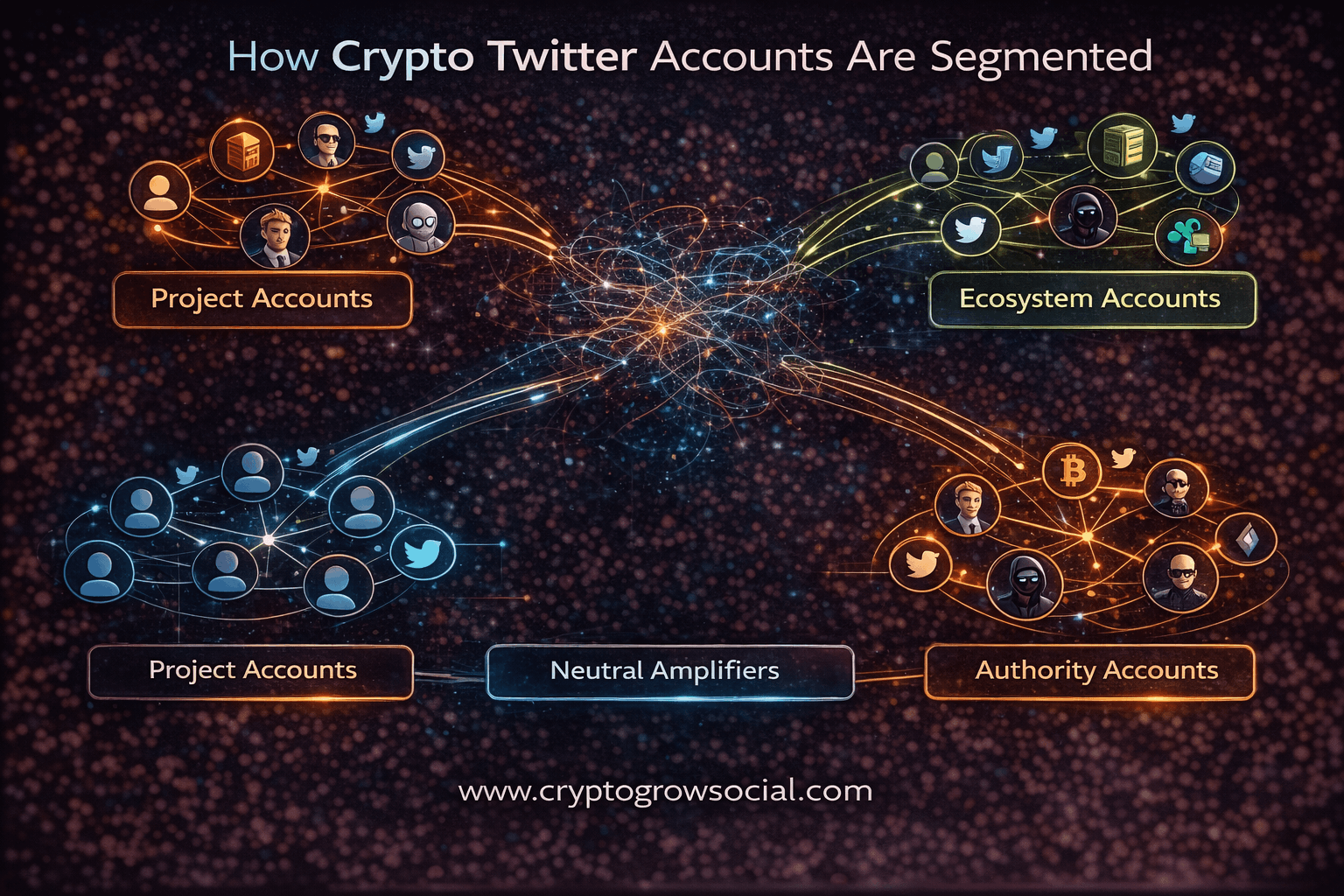
Account segmentation is one of the most important techniques in scaling. It is how you prevent narrative collision and risk contamination.
In a professional system, accounts are divided into several categories. There are project specific accounts. These are tied closely to a single token or brand. They might have bios and posting history that align with that project. They should not be reused for unrelated campaigns.
There are ecosystem accounts. These focus on broader crypto topics such as DeFi, NFTs, infrastructure or trading. They can support multiple projects as long as those projects fit the same niche.
There are neutral amplifiers. These accounts do not have a strong identity. They exist to retweet, like and provide background engagement. They are flexible but should still be managed carefully.
There are also high authority accounts. These are aged profiles with large followings. They are used sparingly because they carry the most risk and the most impact.
By segmenting accounts this way, you can assign the right mix to each project. A DeFi launch might get DeFi focused ecosystem accounts, some neutral amplifiers and a few high authority profiles. A meme coin might use a different mix.
A simple way to think about segmentation is:
Which accounts belong emotionally to this project
Which accounts can safely amplify it
Which accounts should not touch it at all
This approach allows you to scale without making every account do everything.
Infrastructure Requirements for Scaling Safely
As the number of projects increases, the importance of infrastructure multiplies. When you run many campaigns, small technical weaknesses become big problems.
Every account should have its own private proxy. Shared IPs are one of the fastest ways to link accounts together. Each account should also have its own device fingerprint. This includes browser settings, screen size, operating system and cookies. Without this, platforms can detect that the same machine is controlling many profiles.
Session management is also critical. Accounts should stay logged in. Frequent logins from different locations look suspicious. Geographic distribution should match the audience. If your network is supposed to represent a global crypto community, it should not all come from one place.
At scale, infrastructure also needs monitoring. Proxies go bad. IPs get blocked. Devices need refreshing. A professional system handles this automatically.
Some of the infrastructure elements required for safe scaling include:
One proxy per account with no reuse
Persistent device profiles for each login
Session stability over long periods
Geographic diversity that matches targeting
Automatic replacement of failing components
Without these elements, scaling becomes dangerous. With them, it becomes predictable.
Automation Rules for Managing Multiple Campaigns
Automation is what makes scaling possible, but rules are what make it safe. When you manage multiple campaigns, automation must be campaign aware.
Each project should have its own schedule. You should not have all projects posting at the same times. This creates overlap and unnatural patterns. Engagement intensity should also be controlled. A major launch might justify heavy activity. A quieter phase should not.
Automation should also be conditional. If an account is showing signs of being limited, it should reduce activity. If a tweet is performing well, the system can amplify it. If it is not, it can be left alone.
A healthy multi project automation setup often includes:
Separate queues for each project
Different activity limits based on campaign phase
Rules that prevent the same account from pushing conflicting content
Cooldown periods between campaigns
Priority systems that allocate more resources to key launches
This is how you turn automation into a strategic tool rather than a blunt instrument.
Content and Narrative Coordination Across Projects
When you scale, content becomes just as important as technology. Each project must have its own narrative arc. This includes teaser phases, announcement phases, hype phases and community building phases.
The Twitter network should support these arcs. Accounts should not randomly retweet everything. They should amplify key moments. They should reply with context. They should create the illusion of a growing conversation around each project.
If narratives are not coordinated, projects steal attention from each other. One launch might drown out another. This leads to wasted effort and confused audiences.
A professional team plans content and engagement together. They decide which accounts will speak, which will amplify and which will stay quiet. This is how multiple stories can coexist inside the same network.
Monitoring, Risk Control and Optimization at Scale
When running multiple campaigns, you cannot rely on intuition. You need data. You need to know which accounts are performing well, which are being limited and which projects are gaining traction.
Monitoring systems track engagement, reach and account health. They detect shadowbans and rate limits. They show which narratives are resonating.
Optimization is the process of using this data to make better decisions. You might allocate more accounts to a project that is gaining momentum. You might slow down a campaign that is triggering risk signals. Over time, this makes the entire network more effective.
Without monitoring, scaling becomes blind. With it, scaling becomes strategic.
Why DIY Scaling Fails for Most Crypto Teams?
Most teams try to scale with a patchwork of tools. They buy proxies from one provider, accounts from another and bots from a third. They manage everything manually. At first it seems cheaper. Then the hidden costs appear.
Accounts get banned. Proxies fail. Data is missing. Teams spend more time fixing problems than growing projects. Eventually, the network collapses.
Professional systems exist because they solve these problems in an integrated way. They are not just tools. They are architectures that have been tested and refined.
How CryptoGrowSocial Enables Safe Multi Project Scaling?
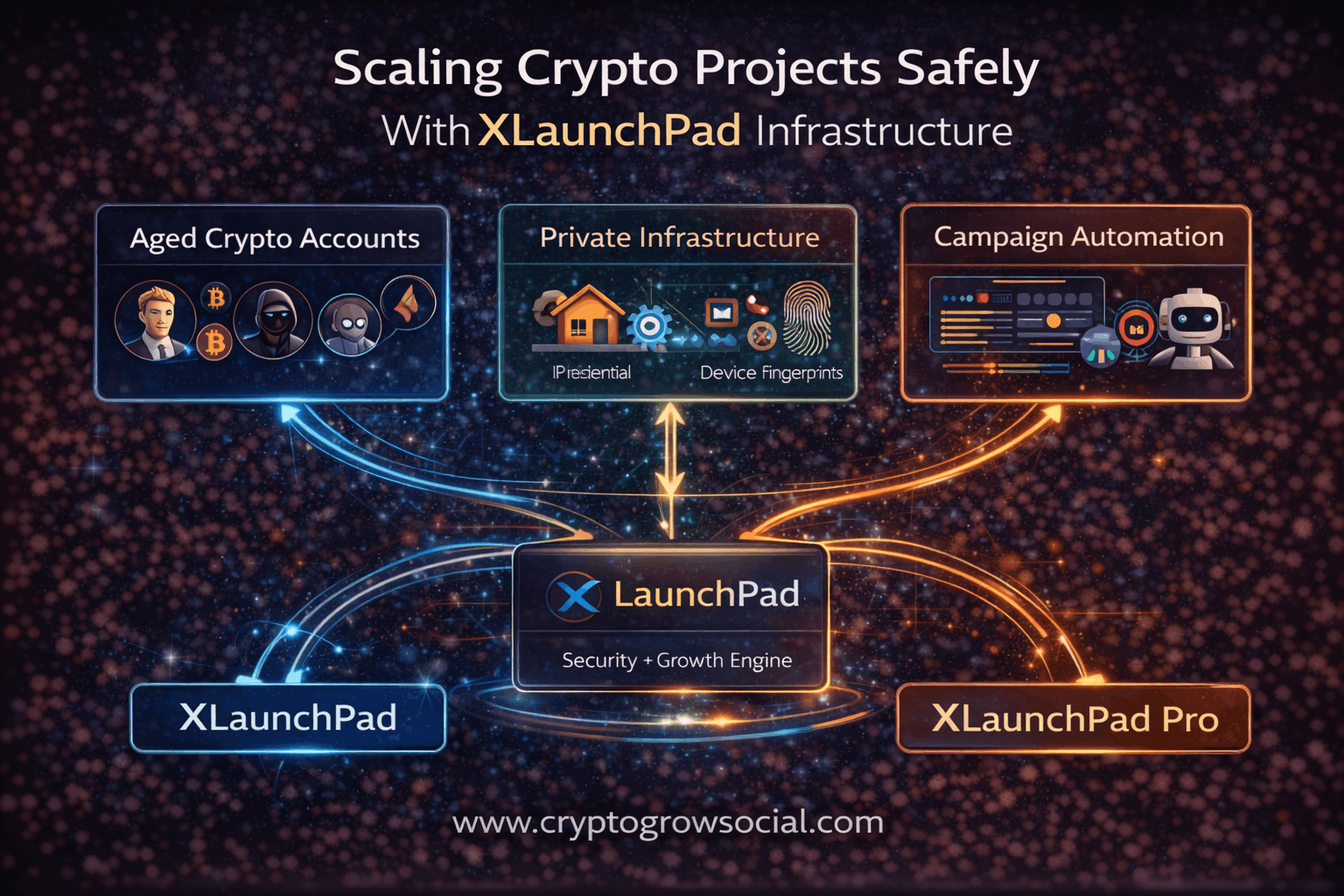
Scaling multiple crypto projects on Twitter is one of the hardest problems in Web3 marketing. The difficulty is not in posting more content. It is in doing so without collapsing the network that supports it. Most teams discover this the hard way. When they try to promote several tokens, launches or communities using the same accounts and basic automation, engagement becomes unnatural, narratives overlap, and detection risk increases. CryptoGrowSocial was built to solve exactly this problem by providing a system that allows teams to scale across many projects while keeping every account and campaign safe.
At the core of CryptoGrowSocial is a multi layer architecture that treats each project as its own ecosystem while still allowing them to share a powerful underlying infrastructure. This starts with the account layer. Instead of using generic or newly created profiles, CryptoGrowSocial operates aged crypto native accounts that already belong inside the Web3 conversation. These accounts can be segmented by niche, persona and role. A DeFi launch can be supported by DeFi focused accounts. A gaming token can be supported by gaming and NFT profiles. Neutral amplifiers can be shared carefully across projects without exposing them to narrative conflict. This segmentation ensures that each project has a network that feels authentic to its audience.
The next layer is the infrastructure layer, which is what keeps scaling safe. Every account runs on private proxies and unique device profiles. This means that even if dozens or hundreds of accounts are active at the same time across different campaigns, they never appear to be connected. Projects are isolated from each other at the technical level. If one campaign increases activity or faces risk, it does not contaminate the rest of the network. This is what makes it possible to run multiple launches in parallel without triggering platform defenses.
On top of this sits the automation and campaign control layer. CryptoGrowSocial does not use one size fits all automation. Every project is treated as its own campaign with its own timing, intensity and engagement logic. You can run a hype phase for one token, a community building phase for another, and a quiet maintenance phase for a third all at the same time. Accounts are assigned, schedules are separated, and engagement rules are customized so that nothing collides. This prevents the patterns that usually expose DIY networks when they try to scale.
CryptoGrowSocial delivers this system in two ways. XLaunchPad is designed for teams that want results without operational complexity. The CryptoGrowSocial team manages the accounts, the infrastructure and the execution of campaigns. Projects simply provide their messaging and goals. XLaunchPad Pro is built for teams, agencies and launchpads that want control. They get access to the same professional grade accounts, infrastructure and automation engine, but they run their own campaigns, control narratives and allocate resources across projects as they see fit.
Because all of these layers are unified inside one ecosystem, CryptoGrowSocial makes it possible to scale ten crypto projects with the same level of safety, precision and stability as one. Instead of fighting infrastructure, risk and coordination problems, teams operate on a platform that was designed for multi project Web3 growth from the ground up.
Choosing the Right Scaling Model for Your Crypto Business
Not every crypto business grows the same way, but almost all of them fail for the same reason. They try to scale with tools that were never designed to support real growth. A single founder running one token, a marketing agency managing multiple clients, and a launchpad pushing dozens of projects each operate at completely different levels of complexity. Yet many of them rely on the same basic scheduling tools, the same cheap bots, and the same fragile account pools. That mismatch between ambition and infrastructure is what causes most Crypto Twitter strategies to collapse.
A small project in its early stage can survive with a limited network. A handful of accounts posting, engaging and replying might be enough to create initial visibility. But the moment that project begins to attract attention, the weaknesses of a simple setup appear. Engagement becomes inconsistent. Accounts get flagged. Narratives drift. What worked for one token no longer works when you are trying to build momentum across multiple communities or sustain attention over time. Scaling is not about doing more of the same. It is about moving to a different type of system.
For agencies, the problem becomes even more serious. Each client represents a different narrative, a different audience and a different risk profile. Running ten projects on one pool of accounts is a recipe for disaster. Overlap causes confusion. Algorithms detect patterns. One failed campaign can damage every other one. Agencies that do not segment their networks and infrastructure end up spending more time fixing bans and drops in engagement than actually growing their clients.
Launchpads face the highest level of complexity. They do not just run campaigns. They operate continuous pipelines of hype, community building, presales and post launch support. Their audience expects constant activity across many tokens. Without a system designed for this level of throughput, even a well funded launchpad will struggle to maintain credibility and visibility.
The key to choosing the right scaling model is understanding that infrastructure must grow with ambition. If you only want a few thousand followers, basic tools might work. If you want to dominate a niche, run multiple launches or operate as a growth partner for Web3 projects, you need a professional system. That means segmented account networks, private infrastructure, campaign level automation and centralized control. It means being able to add new projects without risking the ones you already run.
CryptoGrowSocial was built around this reality. With XLaunchPad, small and mid sized teams can access a fully managed growth system that removes the need to worry about accounts, proxies and execution. With XLaunchPad Pro, agencies and large operators gain a scalable platform that lets them manage multiple projects, narratives and networks from one professional grade environment. Instead of guessing how far your setup can stretch, you choose a scaling model that is designed to grow as far as your business does.
In Crypto Twitter, growth is not limited by demand. It is limited by infrastructure. Choosing the right scaling model is the difference between building a temporary spike and building a long term Web3 growth engine.
Conclusion
Scaling your Twitter network for multiple crypto projects is not about doing more. It is about doing it with a system that protects, organizes and amplifies every campaign. Without architecture, scaling leads to chaos and risk. With the right system, it leads to momentum and trust.
CryptoGrowSocial provides the professional foundation needed to run many projects at once. Whether you choose XLaunchPad for a fully managed experience or XLaunchPad Pro for full control, you gain access to an infrastructure built for Web3 scale. If you are serious about growing multiple crypto projects on Twitter, this is the path that turns complexity into advantage.